A marketing data layer is the single most reliable way to unify customer interactions, ensure accurate tracking, and enable high‑performance advertising across platforms. Without it, channels remain fragmented, attribution becomes messy, and optimization takes longer than it should.
Below is a practical guide for building a scalable, future‑proof data layer.
Why a Marketing Data Layer Matters
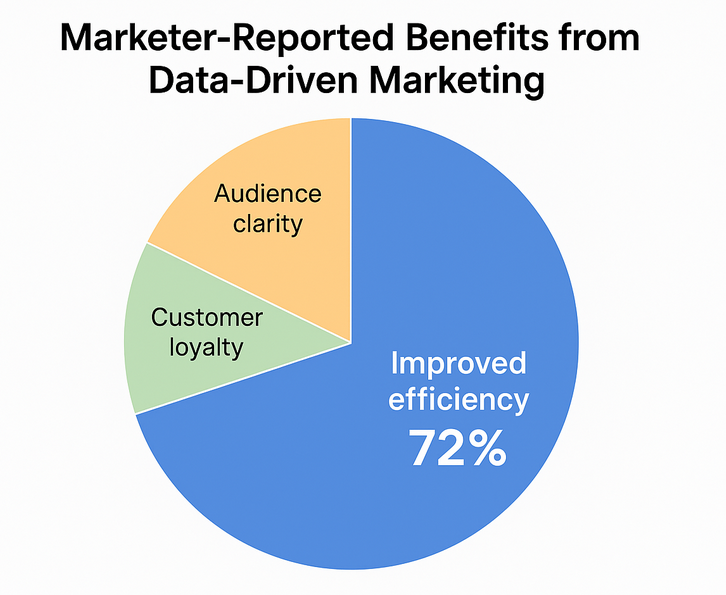
72% of marketers cite improved marketing efficiency as the main benefit of data-driven approaches
A well‑structured data layer creates standardization for all events, properties, and customer identifiers. This directly improves:
-
Attribution accuracy
-
Audience segmentation quality
-
Cross‑channel reporting
-
Conversion optimization
Useful insight: Teams with a unified data layer report 30–50% faster analysis cycles compared to teams relying on unstructured analytics.
Step 1: Map Your Customer Journey
Before writing any code or schema, identify key touchpoints:
-
Ad impressions
-
Website visits
-
Content interactions
-
Product page views
-
Cart events
-
Purchases
-
Repeat engagement
Each event should contain consistent parameters (e.g., product_id, value, traffic_source). Companies that document their tracking plan upfront reduce implementation inconsistencies by 40%.
Step 2: Define a Standard Event Schema
Create a simple and reusable schema for all customer events. Common components include:
-
event_name – e.g., "page_view", "purchase"
-
event_time – timestamp in a unified format
-
user_id / device_id – key identifiers
-
metadata – contextual information such as price, category, referral source
A structured schema improves data cleanliness and reduces debugging time by up to 60%.
Step 3: Implement a Centralized User Identity Framework
Identity resolution ensures your systems correctly identify users across devices and channels. Two methods are typically used:
-
Deterministic matching – email, phone, user account
-
Probabilistic matching – behavior, device, session heuristics
Companies using deterministic identity matching see up to 20% higher attribution accuracy.
Step 4: Connect All Data Sources
Your data layer should unify:
-
Website data
-
CRM and sales data
-
Email engagement data
-
Paid social and advertising platform signals
When these systems feed into one layer, marketers gain a more holistic picture of performance drivers.
Organizations that integrate 3+ data sources in their layer report 28% higher measurement confidence.
Step 5: Validate and Monitor Your Data
Quality assurance prevents drift over time. Set up:
-
Automated event monitoring
-
Parameter completeness checks
-
Duplicate event detection
Teams with automated monitoring catch errors 5× faster than teams relying on manual reviews.
Step 6: Activate the Data Layer for Optimization
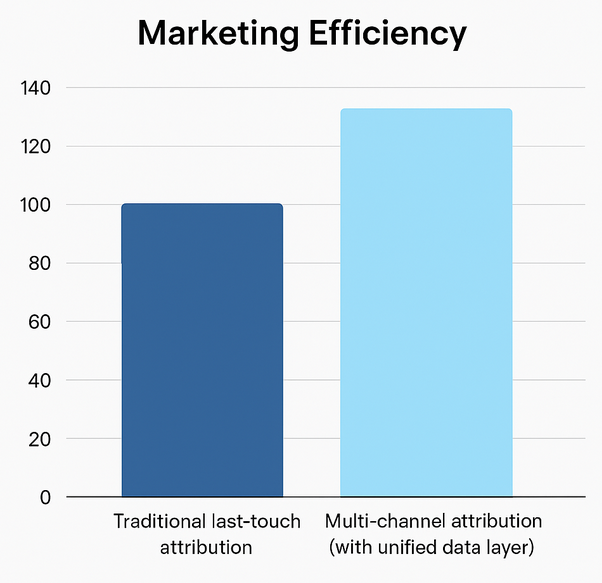
Multi-channel attribution via unified data can improve marketing efficiency / ROI by 15–30%
Once stable, a mature data layer powers:
-
Better audience targeting
-
Improved retargeting logic
-
More accurate ROAS reporting
-
Automated bidding strategies
Marketers leveraging structured data layers see 15–25% improvement in campaign efficiency.
Key Visual Statistics to Add
1. Bar Chart: Analysis Speed Improvement With vs Without Data Layer
-
Without structured data: baseline 100
-
With structured data: 130–150 (showing 30–50% faster analysis)
Placement: After the "Why a Marketing Data Layer Matters" section.
Caption: "Teams with a structured data layer complete analysis cycles significantly faster."
Alt text: "Bar chart comparing analysis speed with and without a data layer."
2. Column Chart: Attribution Accuracy Improvement With Identity Resolution
-
No deterministic matching: baseline 100
-
With deterministic matching: 120 (20% improvement)
Placement: After the "Implement a Centralized User Identity Framework" section.
Caption: "Deterministic identity matching increases attribution accuracy by 20%."
Alt text: "Column chart showing attribution accuracy improvement with identity resolution."