Scaling your ad campaigns without a measurement framework is like trying to steer a ship without a compass — you'll move, but you won’t know where you're heading.
It’s not enough to throw more budget into your top-performing campaigns. Without a structured approach to measuring impact, you’re likely misattributing success, missing early signs of fatigue, and wasting money on channels or tactics that aren't actually moving the needle.
Here’s how to build a measurement framework that helps you scale campaigns with accuracy, confidence, and profit in mind.
Why You Need a Measurement Framework to Scale Campaigns Properly
Too many advertisers make the same mistake: they grow their budget before they grow their understanding of what’s working.
Here’s what typically breaks when you try to scale without a strong framework:
-
Performance plateaus: Budget goes up, but conversions stay flat — or worse, drop.
-
Attribution becomes confusing: It’s unclear which channels are contributing what.
-
Decisions slow down: Teams spend more time arguing about data than acting on it.
-
Optimization is reactive, not proactive: Problems are discovered too late.
With a clear measurement framework, your data becomes directional. Instead of just reporting what happened, it helps you understand why it happened — and what to do next.
For more context, see Facebook Campaign Scaling Without Losing ROAS: What to Watch Closely.
Step 1: Start With Business-Level Objectives, Not Vanity Metrics
Your measurement framework should begin with real business goals — not just what’s easy to track inside Meta Ads Manager or Google Ads.
Avoid surface-level KPIs like “clicks” or “traffic” unless they directly support growth. Instead, define success using metrics that map to revenue, retention, or profitability.
Examples of business-level goals:
-
Acquire X new customers per month, while keeping CAC below a set threshold.
-
Achieve a 3:1 LTV-to-CAC ratio, to ensure sustainable growth.
-
Maintain a 60-day payback period on ad spend, based on blended revenue.
-
Increase repeat purchase rate by 15%, especially for consumable products.
-
Grow net revenue from paid channels by 20%, quarter over quarter.
Once these objectives are locked in, you can map each one to supporting campaign-level metrics — like CTR, ROAS, and conversion rate — and evaluate them through the lens of business impact.
Step 2: Map the Full Funnel and Assign Metrics to Each Stage
A robust measurement framework goes beyond what happens at the point of sale. It captures the entire customer journey — from first impression to repeat purchase — and assigns meaningful metrics at each step.
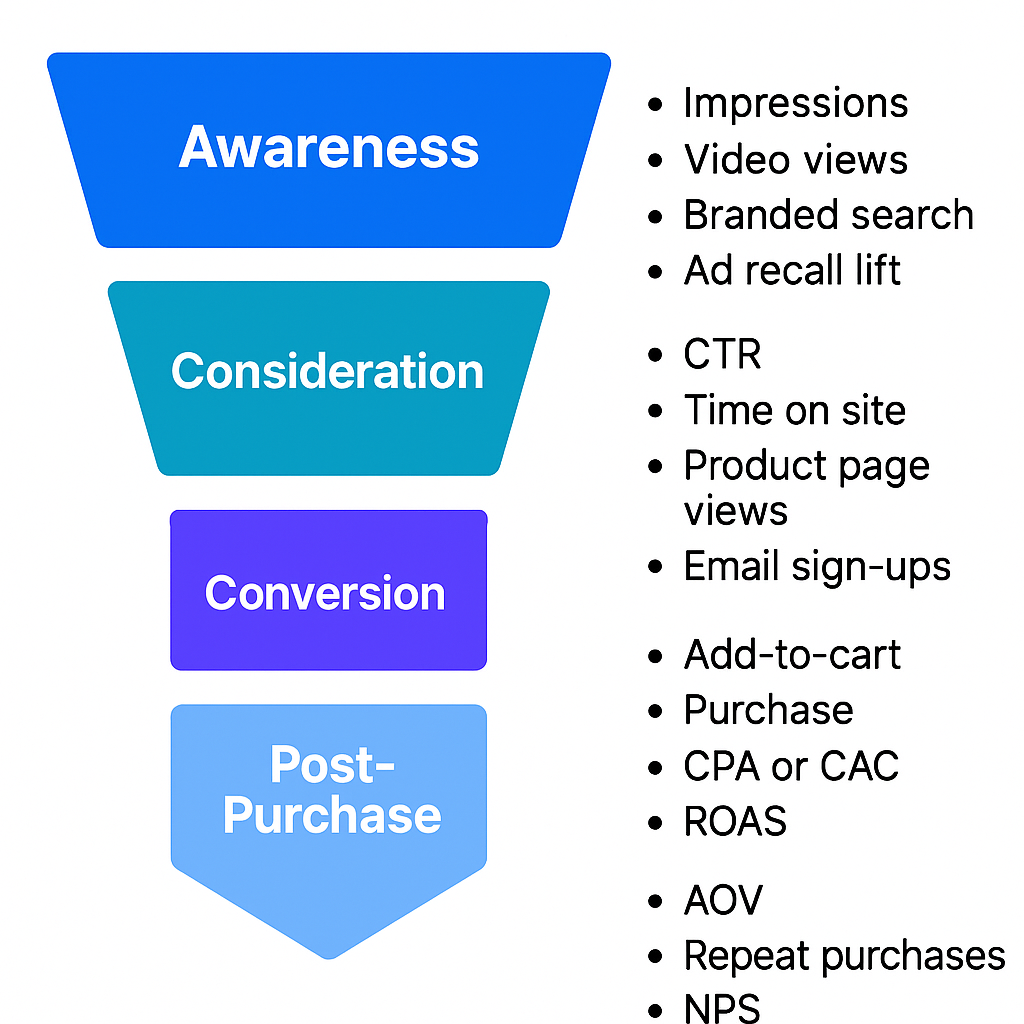
Here’s a breakdown of what that can look like:
Awareness Stage:
-
Impressions (reach and frequency);
-
Video views (especially through-play or 75% completion);
-
Branded search volume (measured in Google Search Console);
-
Ad recall lift (via Meta brand lift studies, if available).
Consideration Stage:
-
CTR (click-through rate);
-
Time on site and bounce rate (via GA4 or heatmaps);
-
Product page depth (scroll depth or interaction with tabs/specs);
-
Email or SMS opt-ins (lead magnet conversion rate).
Conversion Stage:
-
Add-to-cart rate;
-
Checkout initiation rate;
-
Purchase conversion rate;
-
CPA (cost per acquisition) or CAC (customer acquisition cost);
-
ROAS (both platform-reported and third-party validated).
Post-Purchase Stage:
-
Average order value (AOV);
-
Repeat purchase rate (30-, 60-, and 90-day windows);
-
Net promoter score (NPS) or customer satisfaction scores;
-
LTV (customer lifetime value), measured by cohort or product type.
Your analytics tools should be set up to track and unify these metrics across platforms — and ideally show how users flow between stages.
For more insight into this approach, check out How to Analyze Campaign Performance Beyond ROAS: The Full Funnel View.
Step 3: Segment Campaigns by Funnel Stage and Intent
To scale successfully, your measurement framework should separate campaigns by intent and stage in the buyer journey. When you mix cold and warm traffic in the same campaign, it muddies your data and creates misleading performance signals.
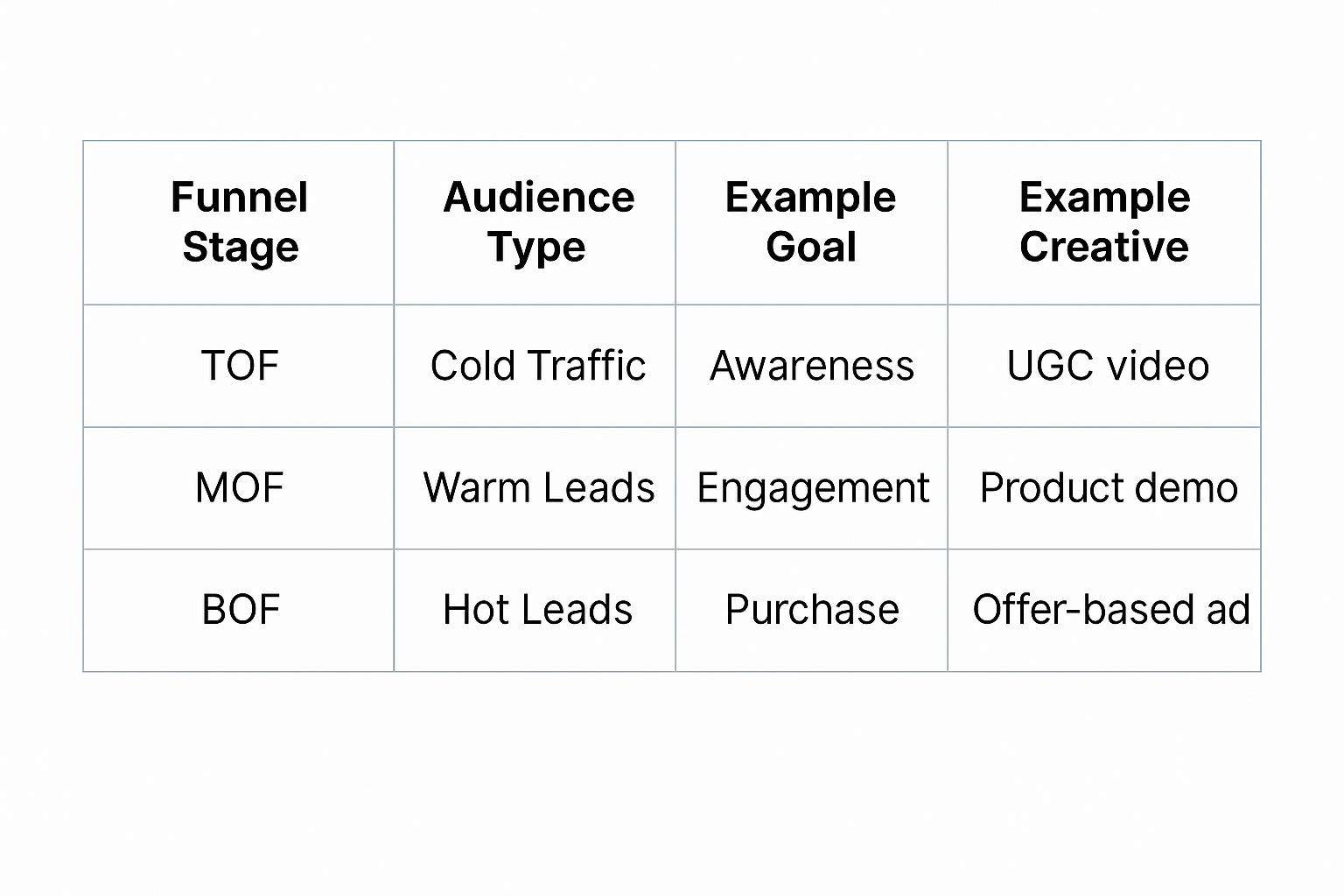
Use this segmentation structure:
Top-of-Funnel (Prospecting):
-
Goals: Reach new audiences and generate awareness;
-
Metrics: CPM, CTR, video watch rate, engagement rate, branded search growth.
Middle-of-Funnel (Consideration/Nurturing):
-
Goals: Educate, qualify, and build interest;
-
Metrics: Add-to-cart rate, email sign-up rate, page scroll depth, return visits.
Bottom-of-Funnel (Conversion):
-
Goals: Drive purchases or leads;
-
Metrics: CAC, purchase rate, ROAS, checkout completion rate.
Post-Purchase (Loyalty/Upsell):
-
Goals: Increase customer value;
-
Metrics: Repeat order rate, AOV increase, subscription start rate, cross-sell success.
Not only does this help with optimization, but it also lets you assign different creative types and budget thresholds to each stage — and measure performance accordingly.
Step 4: Set Baselines and Scaling Thresholds
Before increasing your ad spend, establish performance benchmarks that define when a campaign is ready to scale. Without these, you risk increasing spend on campaigns that can’t maintain profitability under pressure.
Here are examples of benchmarks to define:
-
Minimum CTR: e.g., >1.5% on cold traffic for three consecutive days;
-
Acceptable CAC: e.g., CAC within 10–15% of your target;
-
Conversion rate stability: e.g., hold conversion rate within 5% margin as spend increases;
-
ROAS threshold: e.g., ROAS remains >2.5x across a rolling 7-day window;
-
Frequency ceiling: e.g., CTR drops or CPC spikes if frequency exceeds 3.5.
Also define red flags that signal it’s time to pause or rethink a campaign:
-
CAC spikes more than 20% in 48 hours;
-
CTR drops below 0.9% after creative fatigue sets in;
-
ROAS falls below breakeven despite increased spend;
-
High bounce rates or short session durations post-click.
When you’re scaling, you want predictable growth — not performance surprises.
If you need to troubleshoot specific budget issues during scale, read The Science of Scaling Facebook Ads Without Killing Performance.
Step 5: Unify Data Across Platforms and Tools
Customers don’t live in one platform, and neither should your measurement strategy.
To truly understand performance, unify your data across ad channels, analytics platforms, and customer behavior tools.
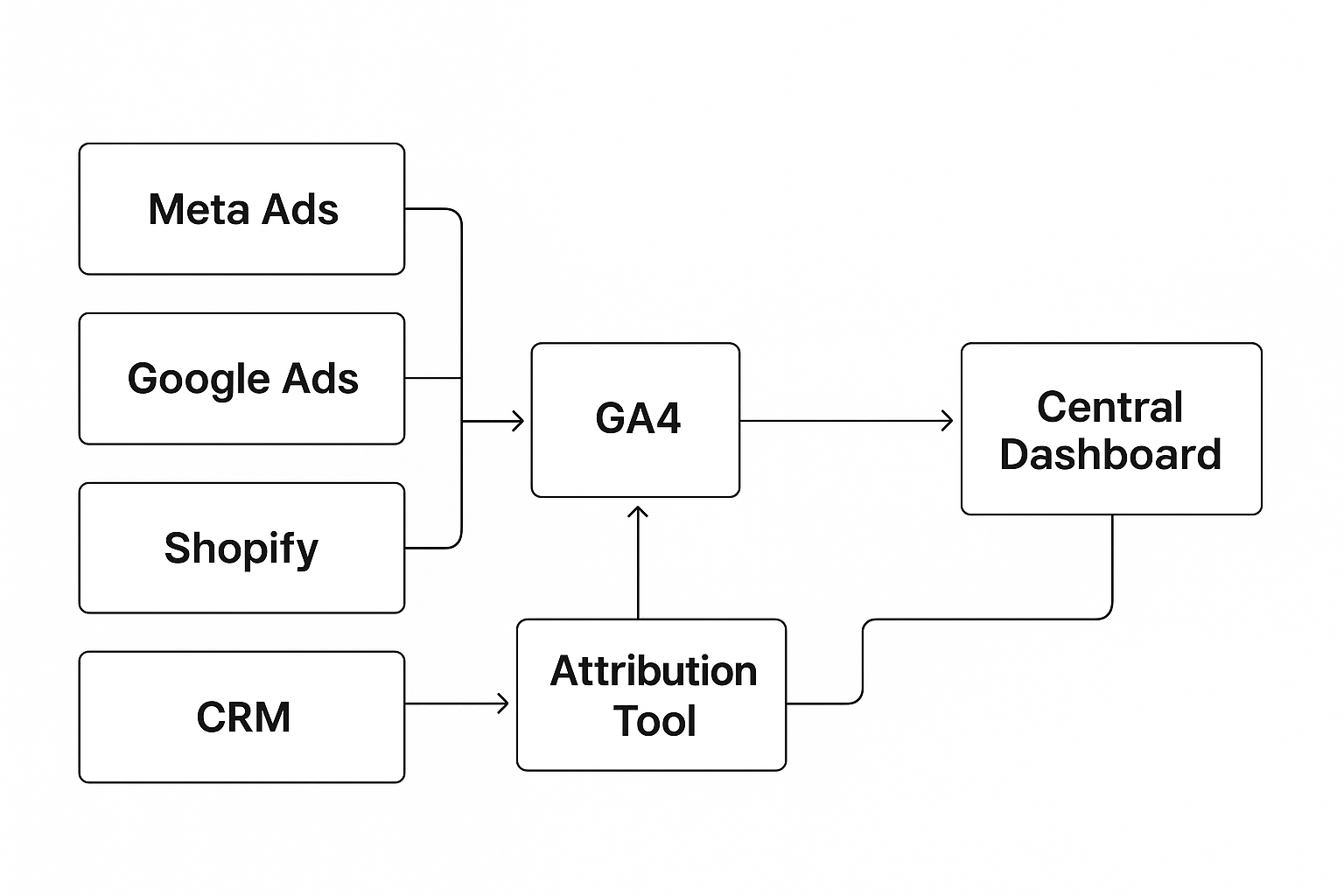
Steps to unify your measurement data:
-
Use UTM parameters consistently in all paid links to track campaign performance in GA4;
-
Integrate post-purchase surveys, asking “How did you hear about us?” to surface dark-funnel attribution;
-
Connect ad platforms to your CRM, so you can trace revenue, churn, and LTV back to acquisition source;
-
Feed back conversion events to Meta, Google Ads, and TikTok via offline conversion tracking;
-
Leverage tools like Segment, Triple Whale, Northbeam, or Hyros to blend multi-touch attribution.
Once connected, your measurement framework becomes a source of truth — not a guessing game.
Step 6: Visualize Everything in a Central Dashboard
Even the best metrics are useless if they live in a dozen browser tabs. Centralize your KPIs in a visual dashboard that helps you spot trends, act fast, and share results.
Your campaign measurement dashboard should include:
-
Total spend, broken down by platform, campaign, and funnel stage;
-
CAC and ROAS (platform-reported and blended);
-
CTR and conversion rate by creative, device, and audience;
-
LTV and AOV trends, ideally segmented by acquisition channel;
-
Creative performance — e.g., hook performance, engagement rate, scroll depth;
-
Frequency, impression share, and daily pacing metrics.
You can build dashboards using:
-
Google Looker Studio, integrated with GA4 and Sheets for flexibility;
-
Triple Whale, if you're on Shopify and want deep ad-to-purchase visibility;
-
Custom dashboards, via Data Studio APIs, Tableau, or Power BI.
Use visuals — graphs, sparklines, and trend lines — to track movement over time. But don’t overcomplicate it. A measurement framework should make data easier to act on, not harder to interpret.
Final Thoughts: Scaling Starts With Smart Measurement
You can't optimize what you don't measure. And you definitely can't scale what you don't understand.
Building a measurement framework forces you to align teams, identify opportunities faster, and avoid costly mistakes. It turns “more budget” into strategic growth — and helps you know when to push forward, when to hold back, and when to try something new.
So before you launch your next big push, ask: do we have the systems in place to measure success clearly and act on it quickly?
If not, now is the time to fix that.
Explore more ideas in How to Optimize Facebook Ads for Continued Success After Scaling.