Most e-commerce marketing starts with short-term goals: generate traffic, convert fast, scale with ads. That works — until it doesn’t.
If your strategy relies on heavy discounts, platform hacks, or luck with one viral campaign, you're building on shaky ground. Costs go up. Margins shrink. And worse — customers don’t come back.
A sustainable marketing strategy grows smarter over time. It builds systems, not spikes. It aligns every channel with clear goals. And it focuses on value — not just volume.
Let’s walk through the 10 steps that will get you there.
Step 1: Define clear business goals and constraints
Before you pick channels or tactics, decide what kind of growth you're aiming for. Otherwise, every marketing decision becomes reactive.
| Primary Goal | Pros | Cons | Best Fit For |
|---|---|---|---|
| Profitability | Strong cash flow | Slower growth | Bootstrapped brands |
| High LTV | Long-term value | Higher upfront CAC | Subscription / repeat-purchase brands |
| Low CAC | Fast scaling | Attracts low-quality buyers | VC-funded or early-stage growth |
| Volume | Broad reach | Can hurt margin or quality | Market-share-focused campaigns |
Ask:
-
Are we optimizing for profitability, volume, or long-term customer value?
-
Do we need a short payback window (e.g., 30 days) or can we invest in slower growth?
-
What is our maximum acceptable CAC? What’s our target LTV?
Examples:
-
A bootstrapped brand may prioritize high-margin channels like email and retention.
-
A venture-backed brand may accept higher CACs to acquire valuable customers and scale.
Without these answers, your marketing strategy will chase KPIs that don’t actually move the business forward.
Step 2: Understand your customer — beyond demographics
Generic audience traits (age, gender, interests) don’t build strong marketing. Sustainable strategies are built on customer motivations and buying behavior.
You need to know:
-
What problems do they want to solve? (e.g., “I don’t sleep well” not “25-year-old professional”)
-
What triggers a purchase? (Urgency, pain, lifestyle shift?)
-
What holds them back? (Price, trust, uncertainty, complexity?)
To get this insight:
-
Review customer support tickets and reviews.
-
Interview recent buyers and non-buyers.
-
Use post-purchase surveys to ask: “What almost stopped you from buying?”
For a deeper breakdown, see How to define your target audience.
Once you know how people decide — and why they hesitate — you can craft better messages, offers, and journeys.
Step 3: Design a full-funnel marketing structure
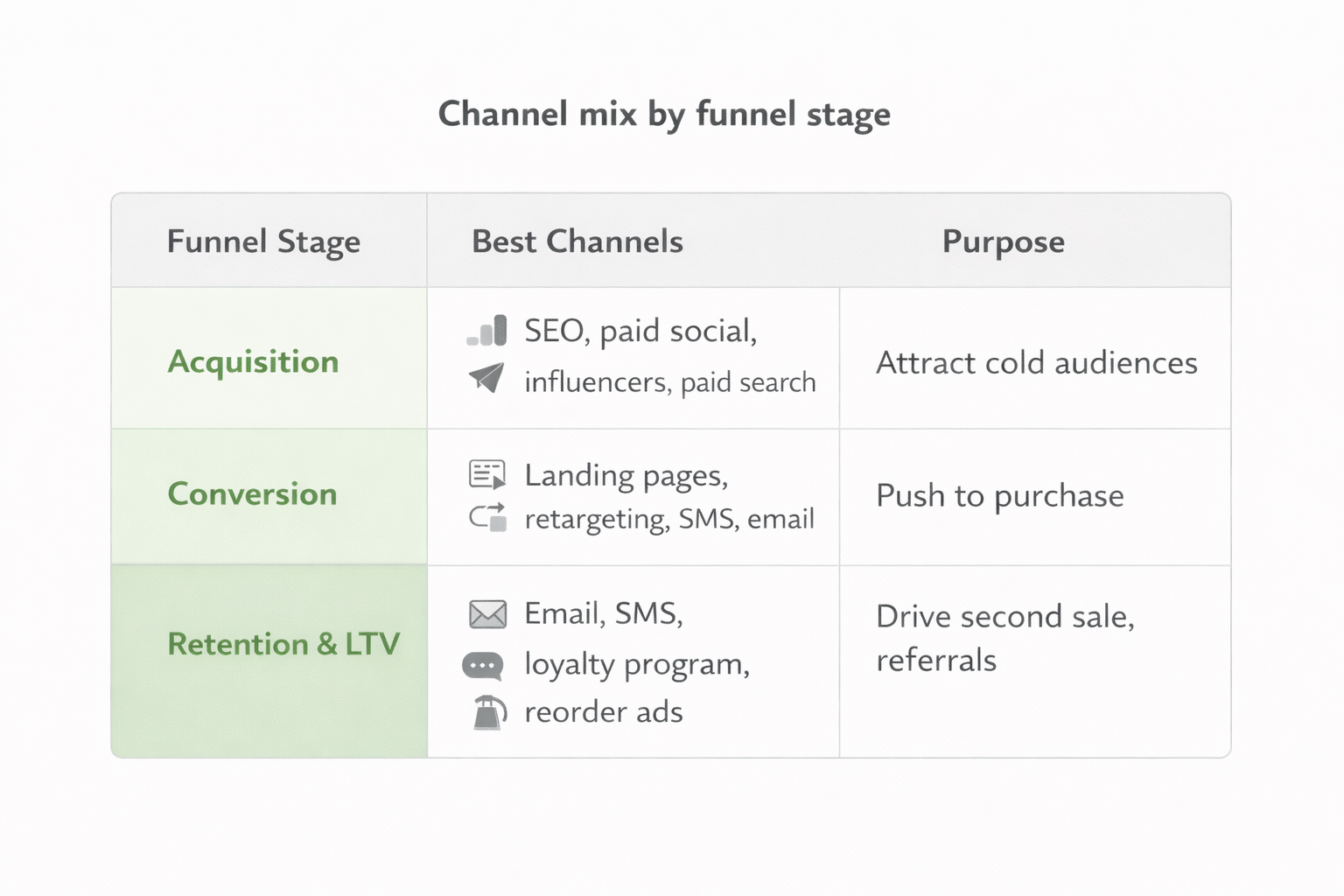
Your strategy shouldn’t be a collection of disconnected campaigns. It should map to the full customer journey — from awareness to retention.
Build structure around 3 core funnel stages:
1. Acquisition (awareness → first conversion)
Use SEO, paid ads, influencers, and PR to reach new audiences. Send them to landing pages designed for clarity and action.
2. Conversion optimization
On-site UX, fast page load, clear product info, and trust-building elements (reviews, guarantees, social proof) make the sale easier.
3. Retention & expansion
Email flows, SMS, remarketing, post-purchase offers, loyalty programs — all build LTV.
Each stage has its own goal, channel mix, and creative style. Align them so you’re not over-investing in traffic while ignoring what happens after the click.
For inspiration, see How to build a full-funnel campaign for your online store.
Step 4: Build a flexible, testable messaging system
You don’t need hundreds of unique ads. You need a message architecture that helps you test and scale core angles.
Here’s how:
-
List 3–5 key value propositions (e.g., “Saves time,” “Cleaner ingredients,” “Risk-free guarantee”).
-
Match each one with a pain point, a benefit, and a proof point.
-
Use these combos across channels: ads, emails, landing pages, packaging, etc.
Then track which angles lead to higher conversion and retention. Over time, you’ll stop guessing and start scaling what works.
Step 5: Choose channels based on behavior and intent
Not every channel suits every brand or offer. A sustainable strategy aligns your mix with how — and when — your customers buy.
General rules:
-
Paid search (Google, Bing): High intent. Best for products with clear demand.
-
Paid social (Meta, TikTok, Pinterest): Interruption-based. Great for discovery, education, storytelling.
-
Email/SMS: Best for retention, conversion nudges, loyalty building.
-
Influencers/UGC: Builds trust and social proof — especially effective for younger or first-time buyers.
-
Organic content & SEO: Slower, but builds compounding traffic with high intent over time.
Don’t spread thin across every channel. Choose 2–3 to focus on based on your offer and customer journey, then expand from there.
Step 6: Create systems for efficient creative production
Creative is one of the biggest performance levers — but it’s expensive and hard to scale without a system.
Here’s how to build one:
-
Use a modular structure: Create templates where headlines, visuals, and CTAs can be swapped in and out.
-
Test creative themes, not just designs. Try different angles — e.g., price-focused, emotional storytelling, trust-building.
-
Track performance by element: Over time, you’ll know which types of hooks or formats work best — and why.
This approach gives you variety without starting from scratch every time.
Step 7: Set up reliable tracking and data feedback loops
You can’t optimize what you can’t see. A sustainable marketing strategy requires clear attribution and performance insights.
Start by:
-
Defining core metrics for each funnel stage (e.g., CAC, CVR, AOV, LTV, churn)
-
Using UTMs and tagging to track where traffic and conversions come from
-
Implementing first-party data tracking (via tools like GA4, server-side tracking, or post-purchase surveys)
Then build feedback loops:
-
Push product and LTV data into ad platforms to improve targeting
-
Use customer behavior to trigger automated flows (e.g., abandoned cart emails, replenishment offers)
Clean data helps every part of the system improve over time — with less guesswork.
Step 8: Focus on improving retention and LTV
Most e-commerce growth stalls because brands focus only on acquisition. But long-term success depends on getting more from each customer.
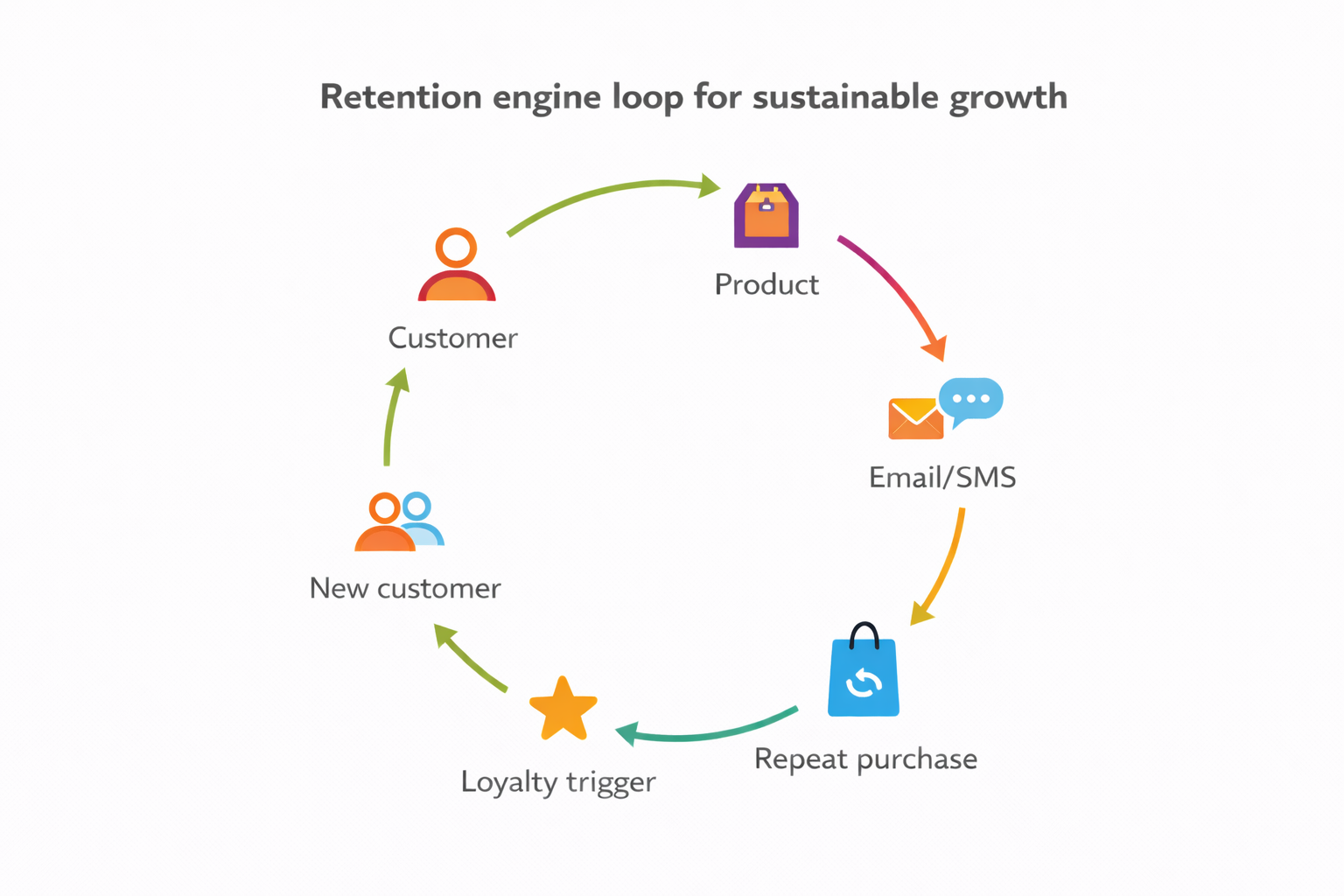
To increase LTV:
-
Improve the post-purchase experience: Clear delivery updates, onboarding emails, helpful tips.
-
Set up cross-sell and upsell flows: Use behavior-based triggers, not generic blasts.
-
Build loyalty or referral programs: Make it easy and rewarding to come back — or bring friends.
Even a small lift in retention can massively improve CAC efficiency and long-term margin.
To go deeper, see Post-purchase ad strategies that drive repeat sales.
Step 9: Create benchmarks — and review them monthly
Industry benchmarks don’t reflect your margins, product, or audience. You need to build your own, and use them to guide your strategy.
Examples:
-
What’s your blended CAC (total marketing spend ÷ new customers)?
-
What’s your time to break even (on average, how long to recover CAC)?
-
What’s your email flow conversion rate? (per campaign, not just list-wide)
Track these monthly. Identify what’s improving, what’s stuck, and what needs deeper testing.
Step 10: Plan for compounding gains, not quick wins
A sustainable strategy doesn’t just optimize for this week’s ROAS — it compounds wins over time.
Build systems that get stronger the longer they run:
-
Use content and SEO to build organic visibility.
-
Grow owned audiences through email and SMS.
-
Reuse top-performing creative themes in new formats and campaigns.
-
Invest in product improvements based on buyer feedback — not just ad trends.
This mindset shift makes growth more predictable, more profitable, and less dependent on constant reinvention.
Final thoughts: the full strategy at a glance
You don’t need more tactics — you need a structure that builds momentum.
Here’s the full 10-step path:
-
Define business goals and constraints.
-
Understand your customer deeply.
-
Map a full-funnel journey with specific goals
-
Create a flexible messaging system.
-
Choose channels based on customer behavior.
-
Build efficient creative production systems.
-
Set up clear tracking and data feedback.
-
Improve retention and lifetime value.
-
Create and track internal benchmarks.
-
Invest in systems that compound over time.
Marketing is a system. Build it to last.