
Volatile markets are characterized by rapid changes in demand, pricing, competition, and user intent. In such conditions, strategies that rely on long learning periods or rigid budgets tend to underperform.
Advertising platforms optimize based on recent signals. When those signals fluctuate sharply, algorithms may overreact—pushing spend into short-term anomalies or pulling back before performance has time to normalize.
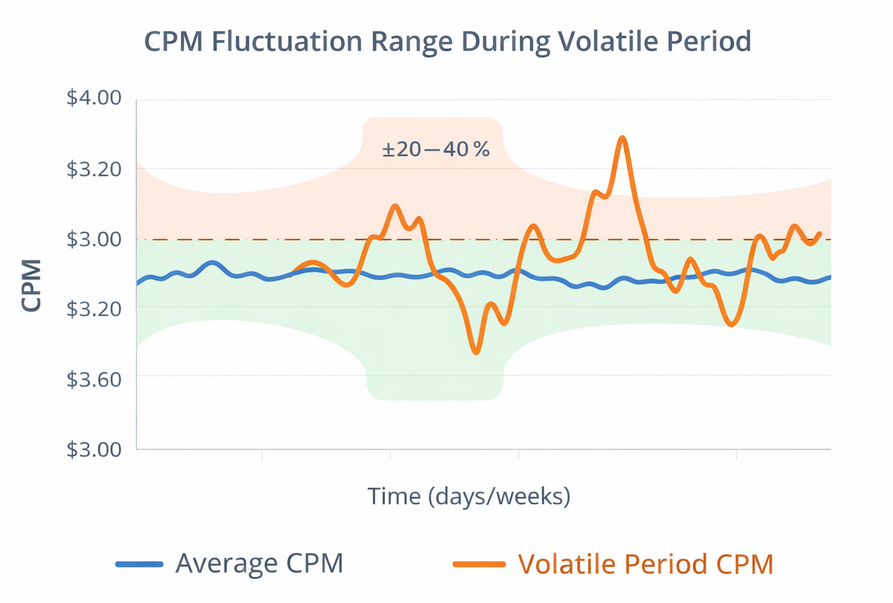
Average CPM vs. Volatile Period CPM Showing Extended Fluctuations
Recent industry data shows:
-
CPMs can fluctuate by 20–40% within a single week during market instability
-
Conversion rates often swing by 15–30% as user intent becomes less predictable
-
Cost per acquisition volatility increases by up to 2× compared to stable periods
Without structural adjustments, these swings result in wasted spend and delayed recovery.
Focus on Signal Stability, Not Short-Term Performance
In volatile environments, daily performance is often misleading. Isolated spikes or drops rarely reflect long-term potential.
Instead of optimizing based on day-to-day changes:
-
Evaluate performance using rolling 7–14 day windows
-
Prioritize statistically significant trends over isolated wins
-
Avoid reacting to performance changes that lack sufficient conversion volume
Campaigns that maintain consistent optimization windows during volatility show up to 18% higher efficiency compared to those adjusted reactively.
Simplify Campaign Structures to Reduce Noise
Complex campaign structures amplify volatility. When markets shift, fragmented budgets struggle to generate enough data per segment.
Best practices during unstable periods include:
-
Reducing the number of active campaigns and ad sets
-
Consolidating overlapping audiences and objectives
-
Allowing algorithms to allocate spend dynamically across fewer variables
Accounts that consolidate campaigns during high volatility have been shown to reduce cost volatility by approximately 22% while maintaining conversion volume.
Adjust Budgets Gradually to Protect Learning
Sudden budget changes disrupt learning and increase performance instability. This risk is amplified when market conditions are already fluctuating.
To maintain algorithmic stability:
-
Limit budget increases or decreases to 10–20% at a time
-
Avoid frequent daily budget adjustments
-
Use budget caps only when necessary to control extreme spikes
Gradual budget adjustments during volatile periods are associated with up to 25% lower CPA variance compared to aggressive scaling or cuts.
Shift Optimization Toward High-Intent Signals
When user behavior becomes unpredictable, upper-funnel signals lose reliability faster than lower-funnel actions.
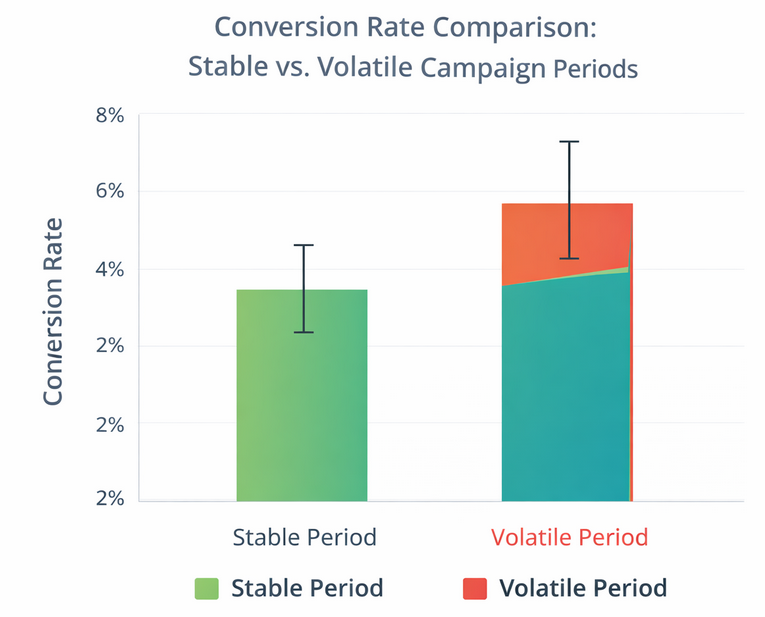
Conversion Rate Comparison: Stable vs. Volatile Campaign Periods
During volatility:
-
Optimize toward conversion-focused events rather than clicks or impressions
-
Narrow optimization goals to actions with clear business value
-
Delay expansion into experimental objectives until conditions stabilize
Campaigns optimized for high-intent events during volatile periods maintain conversion efficiency up to 30% better than those focused on engagement-based signals.
Use Controlled Testing Instead of Broad Changes
Volatile markets increase the cost of failed experiments. Large-scale changes make it difficult to identify what actually caused performance shifts.
A safer approach includes:
-
Testing one variable at a time
-
Isolating experiments in dedicated ad sets
-
Keeping control groups active for accurate comparison
Advertisers using controlled testing frameworks during market instability detect profitable adjustments 40% faster than those applying broad changes.
Build Volatility Buffers Into Performance Expectations
Short-term instability is unavoidable. Campaigns designed without tolerance for fluctuation often get paused prematurely.
To account for volatility:
-
Define acceptable CPA or ROAS ranges instead of fixed targets
-
Evaluate performance relative to market benchmarks, not historical averages alone
-
Separate optimization decisions from emotional responses to short-term losses
Organizations that apply flexible performance thresholds during volatile periods report fewer forced pauses and faster recovery once markets normalize.
Key Takeaways
Volatile markets reward disciplined optimization, not aggressive reaction. Stability comes from simplifying structures, protecting learning, and focusing on meaningful signals rather than short-term noise.
By adapting expectations and execution to market conditions, advertisers can preserve efficiency, uncover resilient opportunities, and emerge from volatility with stronger campaigns.