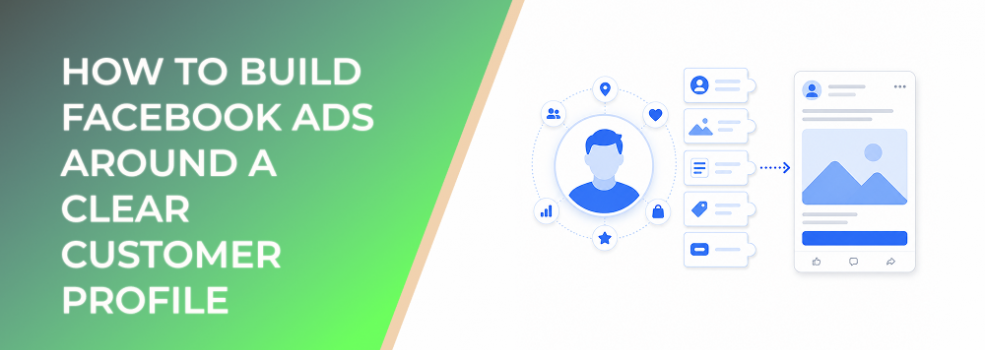
A Facebook ad is only as focused as the customer profile behind it.
If the customer profile is vague, the ad becomes vague. The targeting becomes broad. The creative tries to speak to too many people. The offer sounds generic. The campaign collects mixed signals.
A clear customer profile gives the campaign direction. It defines who the ad is for, what problem matters, what message should lead, and what audience signals are worth testing.
For performance marketers, agencies, startup teams, affiliate marketers, and B2B lead-generation teams, this is not just a branding exercise. It directly affects CPA, CAC, ROAS, lead quality, conversion rate, and scaling decisions.
The Problem
The problem is building Facebook ads around a shallow customer profile.
A shallow profile usually includes basic demographics:
Age.
Location.
Gender.
Industry.
Income.
Job title.
These details can help, but they rarely explain why someone buys.
A clear customer profile goes deeper. It captures the buyer’s problem, motivation, trigger, objection, urgency, trust requirement, decision role, and likely source of intent.
Without that depth, the ad may reach technically eligible users who are not ready, interested, qualified, or motivated.
Why This Problem Hurts Performance
A weak customer profile hurts every part of the campaign.
Targeting becomes imprecise because the advertiser does not know which signals matter.
Creative becomes generic because the team does not know which pain or desire to emphasize.
The offer becomes diluted because it tries to appeal to multiple customer types at once.
The landing page becomes less persuasive because it does not mirror the ad’s specific promise.
Reporting becomes unclear because the team cannot tell which customer segment is responding.
This affects business outcomes. CPC may rise because relevance is weak. CPA may rise because users are not qualified. CAC may rise because sales conversations require more education. ROAS may decline because the campaign attracts interest without purchase intent.
Common Scenarios Where This Happens
A B2B software company says its customer is “operations teams,” but the ad does not distinguish between managers, directors, frontline coordinators, or executives.
A marketing agency says it helps “small businesses,” but the best customers are actually local service businesses with high-ticket appointments and poor follow-up systems.
An ecommerce brand targets “women interested in wellness,” but its strongest buyers are ingredient-conscious shoppers dealing with a specific recurring problem.
A startup targets “early adopters,” but does not define whether that means competitor followers, product-hunt users, niche community members, technical buyers, or founders with urgent pain.
A local business targets everyone nearby instead of defining the customer by service trigger, neighborhood, property type, or readiness.
Why the Problem Happens
This problem happens because many customer profiles are created for brand planning, not performance marketing.
They describe the customer as a person, but not as an ad audience.
A useful Facebook ads customer profile must answer performance questions:
What makes this person worth reaching?
What problem should the ad lead with?
What proof do they need?
What objection might stop them?
What action are they ready to take?
What signal helps us find them?
Another cause is data fragmentation. Sales teams, support teams, analytics platforms, and ad accounts may all hold pieces of customer insight, but nobody turns them into one usable profile.
Finally, teams often build one profile when they need several. A cold prospect, warm lead, repeat customer, and competitor-aware buyer may all need different messaging.
The Solution
The solution is to turn the customer profile into a campaign brief.
Use this structure.
1. Customer identity
Define who the person or account is.
For B2B, include role, seniority, department, company size, industry, buying committee position, and budget relevance.
For ecommerce, include use case, product maturity, lifestyle, preference, and problem type.
For local services, include location, property type, need, urgency, and service trigger.
2. Core problem
Name the problem the ad should surface.
The problem should be specific enough that the right user recognizes it quickly.
Weak:
“Need better marketing.”
Stronger:
“Getting cheap leads that never book consultations.”
3. Buying trigger
Identify what makes the problem urgent now.
Triggers may include a deadline, season, life event, business growth stage, competitor dissatisfaction, budget review, operational bottleneck, compliance pressure, or product need.
4. Desired outcome
Define the result the customer wants.
This should be written in the buyer’s language, not only the company’s language.
5. Objections and proof
List what the buyer might doubt.
Then decide what proof the ad or landing page must provide.
Proof might include testimonials, demos, customer examples, product details, comparison points, process clarity, reviews, or transparent pricing.
6. Audience signals
Translate the profile into reachable signals.
Where does this customer spend time?
Which communities do they join?
Which Instagram profiles do they follow?
Which competitors do they compare?
Which LinkedIn titles, industries, or company types match?
Which custom social-profile data is available?
This is where the profile becomes actionable for paid social.
How LeadEnforce Helps
LeadEnforce helps when the customer profile needs to become a real audience test.
If the profile points to specific Facebook groups, Instagram profiles, Instagram followers or engagers, LinkedIn professional criteria, or custom social-profile sources, LeadEnforce can help advertisers build audiences around those signals. Its official feature pages describe audience creation from Facebook group members, Instagram followers, LinkedIn job-title/company data, and custom social-profile links.
For example:
A B2B customer profile built around HR decision-makers can become a professional audience test.
An ecommerce profile built around niche product enthusiasts can become an Instagram follower or engager audience test.
A local-service customer profile built around community intent can become a Facebook group-based audience test.
A custom research list can become a custom social-profile audience test.
LeadEnforce does not create the customer profile for you. It helps activate the profile once the strategy is clear.
Risks and Considerations
A customer profile can still be wrong.
Do not assume internal beliefs are accurate without market feedback. Validate the profile against sales data, CRM notes, customer interviews, ad performance, and conversion quality.
Avoid over-segmentation. Too many profiles can fragment budget and slow learning.
Do not rely on audience precision alone. The offer, creative, landing page, conversion event, and follow-up process must also match the customer profile.
If using LeadEnforce, source quality matters. A poor source audience can create misleading results even if the profile is well written.
Prerequisites and Dependencies
You need customer insight from real sources: sales calls, customer interviews, CRM data, reviews, analytics, support conversations, and previous campaign performance.
You need a clear campaign objective and a defined conversion path.
You also need audience sources that reflect the customer profile. If the best customer cannot be mapped to communities, profiles, professional data, CRM data, or engagement signals, the profile may need more research before activation.
Practical Recommendations
Build a one-page customer profile before launching the campaign.
Include:
Buyer identity.
Pain.
Trigger.
Desired outcome.
Objection.
Proof.
Audience signal.
Ad angle.
CTA readiness.
Then create ad variations around the profile. Do not change everything at once. Test one strategic variable at a time: audience, angle, proof, offer, or CTA.
Use LeadEnforce when the customer profile identifies clear source-based audience opportunities, such as Facebook groups, Instagram followers, LinkedIn professional segments, or custom social-profile lists.
Evaluate performance by quality. A profile-based campaign should improve the fit of leads or buyers, not only increase activity.
Final Takeaway
A clear customer profile gives Facebook ads strategic focus.
It tells the advertiser who to reach, what to say, what proof to show, and which audience signals to test. When campaigns are built around a real customer profile, performance data becomes cleaner and optimization decisions become more useful.
To activate clearer customer profiles through source-based Facebook and Instagram audiences, join the free 7-day LeadEnforce trial period.
Related LeadEnforce Articles
- Building Buyer Personas for Facebook Ads Based on Engagement Data — Shows how engagement behavior can improve persona development.
- How to Create Facebook Ads That Speak to Different Buyer Personas — Helps translate customer profiles into persona-specific messaging.
- Targeting the Right Decision-Makers in B2B Facebook Ads — Useful for building ads around professional decision-maker profiles.
- Why Narrow Audience Targeting Can Increase Facebook Ad ROI — Explains why focused audience fit can improve relevance and efficiency.