Most advertisers slow down after Q4. Budgets reset, teams take breaks, and many assume users stop paying attention. But that’s not actually what happens.
People are still online — still scrolling, still researching, still discovering. What changes is the auction. Fewer active advertisers mean lower CPMs, and that gives you a powerful edge.
This creates a short window in early Q1 where attention costs less, competition is lower, and performance potential is higher. Brands that act now don’t just save money — they collect data, build audiences, and set up scalable campaigns while others hit pause.
To fully understand the mechanics behind these cost shifts, you can explore what influences CPM on Facebook Ads and how to keep it low.
What You Actually Get from Lower CPMs
It’s tempting to think of lower CPMs as a nice bonus — just a temporary cost break. But smart advertisers know they unlock much more than that. Lower CPMs create leverage across your entire funnel, from testing to optimization to scaling.
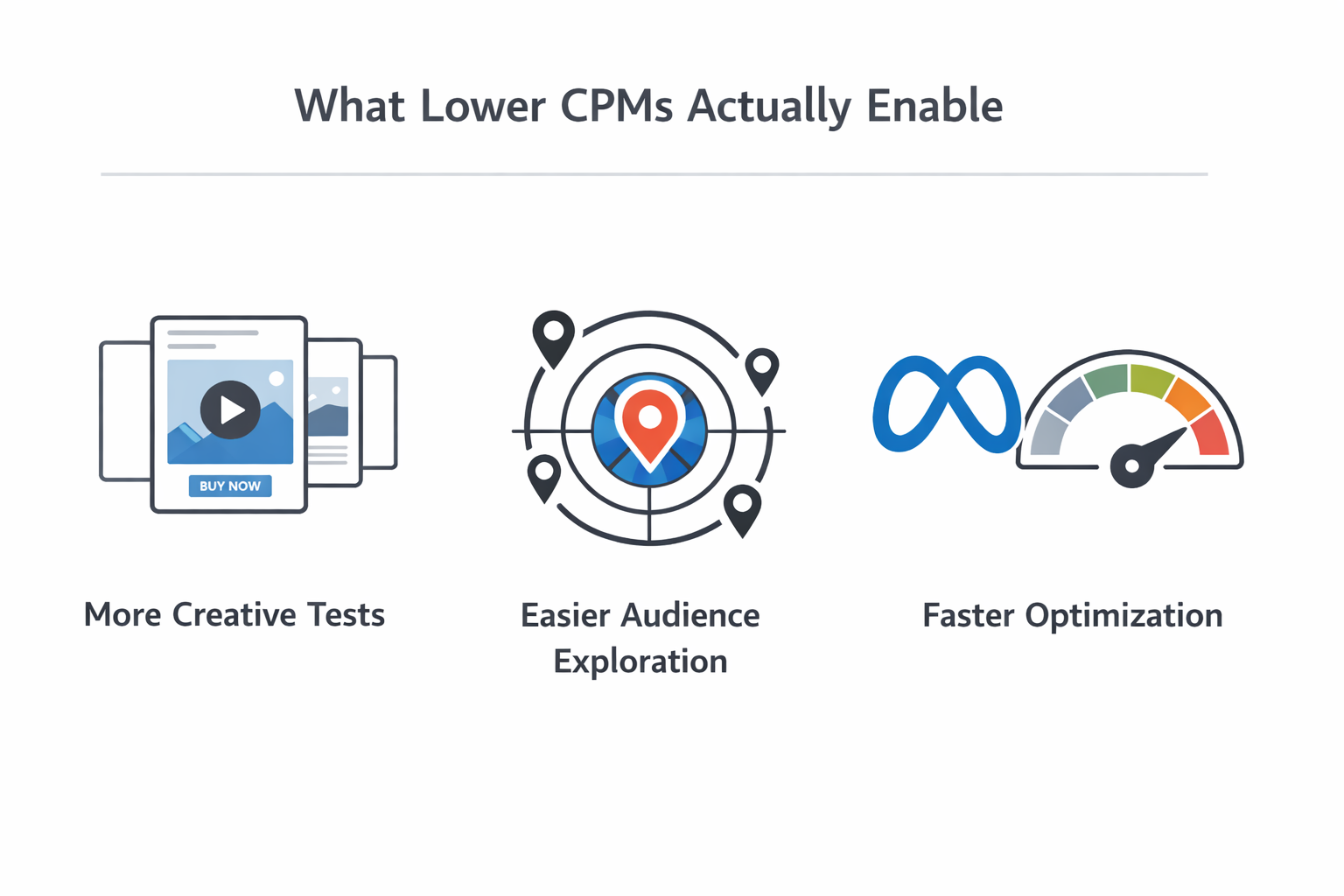
Let’s break down what they actually make possible:
1. Faster, cheaper creative testing
When CPMs are high, you have to pick your tests carefully. But in early Q1, you can afford to run more tests — and get faster results:
-
A $1,000 budget at a $5 CPM gives you 200,000 impressions.
-
That’s enough to run 4–5 creative variations with reliable volume.
-
You can validate ad hooks, formats, and copy without stretching your budget thin.
2. Room to explore riskier audience segments
Normally, you avoid testing colder or less familiar segments because the cost per result is too high. Now you can experiment without the same financial risk:
-
Try broader interests or lower-quality lookalike audiences.
-
Run B2B ads to less-defined buyer personas.
-
Identify segments that perform surprisingly well — ones you might not have considered during peak ad costs.
3. Stronger algorithmic optimization
Meta’s delivery system improves when it has more data to work with. Early Q1 gives you the impression volume to generate those signals:
-
Campaigns exit the learning phase faster.
-
Ad sets stabilize performance more quickly.
-
Your best creatives start working more efficiently — and stay efficient longer.
Low CPMs aren’t just a bargain. They’re a way to upgrade how your entire ad account performs.
Q1 Is Not a Continuation of Q4 — It’s a Reset
If you carried your Q4 strategy into January without changing anything, chances are you're seeing flat or declining performance. That’s because the environment — and user mindset — has changed completely.
In Q4, attention is fragmented, decision-making is emotional, and competition is aggressive. In Q1, people slow down, reassess, and plan. They are still active, but the tone shifts — and your ads need to shift with it.
Here’s a quick comparison to illustrate the difference:
| Q4: Holiday Season | Q1: Reset Season | |
|---|---|---|
| Ad Volume | High — crowded auctions | Low — fewer brands in feed |
| User Mood | Urgent, deal-focused | Reflective, planning-oriented |
| Cost | Rising weekly | Significantly lower |
| Creative Style | Bold, emotional hooks | Calm, utility-first messaging |
You don’t need to change everything, but you do need to speak to the right mindset — or you risk sounding irrelevant.
How to Align Messaging with January Behavior
People are still paying attention in January — but not to the same kinds of ads. This is the season of planning, resetting, and simplifying. Your messaging should reflect that.
Let’s look at three proven message styles that align well with this time of year:
1. Planning and structure
People are organizing their time, budget, and tools. If your product helps with that — even indirectly — highlight it.
For example:
-
“Structure your sales funnel before the year gets busy.”
-
“Plan content 3x faster with this workflow.”
-
“Lock in your Q1 pipeline while everyone else is still planning.”
2. Simplification and clarity
January users are tired of noise. They respond to ads that offer a cleaner, more focused way forward.
-
“Cut your tools from five to one.”
-
“Simplify onboarding — save hours every week.”
-
“Clearer reports, fewer tabs, faster decisions.”
3. Long-term transformation
Don’t overpromise. Instead, speak to sustainable improvements. This approach resonates with serious buyers who are setting new priorities.
-
“Build predictable growth into your 2025 marketing.”
-
“Create systems that scale — not campaigns that burn out.”
-
“Small shifts now, measurable results in Q2.”
The right message will feel calmer, clearer, and more practical. That’s exactly what people are looking for in January.
Smarter Testing Without Rebuilding Everything
Q1 is the best time to test — but that doesn’t mean you need to rebuild your campaigns from scratch. Instead of replacing your whole creative set, focus on key elements that drive performance shifts.
Use modular testing. It’s faster, more scalable, and gives you clearer insights. Here’s how to do it:
Test #1: The first 3 seconds
Whether it’s video or static, what people see first matters most. Try:
-
Visuals that lead with the problem or pain point.
-
Data points that highlight a surprising stat.
-
A headline that speaks directly to their current state.
Test #2: Same creative, different captions
This isolates your messaging from your visuals — and helps you find which angles resonate.
-
“Still stuck with spreadsheets?”
-
“Your sales team deserves better tools.”
-
“Cut onboarding time in half — this week.”
Test #3: Smarter CTAs
Most advertisers default to “Learn More.” Try something more specific:
-
“Streamline Your Q1 Process”
-
“Plan Smarter, Not Harder”
-
“See It in Action”
To measure the success of these creative variations accurately, you’ll need more than just surface-level metrics. For a deeper understanding of how to analyze campaign performance, read How to Analyze Facebook Ad Performance Beyond CTR and CPC.
Keep Campaigns Running — But Change the Objective
If your sales volume typically dips in January, don’t panic — adjust. Now is not the time to stop running ads. It’s time to change why you’re running them.
Your campaigns should be building pipeline, not just driving purchases.
Here’s how to refocus your campaigns in a way that still supports revenue goals later:
1. Lead generation
Use value-driven lead magnets:
-
“2025 Growth Planning Worksheet”
-
“Q1 Budgeting Checklist”
-
“Team Alignment Toolkit”
These help you grow your email list and warm audiences at a low cost.
2. Retargeting December traffic
Bring back people who engaged in Q4 — but with calmer messaging.
Instead of “Limited Time Offer,” try:
-
“Still evaluating options?”
-
“Here’s what to consider before you commit.”
-
“See how others in your role are using this.”
3. Boosting content
Promote valuable blog posts, short guides, or customer stories.
This drives high-quality engagement and gives Meta better audience signals — all while CPMs are still low.
January isn’t about chasing conversions. It’s about positioning yourself for better performance in February, March, and beyond.
Scale Gradually — Or You’ll Break It
Once something works, it’s tempting to crank the budget. But scaling too quickly can reset the learning phase or trigger performance drops. Instead, scale with control and structure.
Here’s what that looks like:
1. Duplicate instead of editing
If you want to scale a winning ad set, duplicate it with a higher budget rather than editing the original.
This keeps your best performer intact — and gives the new ad set a clean learning path.
2. Increase spend gradually
Don’t double your budget overnight.
Raise it by 20–30% every few days.
Monitor key metrics like cost per result and frequency as you go.
3. Test the winner in new segments
Take your best-performing creative and run it in a new audience:
-
A broader interest group
-
A new lookalike
-
A fresh country or region
If performance holds, you’ve found something scalable. If it drops, the success was probably audience-dependent.
Scaling isn’t about spending more. It’s about maintaining control as you grow.
Final Thoughts: Use January to Build, Not Coast
January is not the time to disappear. It’s the time to build your next level of performance — while the cost of attention is still low.
To recap, your priorities should be:
-
Test small but meaningful creative changes.
-
Match your messaging to real user behavior.
-
Build warm audiences and collect better signals.
-
Scale slowly and track what really drives results.
This isn’t about being aggressive. It’s about being smart — and using a quieter moment in the ad auction to your advantage.