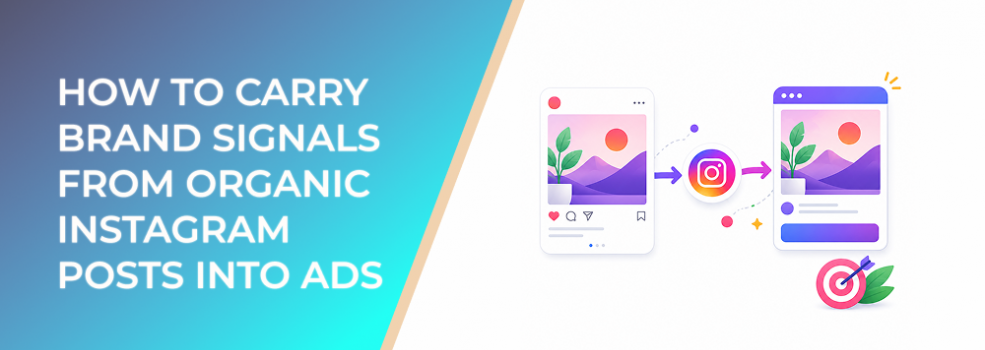
Many Instagram ads feel disconnected from the organic profile behind them.
A user sees the ad, taps the profile, and suddenly the brand feels different. The ad looks polished, but the profile feels casual. The organic posts feel educational, but the ad feels aggressively promotional. The visuals, tone, and content themes do not match.
That disconnect weakens trust and recognition.
Organic Instagram content often contains valuable brand signals already: repeated colors, recurring content themes, creator style, product framing, captions, community language, and visual rhythm.
The opportunity is to carry those signals into ads intentionally.
The Problem
The problem is that marketers often separate organic and paid creative too sharply.
Organic teams build familiarity. Paid teams build conversion assets. But users do not experience the brand that way. They see one brand across posts, Reels, Stories, ads, profile visits, and landing pages.
When ads ignore the signals that already work organically, the paid experience feels disconnected.
This is especially risky when organic content has built audience trust. If the ad suddenly looks like a generic sales asset, users may feel the brand has changed tone.
The result is lower trust, weaker recall, and less efficient paid performance.
Why This Problem Hurts Performance
Organic-to-paid disconnect can hurt performance across the funnel.
Cold users may not understand the brand personality because the ad does not reflect the profile.
Warm users may fail to recognize the brand because the ad looks different from the posts they previously engaged with.
Profile visitors may lose confidence if the ad promise and profile content do not align.
Retargeting can feel repetitive or random if paid ads do not build on organic themes.
Lead quality can suffer if the ad attracts users with a message that the organic presence does not support.
This can affect CTR, CPA, conversion rate, CAC, ROAS, and downstream lead quality.
Common Scenarios Where This Happens
An ecommerce brand has organic posts built around lifestyle, community, and product education. Its ads only show discount graphics.
A SaaS company has strong organic posts explaining workflow problems, but its ads use generic product screenshots and feature lists.
A creator-led brand has a recognizable face and tone organically, but its paid ads use anonymous stock-style videos.
A local business has organic posts showing real staff, customer moments, and community events. Its ads use generic promotional templates.
An agency takes a client’s best organic posts and turns them into ads without preserving the visual cues that made them recognizable.
Why the Problem Happens
This problem happens because paid teams often optimize for direct response while organic teams optimize for engagement and community.
Both goals matter, but they need to share a brand foundation.
Another cause is treating organic performance as content inspiration only. Marketers look at which posts got likes or saves, but they do not analyze which brand signals made the content recognizable.
A third cause is poor asset handoff. Organic teams may have photos, Reels, captions, and visual patterns that paid teams never use.
A final cause is misunderstanding adaptation. Carrying organic signals into ads does not mean boosting posts unchanged. Paid creative needs clearer hooks, CTAs, and funnel alignment. But it should still feel connected to the organic brand.
The Solution
The solution is to audit organic Instagram content for repeatable brand signals, then adapt those signals into paid creative.
Start with your strongest organic posts from the last 60 to 180 days.
Look for patterns in:
- Visual style
- Color use
- Product framing
- Creator presence
- Caption tone
- Opening hooks
- Carousel structures
- Recurring topics
- Community language
- Proof formats
- Questions in comments
- Saves and shares
Then identify which signals should move into ads.
For example, if organic carousels with simple educational layouts perform well, build paid carousels with the same visual structure but stronger offer framing.
If founder-led Reels drive strong comments, test founder-led paid Reels with clearer CTAs.
If product-in-use posts outperform studio shots, use that environment as a paid visual cue.
If your audience responds to a specific phrase, problem statement, or content theme, use it as part of paid messaging.
The key is to preserve the recognizable parts while improving the ad for paid intent.
Risks and Considerations
Do not assume every high-engagement organic post deserves ad spend. Likes and comments do not always reflect buying intent.
Do not copy organic content into paid campaigns without adapting the CTA, offer, and funnel stage.
Do not remove the brand’s organic personality in the name of conversion. That is what creates disconnect.
Do not overuse one organic signal until it loses freshness.
Do not ignore placement fit. A carousel insight may need a Reel version, Story version, or static version.
Also, remember that organic audiences and paid audiences may behave differently. A signal that works with followers may need adjustment for cold prospects.
Prerequisites and Dependencies
You need enough organic content history to identify patterns.
You need access to post performance data, including saves, shares, profile visits, comments, link clicks, and engagement quality.
You need a clear paid objective.
You need a strong offer or next step.
You need creative resources to adapt organic signals into multiple ad formats.
You need alignment between the organic team, paid team, and landing page owner.
You also need a clear definition of which organic signals are brand signals and which are just content trends.
Practical Recommendations
Create a monthly organic-to-paid review.
Select posts based on quality of response, not only total engagement.
Document recurring visual cues from your strongest posts.
Turn each strong organic signal into at least two paid variations.
Keep the original brand tone, but make the paid CTA clearer.
Use profile continuity as a quality check. If a user taps from the ad to the profile, the experience should feel connected.
Build a simple library of paid-ready brand signals: colors, frames, captions, intro styles, proof layouts, creator guidelines, and product shots.
Measure both immediate ad performance and profile behavior after ad exposure.
Final Takeaway
Organic Instagram content often contains the brand signals your ads need.
When paid ads ignore those signals, the campaign can feel disconnected from the brand users see on the profile. When ads carry organic cues forward, the experience feels familiar, trustworthy, and easier to recognize.
The best approach is not to boost everything that performs organically. It is to extract the recognizable patterns and rebuild them for paid performance.
Related LeadEnforce Articles
- Find Repeatable Instagram Ads Creative Signals From High-Performing Posts — Directly supports identifying organic signals that can guide ad creative.
- How to Scale Better Instagram Ads by Spotting Content That Already Performs — Helps turn proven organic content into stronger paid tests.
- Stop Missing Strong Instagram Ads Ideas by Finding Standout Post Themes — Useful for spotting repeatable organic content themes before building ads.
- Instagram Content Pillars: Build a Strategy That Scales — Helps structure organic content in a way that can support future paid campaigns.