Choosing a Meta ad objective looks simple until performance goes sideways.
The objective is one of the first settings in campaign setup, but it affects everything that follows: who sees your ads, which actions Meta prioritizes, how results are reported, and whether your budget moves toward real business value.
Many advertisers choose the objective too quickly.
They pick traffic because they want website visitors. They pick engagement because they want attention. They pick leads because they want contacts. But if the objective does not match the actual business goal, Meta may optimize toward the wrong behavior.
The result is wasted spend hidden behind decent-looking metrics.
What the Objective Really Does
The campaign objective tells Meta what outcome you want.
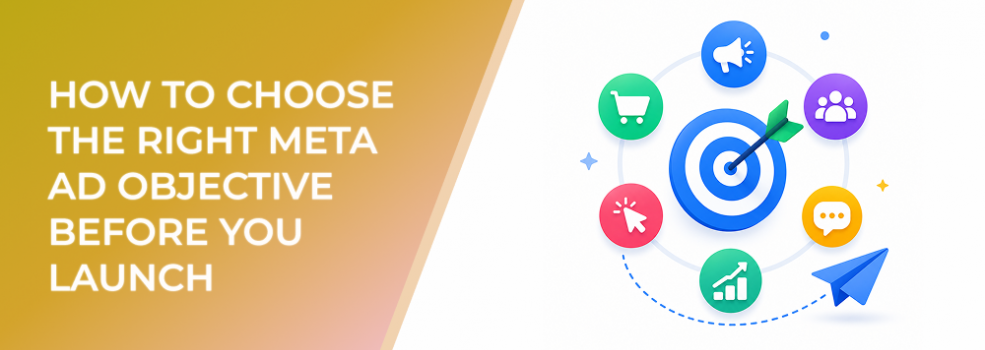
If you choose awareness, Meta focuses on visibility. If you choose traffic, it looks for people likely to visit a destination. If you choose engagement, it prioritizes interaction. If you choose leads, it looks for users more likely to submit information. If you choose app promotion, it focuses on app-related actions. If you choose sales, it optimizes toward purchase or revenue-related outcomes.
That means objective choice is not cosmetic.
It directly influences delivery.
A campaign optimized for clicks is not the same as a campaign optimized for leads. A campaign optimized for leads is not the same as a campaign optimized for sales. Each objective trains the system around a different type of user behavior.
Business Impact on Campaign Performance
The wrong objective can make campaigns look efficient while business results remain weak.
A traffic campaign may deliver low CPC, but low CPC does not matter if visitors do not convert. An engagement campaign may build reactions and comments, but those interactions may not turn into revenue. A leads campaign may generate low-cost forms, but the leads may not qualify. A sales campaign may cost more upfront, but it may produce stronger ROAS if the conversion path is ready.
Objective choice affects:
- CPC by changing the type of users Meta targets.
- CPA by influencing how close optimization is to the desired action.
- CAC by affecting user or lead quality.
- ROAS by prioritizing or ignoring purchase intent.
- Budget efficiency by determining whether spend supports the right funnel stage.
The objective should match the business KPI, not just the campaign activity.
Typical Scenarios Where This Applies
Use awareness when the goal is visibility, reach, or brand introduction.
Use traffic when the goal is to send users to content, a landing page, or another destination where the next step is not immediate conversion.
Use engagement when the goal is post interaction, video interaction, messages, or social proof.
Use leads when the goal is collecting contact information or inquiries.
Use app promotion when the campaign is focused on app installs or app activity.
Use sales when the goal is purchases, bookings, subscriptions, or revenue-related conversions.
The practical rule is simple: choose the objective closest to the action you actually care about, as long as the campaign has enough signal to support it.
Risks and Considerations
The biggest risk is choosing a shallow objective because deeper objectives appear more expensive.
For example, traffic campaigns often produce cheaper clicks than sales campaigns. But if those clicks do not convert, the lower CPC is not a win.
Another risk is optimizing too deep too early. If a new campaign has very little conversion data, a sales or qualified lead objective may struggle to stabilize. In that case, advertisers may need to simplify the funnel, improve the audience, or temporarily optimize for a higher-volume action.
Campaign structure also matters. If one campaign tries to drive awareness, leads, and sales at the same time, reporting becomes harder to interpret. Separate objectives usually produce cleaner learning.
Prerequisites and Dependencies
Before selecting an objective, define:
- The business result the campaign must support.
- The funnel stage of the audience.
- The conversion location.
- The primary KPI and quality metric.
- Whether the account has enough signal for the chosen event.
- Whether the offer and creative match the objective.
- Whether the budget can support the desired action.
A good objective cannot fix a weak offer, irrelevant audience, or broken conversion path.
How LeadEnforce Helps
LeadEnforce improves the quality of the audience inputs behind the objective.
Meta’s objective can optimize delivery, but it still needs a relevant audience pool. If the audience is too broad or based on weak assumptions, even the right objective can waste money.
LeadEnforce helps advertisers build audiences from Facebook groups, Instagram profiles, followers, engagers, LinkedIn professional data, and custom social-profile data.
That makes objective selection more powerful.
A leads campaign can start with people connected to relevant communities. A sales campaign can use audiences built from niche profiles or high-intent social signals. A B2B campaign can reach professional segments instead of relying only on broad interests. An agency can create campaign-specific audiences for each client offer.
The objective tells Meta what action to find. LeadEnforce helps improve who enters the search.
Practical Recommendations
Write the campaign goal in business language before opening Ads Manager.
For example, “Generate qualified demo requests from operations leaders” is clearer than “run a lead campaign.”
Choose the objective that matches that goal as closely as possible.
Avoid judging objectives by CPC alone. Compare conversion rate, qualified lead rate, CAC, ROAS, and revenue quality.
Do not mix too many goals in one campaign. If you need awareness and sales, build separate campaigns with separate measurement expectations.
Use audience quality as a setup variable. A better audience can make the same objective perform more efficiently.
Final Takeaway
Your Meta ad objective is the campaign’s instruction manual.
When it matches the business goal, Meta can optimize toward useful behavior. When it does not, the campaign may generate activity without meaningful performance.
To build more relevant audiences for your next objective-based campaign, join the free 7-day LeadEnforce trial period.
Related LeadEnforce Articles
- Beginner’s Guide to Facebook Ads: How to Launch Campaigns That Convert — A broader setup guide for choosing objectives, audiences, budgets, and creative.
- Your First Meta Ad Campaign: What to Set Up Before Spending Money — Explains why objective choice shapes traffic quality from the start.
- Meta Ads Manager Explained: How to Manage Campaigns Without Wasting Budget — Shows how Ads Manager setup decisions affect delivery and optimization.
- What Is Facebook Ad Audience Targeting and Why It Matters — Connects objective performance with stronger audience targeting.