Most event campaigns don’t fail at setup. They fail at conversion.
You can follow every step in Ads Manager, launch an event ad, and still see low attendance. The problem is rarely technical. It comes from how Meta optimizes event responses versus real attendance.
Event ads are designed to drive interactions like “Interested” or “Going.” That signal does not always translate into ticket purchases or actual attendance.
Understanding how the setup works — and what Meta is actually optimizing for — is where performance improves.
What Meta event ads actually optimize for
When you create an event ad, the platform pushes you toward engagement-based signals.
If you select the Engagement objective, Meta optimizes for event responses. These include users who click “Interested” or “Going.” This signal is easy for the algorithm to generate because it requires low commitment.
If you switch to a Sales objective with a ticket flow, the system attempts to optimize toward higher-intent actions. However, this only works when ticket data is properly structured inside the event.
This creates a clear tradeoff:
- Event response campaigns generate volume. You will see lower CPC and higher engagement rates, but weaker conversion to actual attendance.
- Ticket-focused campaigns generate intent. You may see higher CPC and slower delivery, but stronger downstream results.
The two event ad setups — and how they behave differently
Meta provides two primary paths when creating event ads.
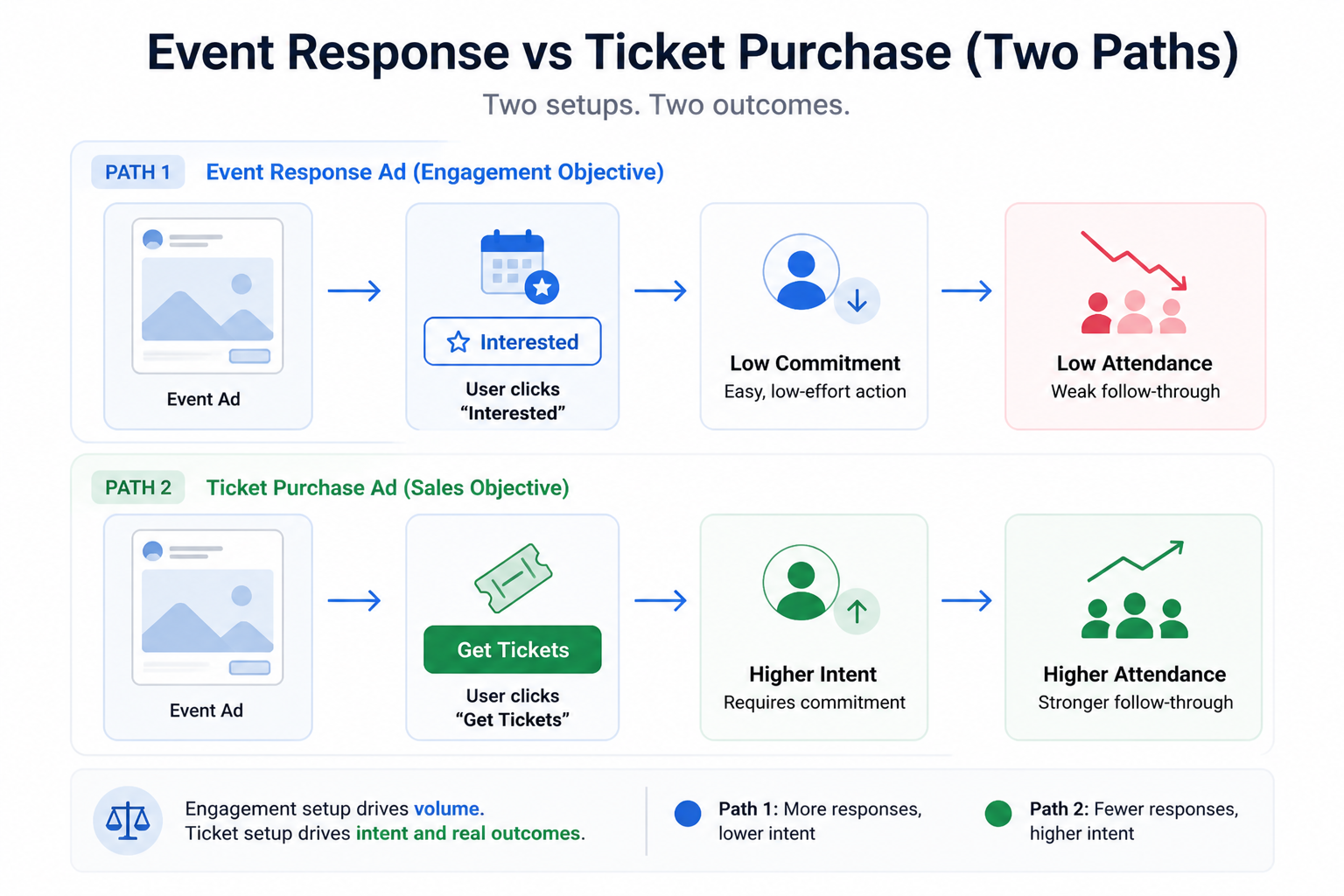
- Event ads with an “Interested” button. These use the Engagement objective and optimize for event responses directly on the ad.
- Event ads with a “Get tickets” button. These use a Sales objective and push users toward ticket-related actions with stronger intent signals.
The difference becomes obvious in reporting.
With “Interested” campaigns, you will often see high engagement but low attendance. With “Get tickets,” the volume drops, but the quality of interactions improves.
If you’re structuring campaigns across funnel stages, this ties directly into how you design a broader Facebook Ads funnel strategy.
Why event ads often show good metrics but poor turnout
This is one of the most common patterns in Ads Manager.
You launch an event campaign and see:
- high engagement rates;
- low cost per event response;
- steady delivery across placements.
Everything looks healthy. But attendance numbers stay flat.
This happens because Meta optimizes for the easiest measurable action. Clicking “Interested” requires minimal effort. Buying a ticket or attending requires much more commitment.
The algorithm follows the easiest path unless you structure your campaign differently.
This is the same reason many advertisers run into issues described in why your Facebook ads aren’t generating leads.
The hidden dependency — your event setup itself
Event ads depend heavily on the quality of the event page.
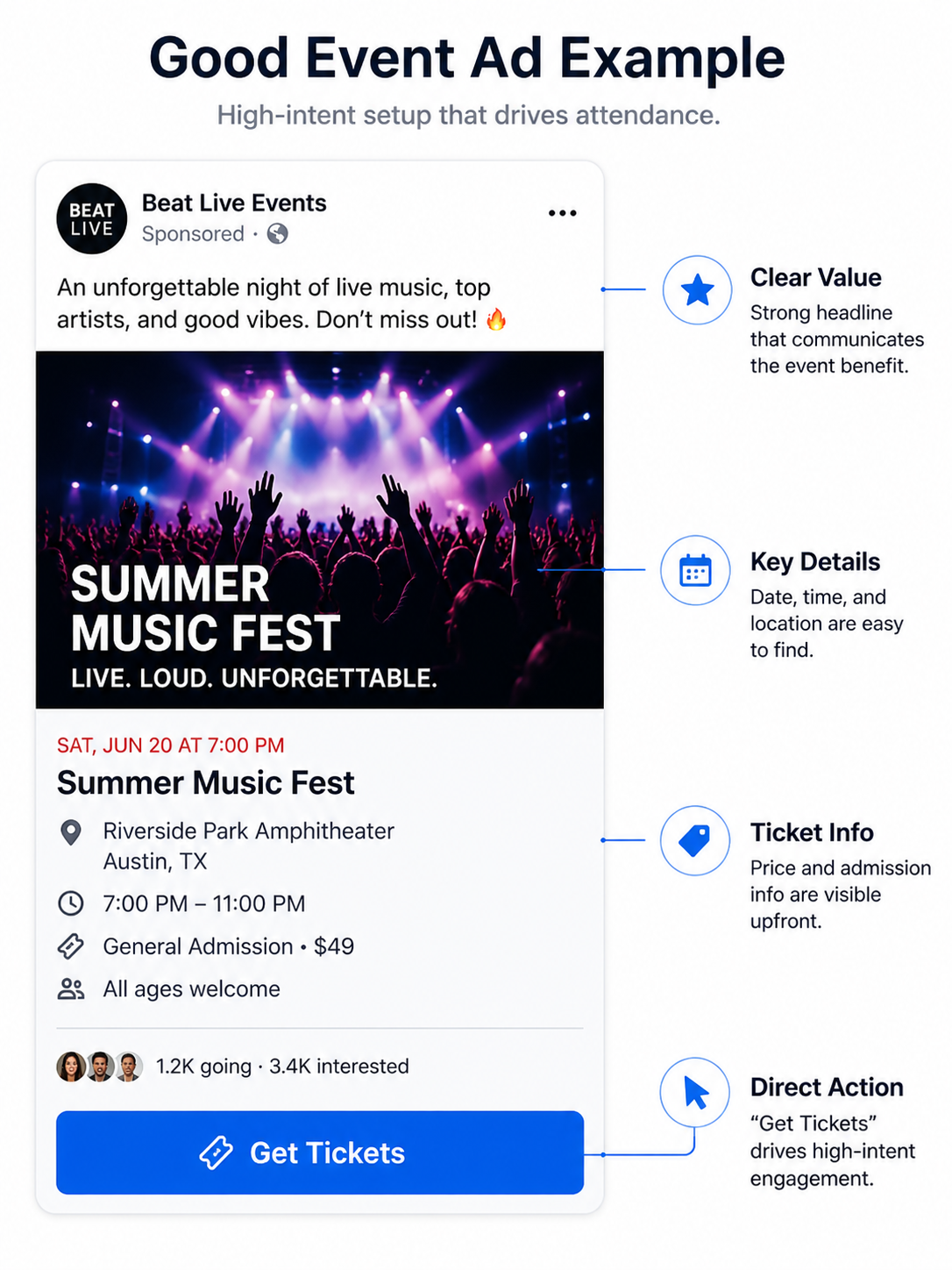
If the event is missing key details, performance drops regardless of targeting or creative. Meta pulls the event title, description, and media directly into the ad.
Common issues include:
- unclear event value or agenda;
- missing ticket or admission details;
- weak visuals or outdated cover image;
- no urgency signals such as limited seats or deadlines.
These problems show up as strong engagement but weak follow-through.
How Advantage+ changes event ad delivery
Meta is gradually introducing Advantage+ elements into more campaign types.
You may see:
- a campaign score indicating optimization completeness;
- automatic placement expansion;
- budget allocation handled at the campaign level.
This shifts control toward algorithmic delivery.
In practice, that means performance becomes harder to evaluate using surface metrics. You need to go deeper and analyze Facebook ad performance beyond CTR and CPC.
Placement behavior — especially Instagram
Event ads behave differently across placements.
Instagram introduces a slightly different intent dynamic. The “Get tickets” button becomes “Buy tickets,” which increases urgency but also raises expectations.
You may notice:
- lower CTR but higher intent on Instagram;
- stronger performance for visual-first events;
- higher drop-off if the event page does not match the ad promise.
Placement breakdowns in Ads Manager often reveal where real conversions come from.
The most common structural mistakes in event ad campaigns
Most issues are not caused by creative. They come from setup decisions.
- Using engagement objective for revenue-driven events. This inflates responses but weakens actual attendance.
- Skipping ticket integration. Without ticket data, Meta cannot optimize toward meaningful outcomes.
- Relying only on the event page for conversion. Users often need more context before committing.
- Ignoring post-click behavior. Engagement does not equal intent.
These mistakes appear early in performance data.
Practical checks before launching an event ad
Before publishing, validate the structure.
- Is your objective aligned with your goal? Awareness events can use engagement; revenue events should focus on ticket actions.
- Does your event page clearly communicate value? Users should understand the benefit immediately.
- Are ticket details properly configured? Missing admission data limits optimization.
- Are you evaluating real outcomes, not just engagement? Event responses are not the final metric.
Final takeaway
Creating a Facebook event ad is simple. Making it perform is not.
Meta will optimize for the easiest signal unless you guide it toward real outcomes. Engagement produces volume. Ticket-focused setups produce intent.
If your campaigns show strong metrics but weak attendance, the issue is not the ad — it is the structure behind it.
Fix that, and performance follows.