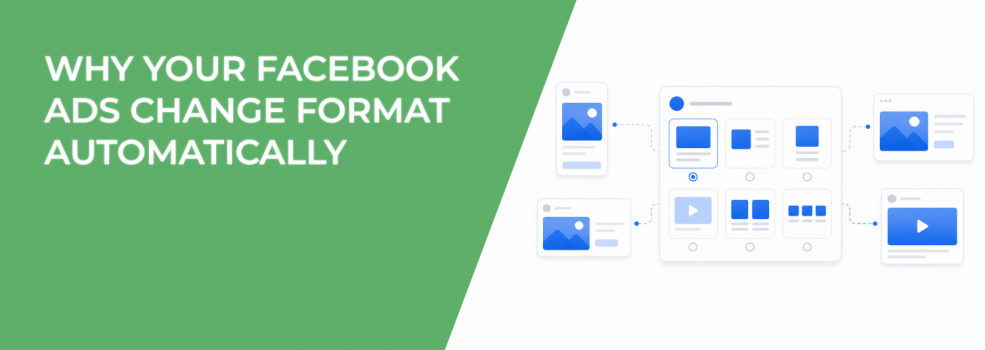
You launch a clean carousel ad. A few days later, you check previews — and it shows as a single image in some placements.
Nothing was edited. No one touched the campaign.
This is format display options at work.
Meta no longer treats format as fixed. Instead, it treats your creative assets as components that can be rearranged depending on where and to whom the ad is shown.
What actually changes when format display options are on
The system does not just resize your ad. It rebuilds it.
If you upload images, videos, or product data, Meta tests different combinations across placements and audiences. These combinations become different formats — even if you selected only one during setup.
- A single image can expand into a collection layout. The system adds supporting elements like products or links if it predicts stronger engagement.
- A carousel can compress into a single frame. This often happens in placements where users scroll faster and engage less with multi-card formats.
- Product-based ads can merge with uploaded media. This creates hybrid formats that look different across feeds.
These changes are not cosmetic. They influence how quickly users understand the ad and whether they take action.
Why Ads Manager metrics start behaving differently
When formats shift, performance patterns shift with them.
You may notice CTR rising without any creative changes. That usually means the system found a simpler format that gets more clicks. At the same time, conversion rate may drop because the simplified version removes context.
Other signals appear quickly:
- CPM fluctuates across placements even with stable targeting;
- frequency increases faster in certain formats;
- engagement spikes without a corresponding lift in conversions;
- spend clusters around specific placements that favor one format.
If you only look at headline metrics, these shifts can look like improvement. Looking deeper tells a different story.
That is why it becomes necessary to analyze Facebook ad performance beyond CTR and CPC instead of relying on surface indicators.
When automation improves delivery — and when it dilutes intent
Format flexibility works well when the message is simple.
If your ad communicates a clear, visual offer — such as a product, discount, or event — Meta can safely adapt the format without breaking the message. In these cases, automation often increases reach and reduces friction.
Problems start when the message depends on structure.
A B2B ad explaining a service, pricing model, or workflow often relies on sequence. If Meta removes steps or rearranges elements, users lose context. This shows up as clicks without follow-through.
In practice, this leads to a familiar situation: the campaign looks active and healthy, but downstream actions slow down.
This pattern overlaps with issues described in why your Facebook ads aren’t generating leads.
Placement behavior quietly drives most format changes
Format variation is tightly linked to placement.
The same ad will not behave the same way in Facebook Feed and Instagram Feed. Meta adapts format based on how users interact in each environment.
You will typically see:
- video formats prioritized in high-engagement feeds;
- simplified image formats in low-attention placements;
- expanded formats where users tend to browse more;
- compressed formats where users scroll quickly.
This explains why performance often differs by placement even when targeting stays identical.
The role of Advantage+ in format reshaping
With Advantage+ systems, format changes become more aggressive.
Meta takes broader control over how assets are combined and displayed. Instead of testing a few variations, the system continuously reshapes ads to match predicted behavior.
This speeds up learning but reduces visibility.
You may see performance improve quickly at the start, followed by volatility as the system shifts formats more aggressively.
Understanding the structure behind Facebook ad formats helps interpret these shifts more accurately.
Where advertisers lose control without realizing it
Most advertisers assume format equals control.
They choose carousel, upload assets, and expect the ad to behave consistently. Format display options break that assumption.
Control is replaced with probability. Meta chooses what it believes will perform best based on past behavior.
Loss of control becomes visible through:
- inconsistent messaging across placements;
- mismatched visuals and copy;
- sudden shifts in engagement quality;
- difficulty replicating winning results.
Practical checks before relying on format display options
Before enabling or scaling with format automation, pressure-test your setup.
- Does your message survive simplification? If removing elements breaks clarity, automation will hurt performance.
- Are your assets consistent across formats? Mixed-quality inputs produce unpredictable outputs.
- Can you isolate placement performance? Without breakdowns, format-driven issues remain hidden.
- Are you optimizing for the right outcome? Click-focused formats often mask conversion issues.
Final takeaway
Format display options turn your creative into a flexible system instead of a fixed asset.
That flexibility helps Meta find cheaper engagement paths. But it can also reshape your message in ways that reduce intent.
If your results change without edits, look at format variation before changing targeting or budget.
The format is often the hidden variable behind both improvement — and decline.