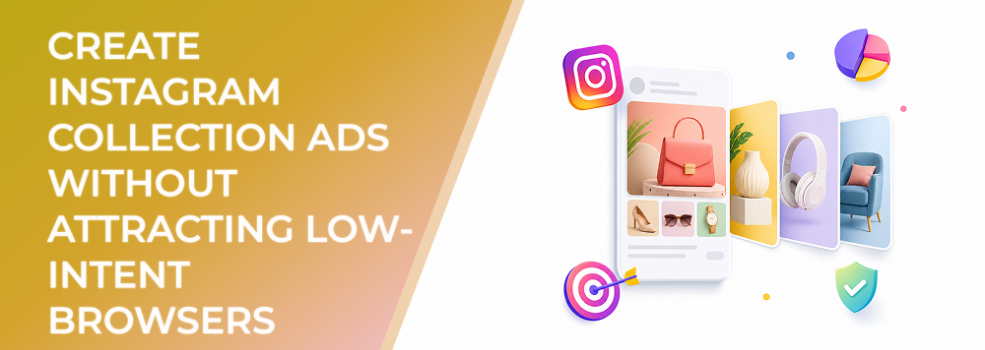
Instagram Collection ads can be powerful because they turn a single ad into a richer browsing experience.
Instead of showing one product, one image, or one video, you can introduce people to a group of products, services, or offers from a more immersive mobile format. That is useful for ecommerce brands, agencies, affiliate marketers, and any advertiser trying to move users from discovery to consideration faster.
The risk is that Collection ads can also attract low-intent browsers. Users may tap because the format looks engaging, not because they are ready to buy, request a quote, book a demo, or become a qualified lead.
That is where advertisers need to think beyond the format itself.
What Instagram Collection Ads Actually Solve
Collection ads are designed for discovery.
They work best when users need to see more than one item, angle, benefit, or offer before they understand why your product is relevant. For example, a single image might not fully explain a product line, but a Collection ad can show a hero visual plus supporting products or options.
This creates a smoother path from interest to exploration.
For performance marketers, the opportunity is clear: reduce the gap between attention and action. Instead of sending users from a cold ad directly to a complex website, a Collection ad can create a faster browsing step that feels native to Instagram.
But the format does not automatically create intent.
If the wrong people see the ad, the experience becomes expensive window shopping.
Why Collection Ads Can Help or Hurt Performance
Collection ads affect campaign performance in two major ways: how users engage before the click and how qualified they are after the click.
When the format works well, it can improve product discovery, reduce friction, and help users evaluate multiple options before visiting a landing page or taking the next action. That can support stronger conversion rates and better ROAS.
When the format is misused, it can create the opposite pattern:
- High engagement but weak purchase behavior.
- Strong tap volume but poor add-to-cart or lead quality.
- Lower CPC but higher CPA.
- More browsing activity without enough qualified conversions.
The issue is not that Collection ads are weak. The issue is that they are easy to use for the wrong audience.
A visually attractive format shown to a broad, low-intent segment can spend budget quickly without producing meaningful business results.
Typical Scenarios Where Instagram Collection Ads Make Sense
Ecommerce Product Discovery
Collection ads are a natural fit for ecommerce brands promoting product sets, seasonal drops, category pages, bundles, or bestsellers.
They work especially well when users benefit from seeing multiple options before deciding.
Retargeting Warm Shoppers
If users have already visited your website, engaged with your Instagram profile, viewed product content, or interacted with a campaign, Collection ads can help bring them back with a more complete offer.
This is often a better use case than cold prospecting because the user already has some context.
Creator or Influencer-Based Campaigns
If your brand is connected to a creator campaign, Collection ads can extend that discovery path. A hero creative can frame the influencer angle while the product grid supports purchase consideration.
Multi-Offer Lead Generation
Collection ads are not only for physical products. Service businesses can use the format to show packages, use cases, industries served, or different entry points into a funnel.
The key is to make the user’s next step obvious.
Business Impact on CPC, CPA, CAC, and ROAS
Collection ads often create more interaction because the format invites exploration.
That can help lower friction and improve engagement metrics. But performance marketers should not judge Collection ads only by CTR, CPC, or tap volume.
The real question is whether the additional engagement improves business efficiency.
A good Collection ad should support:
- Better conversion rate from qualified users.
- Lower CPA from warm or high-intent audiences.
- Stronger ROAS when product selection is relevant.
- Lower wasted spend by helping users self-select before clicking deeper.
- Better lead quality when the collection explains the offer clearly.
A weak Collection ad usually produces the reverse: attractive engagement metrics with poor downstream results.
If CAC rises after launching Collection ads, the first thing to check is whether the audience is too broad, the product set is too unfocused, or the ad is optimized around browsing instead of buying intent.
Risks and Considerations
Collection Ads Can Reward Curiosity Instead of Intent
A user may tap because the layout is visually interesting. That does not mean they are ready to purchase or become a lead.
This matters when you evaluate CPC. A cheap click or tap is not useful if it creates low-quality sessions.
Product Selection Can Dilute the Offer
If the collection includes too many unrelated items, users lose the thread. The format should help people understand the offer faster, not create more choice fatigue.
Creative and Catalog Quality Matter
A strong cover image or video gets attention, but the supporting items must reinforce the message. If the cover promises one thing and the products show another, conversion quality drops.
Placement Behavior Can Change Results
Instagram Feed, Stories, Explore, and other placements do not behave the same way. A Collection ad that performs well in one environment may generate weaker intent in another.
Broad Audiences Can Waste Budget Quickly
Because Collection ads invite browsing, weak audience targeting can produce a lot of activity with limited commercial value.
Prerequisites and Dependencies
Before using Instagram Collection ads, advertisers should have:
- A clear campaign objective tied to business outcomes.
- A connected Instagram presence and Meta ad account.
- Strong cover creative that communicates the main offer quickly.
- A focused product set, service set, or offer structure.
- A clear destination or next step after the collection experience.
- Enough creative variation to test without changing too many variables at once.
- A performance measurement plan beyond CTR and CPC.
- A defined audience strategy.
That last point is critical. Collection ads need relevant users. Without them, the format can hide audience weakness behind attractive engagement.
How LeadEnforce Helps
LeadEnforce helps advertisers improve the audience input behind Instagram Collection ads.
Instead of relying only on broad interests or automated expansion, marketers can build more relevant custom audiences from sources such as Instagram followers, Instagram engagers, Facebook groups, LinkedIn professional data, and custom social-profile data.
That matters because Collection ads perform better when users already recognize the problem, category, brand type, creator, competitor, or use case.
For example, an ecommerce brand can build audiences from followers of relevant Instagram profiles. A B2B advertiser can layer professional data around a specific industry. An affiliate marketer can target users already engaging with niche communities related to the offer.
LeadEnforce does not replace creative strategy or campaign testing. It improves the quality of the audience pool so the test is less dependent on guesswork.
Practical Recommendations
Start With a Narrow Product or Offer Theme
Do not use Collection ads as a dumping ground for every product.
Pick one theme: bestsellers, new arrivals, problem-based bundles, industry-specific solutions, or creator-recommended products.
The tighter the theme, the easier it is for users to understand the value.
Use the Cover Creative to Frame the Decision
Your cover image or video should not just look good. It should explain why the user should browse.
Good cover creative answers one of these questions:
- What problem does this solve?
- Who is this for?
- Why should I care now?
- What makes this product set different?
Build Audiences Around Real Signals
Use higher-intent audience sources before scaling to broader audiences.
Start with users connected to relevant Instagram accounts, Facebook groups, niche communities, competitor profiles, or professional segments. This makes Collection ad engagement more meaningful.
Separate Prospecting and Retargeting
Cold users and warm users need different collection structures.
Cold audiences usually need education and context. Warm users can handle more direct product selection, pricing cues, or offer-led messaging.
Monitor Post-Click Quality
Do not stop at CTR or CPC.
Review product views, landing page behavior, add-to-cart rate, purchase rate, qualified lead rate, booked call rate, and ROAS. If users browse but do not progress, the campaign may be attracting curiosity instead of intent.
Test Placement Performance
Check whether spend is concentrating in placements that produce weak downstream results.
If a placement delivers cheap engagement but poor conversion quality, consider adapting creative for that placement or tightening the audience.
Final Takeaway
Instagram Collection ads are useful when you need to turn visual discovery into structured consideration.
They are risky when used as a broad-reach engagement format without enough audience quality, product focus, or post-click measurement.
The best results come from combining strong collection structure with high-intent audience inputs, then judging performance by CPA, CAC, ROAS, and lead quality instead of surface engagement.
Join the free 7-day LeadEnforce trial period to test higher-intent audiences for your next Instagram Collection ad campaign.
Related LeadEnforce Articles
- Meta Ad Formats: Choose the Right Format for Results — Explains how ad formats affect delivery, CPC, CPA, and lead quality.
- Carousel, Collection, or Reels? Choosing the Best Meta Ad Format for Your Product — Directly compares Collection ads with other Meta formats.
- Meta Asset Customization for Placements: Improve CPA and ROAS — Helps advertisers adapt creative assets for stronger placement performance.
- Ways to Advertise on Instagram (And Which One Actually Scales) — Covers Instagram ad creation paths and why Ads Manager offers more performance control.
- How Much Do Instagram Ads Cost? — Useful for understanding how audience, auction pressure, and ad relevance affect Instagram ad costs.