If you’re running Facebook campaigns long enough, performance will eventually decline. CTR drops. CPM rises. CPA creeps up. Frequency increases quietly in the background.
At that point, many advertisers assume something is broken. Most of the time, it isn’t. It’s creative fatigue.
Creative fatigue is not just “people are bored of your ad.” It’s a signal decay issue inside an auction system. If you treat it as a cosmetic refresh problem instead of a structural one, you’ll keep swapping visuals without restoring performance stability.
Let’s unpack what’s actually happening — and how to fix it properly.
What Creative Fatigue Actually Means
Creative fatigue occurs when the incremental probability of response declines after repeated exposure within a defined audience.
That definition matters.
Fatigue is not:
-
A fixed frequency threshold, such as “3 impressions and you’re done,” because different audiences tolerate repetition differently.
-
A time rule, such as “replace ads every 14 days,” since some creatives last months in broad pools.
-
A design flaw by default, because strong visuals still decay if distribution is narrow.
It’s a diminishing marginal return problem.
On the first exposure, novelty drives attention. On the second or third exposure, response depends on whether the ad still offers new cognitive value. Once the message is fully processed, incremental engagement probability declines.
Meta’s system detects that shift through engagement signals. As response weakens:
-
Estimated Action Rate decreases, which reduces auction competitiveness.
-
CPM increases, because lower predicted response requires stronger bidding to win impressions.
-
CPA rises, because more impressions are required to produce the same number of conversions.
If you want a tight explanation of why CPM often rises before conversions drop, see: What Influences CPM on Facebook Ads (and How to Keep It Low).
The Mechanism Behind Creative Decay
Most advertisers think repetition alone causes fatigue. Repetition accelerates it, but it is rarely the root cause.
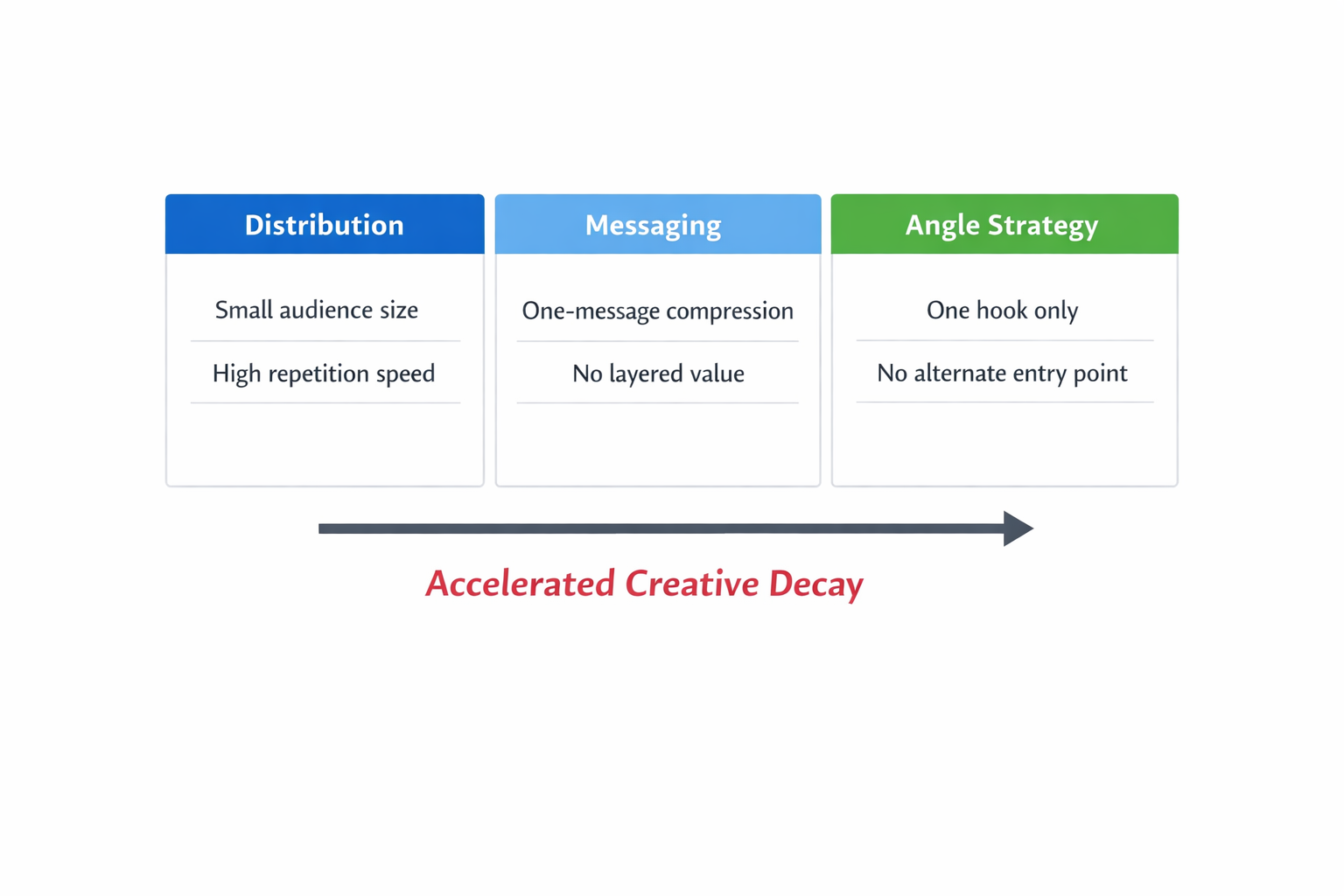
Fatigue compounds when three structural conditions exist.
1. Audience Saturation.
When your audience pool is small, repetition accelerates. For example, spending aggressively against 30,000 people can push frequency beyond 3 within days. As frequency increases, novelty disappears faster.
Broad audiences distribute impressions across a larger pool, which slows decay. This is why fatigue appears faster in tight interest stacks or narrow lookalikes.
If you suspect your audience is simply too constrained to carry your spend, read: Does Audience Size Matter in Facebook Ads? How It Affects Delivery and Cost.
2. Message Compression.
If your creative communicates everything in a single exposure, it has no layered depth. Ads that present the full pitch immediately often burn out faster.
Layered messaging extends lifespan. When each exposure adds incremental context — problem framing, mechanism explanation, objection handling — novelty lasts longer.
3. Single-Angle Dependence.
If every creative uses the same hook, the same framing, and the same promise, the campaign becomes structurally fragile. Once that angle fatigues, the entire ad set declines.
Angle diversification protects performance. When one psychological entry point weakens, another can absorb delivery.
Also, be careful not to confuse “more variations” with “more angles.” Too many near-duplicates can speed up fatigue by creating repetition under different skins. This is covered well here: Creative Clutter: How Too Many Variations Hurt Facebook Ad Performance.
How to Diagnose Creative Fatigue Properly
Before rotating assets, confirm that fatigue is the actual issue. Many advertisers misdiagnose tracking issues, offer misalignment, or funnel problems as creative burnout.
Look for pattern-based evidence.
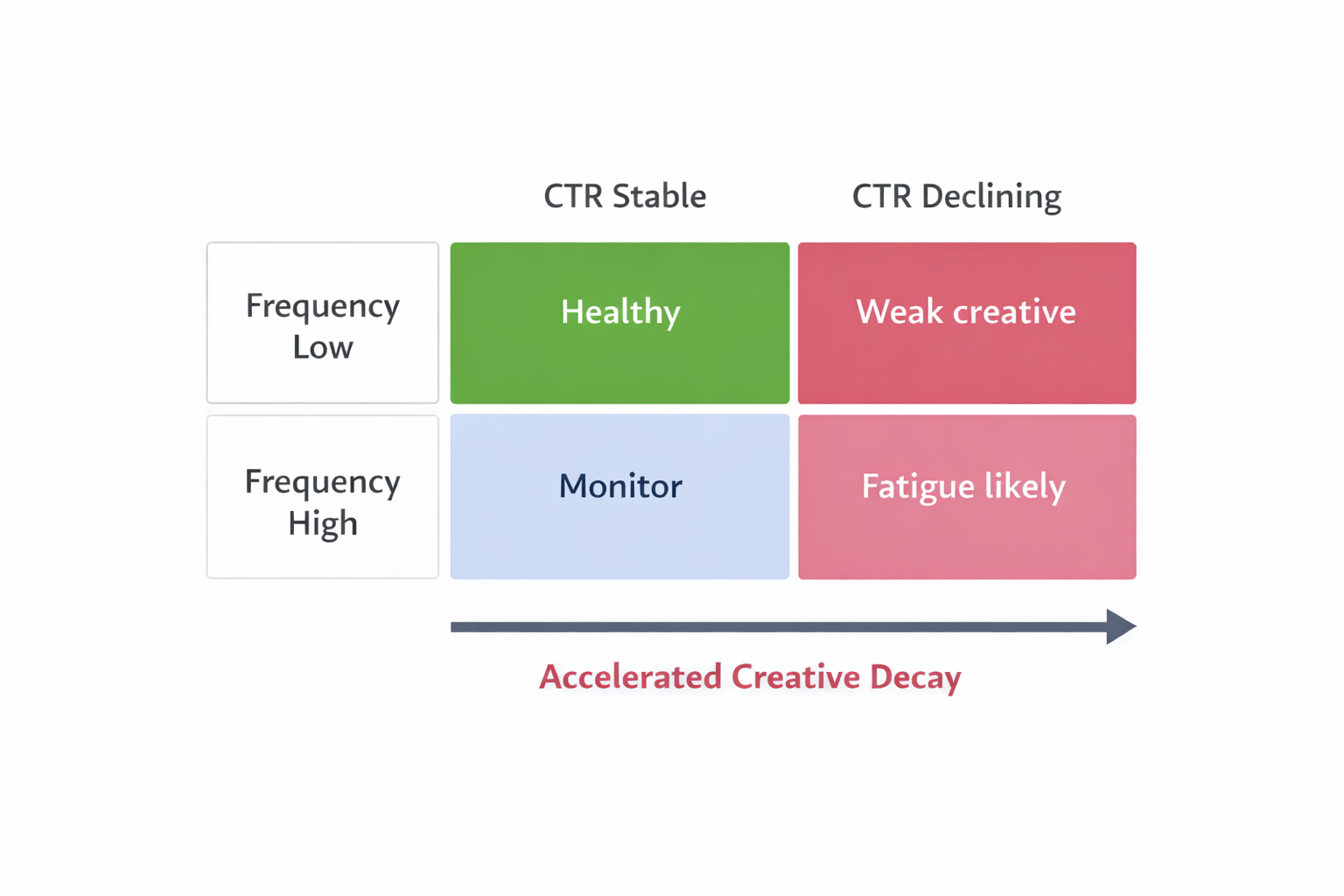
1. Rising Frequency Combined with Declining CTR.
If frequency steadily increases while CTR consistently decreases, you are likely experiencing saturation. For example:
-
Frequency rises from 1.8 to 3.2 over two weeks, which means the same people are absorbing most delivery.
-
CTR drops from 1.4% to 0.9% over the same period, which suggests the ad is no longer producing incremental curiosity.
-
Spend remains stable, which rules out simple “budget shock” as the driver.
That combination strongly indicates declining novelty within a fixed exposure pool.
2. Increasing CPM Without Structural Changes.
If targeting, budget, and placements remain unchanged but CPM climbs, engagement signals may be weakening. Lower predicted response reduces auction efficiency.
3. Stable CTR, Falling Conversion Rate.
If hook rate and CTR remain strong but conversion rate declines, the problem may be post-click misalignment rather than fatigue. In that case:
-
The creative still captures attention, which means the first half of the system still works.
-
The landing page may no longer match expectations, which increases bounce and reduces intent carryover.
-
Offer-market fit may have shifted, especially if competitors changed pricing or positioning.
Rotating creative would not solve that problem.
Why Random Creative Rotation Makes Things Worse
Many advertisers rotate creatives every 7–14 days as a rule.
That approach often increases volatility.
Constant rotation:
-
Resets learning signals, which makes delivery less stable.
-
Splits budget across too many “new” objects, which slows optimization.
-
Turns creative into a calendar exercise instead of a performance system.
Fatigue management is not about constant replacement. It’s about structured diversification.
The Structural Fix: Build Creative Depth
Instead of asking, “What new ad should I design?” ask, “What structural angle am I missing?”
Here is a more stable approach.
1. Develop Multiple Strategic Angles Per Offer.
Do not produce five cosmetic variations of the same message. Instead, build three distinct strategic angles, such as:
-
Problem-aware framing, which names the friction clearly and makes the reader feel understood (e.g., “If you’re scaling but CPA drifts up every week…”).
-
Outcome-driven framing, which anchors on the target state (e.g., “Predictable CPA at higher spend, without constant resets.”).
-
Mechanism-focused framing, which explains why your approach works differently (e.g., “Here’s what we changed in the system, not just the ad.”).
Each activates a different psychological pathway. When one fatigues, the system can shift delivery without collapsing overall performance.
2. Layer Information Across Creatives.
Avoid compressing your full sales argument into one ad. A stronger approach is sequencing value across creatives:
-
One creative introduces the core friction or problem context, so the user instantly self-identifies.
-
Another explains the mechanism or differentiator, so curiosity turns into comprehension.
-
A third addresses objections (time, price, complexity), so hesitation has fewer places to hide.
-
A fourth reinforces proof (results, constraints, process), so “maybe” becomes “worth trying.”
3. Expand Distribution Before Replacing Creative.
If performance declines and frequency is high, test audience expansion before replacing assets. You can:
-
Broaden interest clusters, while keeping one clear angle to avoid muddy learnings.
-
Increase lookalike percentage ranges, while monitoring lead quality and down-funnel signals.
-
Remove unnecessary exclusions, especially if you’re choking reach in the name of “clean targeting.”
Often the creative is not fatigued globally. It is fatigued inside a narrow pool.
When You Actually Should Replace Creative
There are situations where full replacement is justified.
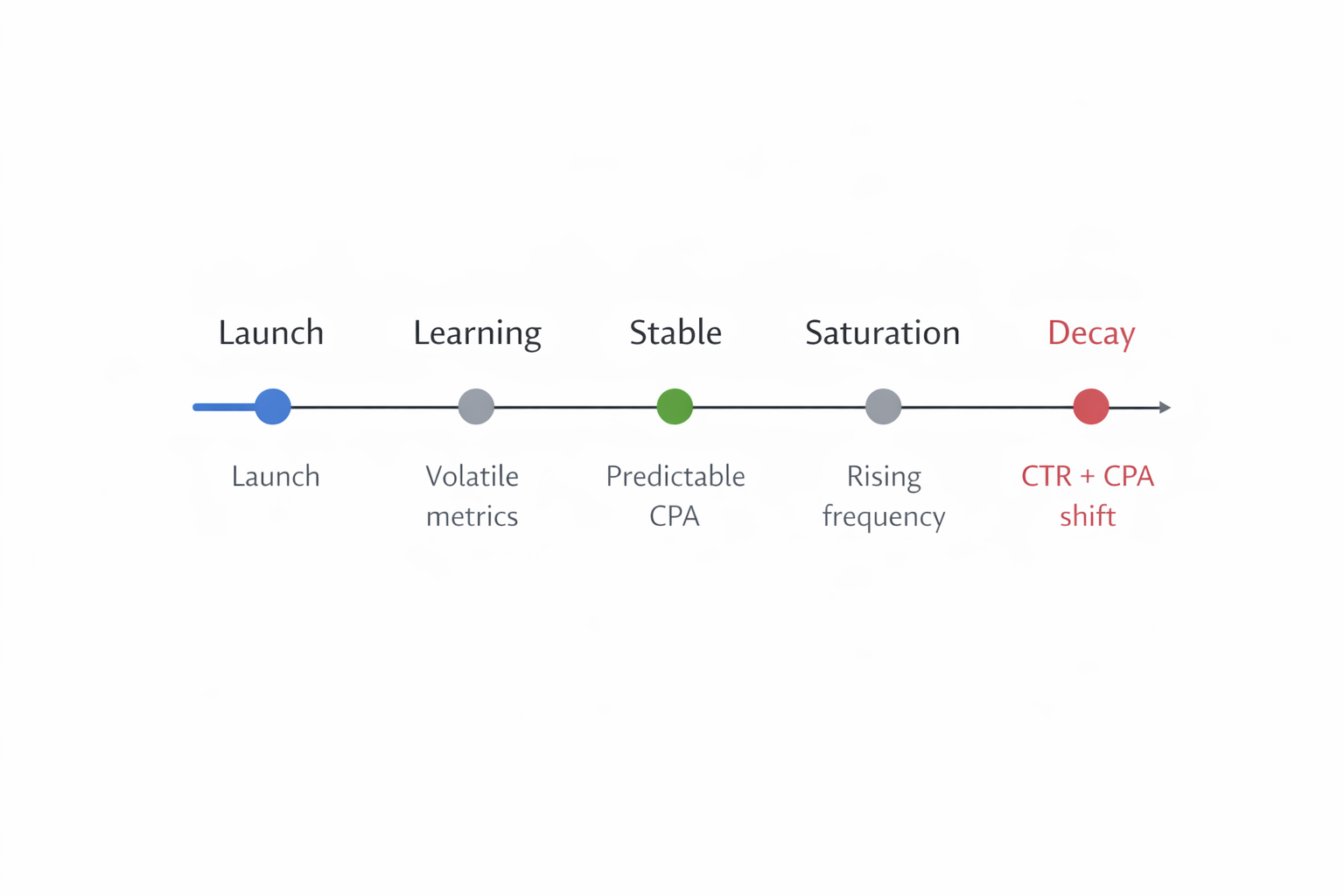
Replace or rebuild when:
-
CTR declines consistently across expanded audiences, not just one tight segment.
-
Hook rate collapses within 48–72 hours of launch, indicating weak resonance.
-
Conversion rate deteriorates despite stable traffic quality and offer consistency.
-
Engagement drops across placements simultaneously, suggesting message decay rather than distribution saturation.
If you want a clean benchmark for “how long to let it run” before judging, use: The Lifecycle of a Facebook Ad: How Long Should You Let It Run?.
When replacing creative, do not change colors and keep the same hook. Change the angle. Change the claim structure. Change what the audience learns in the first second.
Managing Fatigue in Retargeting
Retargeting audiences are inherently smaller, so fatigue accelerates faster.
To stabilize retargeting:
-
Segment audiences by intent depth (e.g., viewed product vs added to cart), so messaging matches awareness and urgency.
-
Rotate objection-handling creatives, not just offers, because warm users usually stall on uncertainty, not curiosity.
-
Apply frequency caps strategically when impression volume is high, especially in short windows.
-
Refresh messaging cadence based on your retargeting window (7-day buyers need different repetition than 30-day buyers).
If you repeat the same message to someone who already evaluated your offer, engagement drops quickly.
Retargeting fatigue is usually messaging redundancy, not design failure.
Creative Fatigue Is a Signal, Not a Crisis
Performance decline does not mean your campaign is broken. It means the current signal has been priced into the auction.
Fatigue becomes destructive only when your campaign relies on:
-
A single audience pool, with no capacity buffer.
-
A single messaging angle, with no alternative entry point.
-
A single creative theme, repeated across formats.
-
Constant resets, which prevent stable optimization.
When you design campaigns with layered angles, diversified messaging, and controlled audience saturation, fatigue shifts delivery rather than collapses performance.
The goal is not to eliminate fatigue. It is to build a system that absorbs it.