
High-margin products should drive your growth strategy—but identifying and prioritizing them at scale is rarely straightforward. Meta Value Rules provide a structured way to score, segment, and elevate the products that generate the highest contribution to profit.
Introduction: Why Margin-Based Prioritization Matters
Revenue growth alone does not guarantee profitability. According to a McKinsey study, companies that actively manage gross margin through analytics-driven pricing and assortment strategies can increase operating profit by 2–7% within 12 months. Meanwhile, research from Bain & Company shows that a 5% increase in price can lift profits by 20–30% in many industries, assuming volume remains stable.
Yet many organizations still prioritize products based on sales volume rather than contribution margin. The result: operational complexity, inventory pressure, and marketing spend allocated to low-return SKUs.
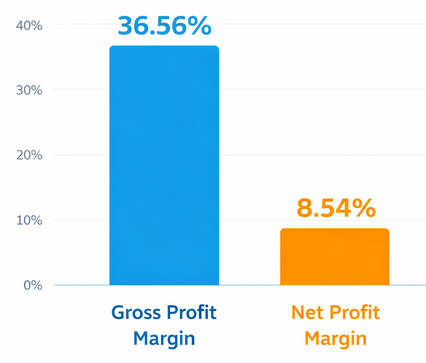
Comparison of Average Gross and Net Profit Margins Across Industries (Gross Margin vs. Net Margin)”
Meta Value Rules solve this problem by applying a consistent logic layer over product data—automatically identifying high-margin, high-impact items and elevating them across sales, marketing, and operational workflows.
What Are Meta Value Rules?
Meta Value Rules are structured, conditional scoring frameworks that assign priority levels to products based on predefined metrics. Rather than looking at a single indicator (e.g., gross margin), these rules combine multiple variables to calculate composite value.
Typical inputs include:
-
Gross margin percentage
-
Contribution margin
-
Customer acquisition cost (CAC)
-
Inventory turnover
-
Return rate
-
Customer lifetime value (CLV)
-
Sales velocity
-
Cross-sell or upsell attachment rate
A Meta Value Rule engine evaluates these inputs and assigns a tier (e.g., "Priority A," "Growth Focus," "Maintain," or "Deprioritize").
Step 1: Define What "High-Margin" Actually Means
High margin is contextual. A 40% margin may be strong in retail but average in software. Begin by establishing:
-
Baseline gross margin across your catalog
-
Target margin threshold (e.g., top 25% of SKUs)
-
Contribution margin after marketing and operational costs
For example:
-
If median gross margin = 32%
-
Top quartile margin = 48%+
You might define "High-Margin" as any SKU above 45% gross margin AND with positive contribution margin after CAC.
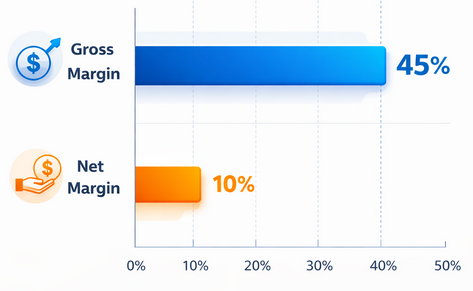
Average Gross and Net Profit Margins for eCommerce Businesses
This dual condition prevents prioritizing products that appear profitable but consume excessive marketing budget.
Step 2: Build a Multi-Factor Scoring Model
Margin alone is insufficient. A product with 60% margin but low demand may not warrant heavy prioritization.
A weighted model typically improves accuracy. Example weighting structure:
-
Gross Margin: 35%
-
Sales Velocity: 20%
-
Inventory Turnover: 15%
-
CLV Impact: 15%
-
Return Rate (inverse): 10%
-
Cross-Sell Rate: 5%
Each metric is normalized on a 0–100 scale. The weighted sum generates a Meta Value Score.
Products above 75 = Tier 1
Products 60–74 = Tier 2
Products below 60 = Tier 3
This structure ensures that profitability, demand, and operational efficiency are all considered.
Step 3: Segment by Contribution Margin, Not Just Gross Margin
Gross margin ignores marketing spend and operational overhead. Contribution margin provides a more realistic profitability view.
Formula:
Contribution Margin = Revenue − Variable Costs − Marketing Costs
In performance-driven environments, up to 30–50% of revenue may be reinvested into acquisition. A product with 50% gross margin and 40% marketing cost has only 10% contribution margin.
Meta Value Rules should automatically downgrade products where:
-
CAC exceeds threshold
-
Paid traffic dependency is high
-
Return rates erode profitability
This protects your margin structure from hidden cost leakage.
Step 4: Integrate Inventory Intelligence
According to IHL Group, global retailers lose over $1 trillion annually due to stockouts and overstocks combined. Prioritizing high-margin products without inventory alignment creates friction.
Meta Value Rules should include:
-
Inventory turnover ratio
-
Days of stock remaining
-
Supply chain lead time
Example rule:
IF Margin > 45% AND Sales Velocity > Median AND Days of Inventory < 45 → Increase replenishment priority
Conversely:
IF Margin > 45% BUT Sales Velocity < Bottom 30% → Limit marketing allocation
This ensures operational efficiency aligns with profitability objectives.
Step 5: Align Sales and Marketing Around High-Margin SKUs
Once Tier 1 products are identified, activation is critical:
-
Prioritize them in paid campaigns
-
Feature them in outbound sales sequences
-
Highlight them in email promotions
-
Position them as default upsell options
According to HubSpot research, personalized product recommendations can increase revenue by up to 20%. When these recommendations prioritize high-margin products, the profitability multiplier compounds.
Meta Value Rules enable dynamic product feeds and sales scripts to automatically emphasize the most profitable items.
Step 6: Automate Ongoing Recalibration
Market conditions shift. Supplier pricing changes. Customer behavior evolves.
Meta Value Rules should update automatically on a weekly or monthly cadence using fresh data inputs. Key triggers for recalibration include:
-
Margin fluctuation > 5%
-
CAC increase > 10%
-
Return rate spike
-
Inventory imbalance
Automation prevents manual bias and ensures that product prioritization remains performance-driven.
Common Pitfalls to Avoid
-
Overweighting revenue instead of profit
-
Ignoring marketing cost variability
-
Failing to normalize metrics
-
Allowing static thresholds to persist too long
-
Neglecting operational constraints
A disciplined scoring framework eliminates subjective decision-making and replaces it with measurable criteria.
Strategic Impact of Meta Value Rules
Organizations that prioritize high-margin SKUs systematically typically observe:
-
Improved blended gross margin
-
Reduced marketing waste
-
Faster inventory turnover
-
Higher average order value
-
Increased EBITDA stability
Even a 2–3% improvement in blended margin can significantly impact enterprise valuation, particularly in capital-intensive sectors.
Implementation Framework Summary
-
Define contextual high-margin thresholds
-
Incorporate contribution margin analysis
-
Build a weighted multi-factor score
-
Integrate inventory and demand data
-
Activate through sales and marketing workflows
-
Automate recalibration cycles
When executed correctly, Meta Value Rules transform product prioritization from reactive decision-making into a strategic, data-governed system.
Further Reading
To deepen your understanding of data-driven prioritization and segmentation, consider exploring:
By applying structured Meta Value Rules, organizations can ensure that growth efforts concentrate on products that not only sell—but generate meaningful profit and sustainable competitive advantage.