Many Facebook advertisers switch to video because they assume Meta prefers it.
That usually creates a new problem.
Some offers perform far better with static creative. Others struggle badly without motion. When advertisers use the wrong format, campaigns often suffer from weak CTR, rising CPA, and inconsistent conversion quality.
The issue is not whether video is “better.”
The issue is whether the offer needs movement to be understood.
Why Advertisers Misuse Video in Facebook Ads
Many brands use video for products that do not require explanation.
A simple clothing promotion, discount offer, or product launch can often perform perfectly with a strong image and headline. Adding unnecessary video sometimes slows communication instead of improving it.
At the same time, advertisers regularly force complex offers into static ads that cannot explain the value clearly enough.
This usually happens with:
- SaaS products;
- AI tools;
- financial services;
- fitness systems.
Users see the ad but do not fully understand the product before scrolling away.
That weakens engagement signals early in the campaign. Over time, Meta reduces delivery efficiency because users are not interacting with the creative strongly enough.
The Main Problem Video Solves
Video works best when the audience needs context before clicking.
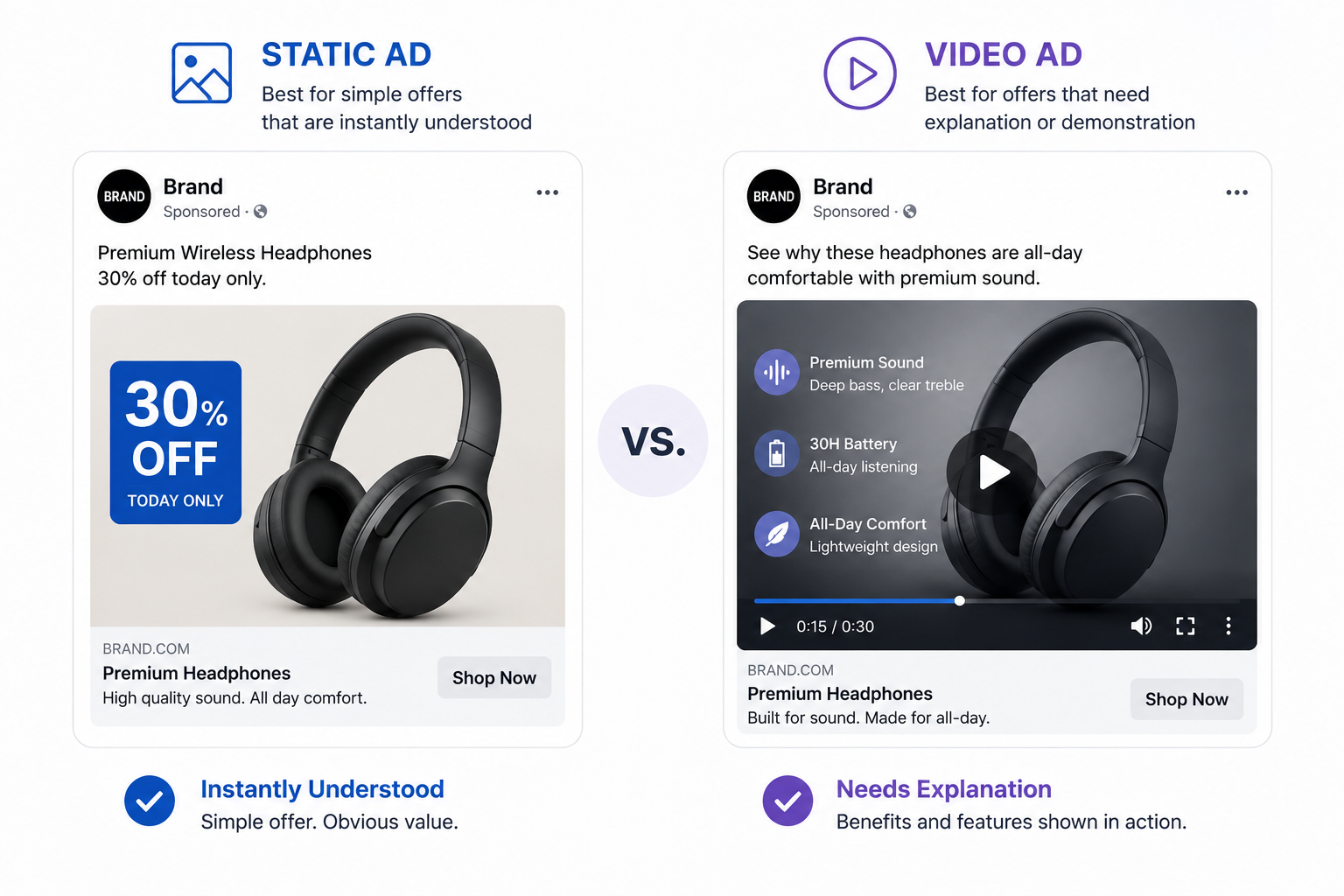
Motion helps explain:
- how a product works;
- what changes after using it;
- why the process feels easier;
- what the transformation looks like.
That clarity matters because Facebook and Instagram feeds move extremely fast.
Users rarely stop to “figure out” an ad themselves. If the offer feels confusing, they keep scrolling.
This is why advertisers should focus on choosing the right Facebook ad format for each funnel stage instead of defaulting to one creative style.
When Video Usually Improves Performance
Video tends to perform better when:
- the product requires demonstration;
- the workflow needs explanation;
- the audience is unfamiliar with the category;
- trust must be built before conversion.
This is especially common in B2B lead generation campaigns.
For example, a static screenshot of a targeting dashboard rarely explains why lead quality improves. A short walkthrough showing audience filtering or engagement segmentation communicates the value much faster.
For LeadEnforce campaigns, motion can help demonstrate how advertisers build high-intent audiences using Facebook groups, Instagram followers, and engagement signals. That process is much easier to understand through movement than through a single static frame.
When Static Creative Works Better
Static creative still performs extremely well for simple offers.
In many cases, static ads outperform video because they communicate instantly. Users do not need to wait for information to unfold.
Static ads often work best for:
- impulse purchases;
- product discounts;
- visually obvious products;
- retargeting campaigns.
This is important because many advertisers damage performance by overcomplicating simple offers with unnecessary video production.
The goal is not to use more motion.
The goal is to reduce friction before the click.
Why Weak Video Creative Hurts Results
Poorly structured video ads often create curiosity instead of buying intent.
Common problems include:
- slow intros;
- generic stock footage;
- weak pacing;
- branding before the value proposition.
These ads may generate views while hurting conversion quality.
That is one reason many advertisers experience why Facebook ads get clicks but no sales. The creative attracts attention without clearly qualifying the audience.
Better video ads focus on clarity instead of entertainment.
In many cases, small visual improvements are enough. Simple edits, transitions, and movement cues can improve engagement without expensive production. Many advertisers improve performance by using motion graphics to improve Facebook ad engagement.
Final Takeaway
Facebook ad creative performs better when the format matches the complexity of the offer.
Static ads work best when the value is obvious immediately. Video works best when the audience needs explanation before clicking.
The mistake is assuming video automatically improves performance.
When advertisers understand when motion actually helps communication, campaigns usually generate:
- stronger engagement;
- lower CPA;
- better conversion quality;
- more stable scaling performance.
The best format is the one that explains the offer with the least friction possible.