Many advertisers assume Facebook video ads automatically perform better than static creative.
That assumption quietly wastes budget.
The format itself is rarely the real advantage. What matters is whether the creative helps users understand the offer fast enough to take action.
The Real Problem: Advertisers Use Video for the Wrong Reasons
A lot of Facebook campaigns switch to video because competitors use video or because Meta pushes video placements heavily.
That creates a common performance issue.
Advertisers end up running:
- slow explainer videos for simple offers;
- static images for products that require demonstration;
- expensive creative that adds motion without clarity.
The result is usually the same:
- weak CTR;
- unstable CPA;
- poor conversion quality;
- higher acquisition costs during scaling.
In many cases, the problem is not targeting or bidding. The creative format simply does not match the complexity of the offer.
Why Static Ads Sometimes Lower CPA Faster
Static ads work best when users understand the value immediately.
That speed matters because Facebook and Instagram feeds reward fast attention and quick decision-making.
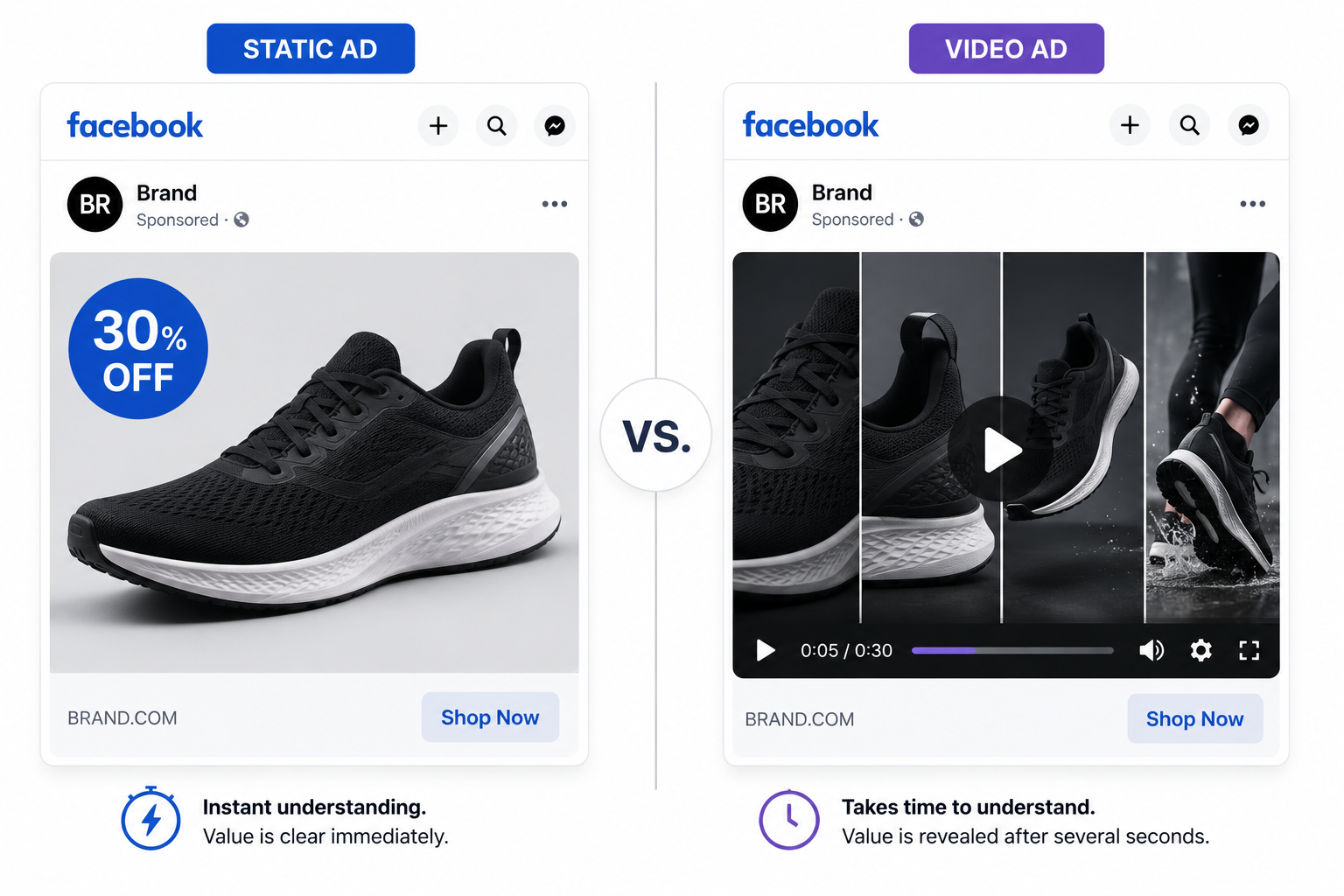
Static creative often performs better for:
- discounts;
- flash offers;
- impulse purchases;
- visually obvious products.
A single image with strong copy can communicate the value before the user scrolls away.
Static ads also make creative testing faster. Advertisers can launch more variations quickly, identify winners faster, and stabilize campaigns without expensive production cycles.
This is especially useful for e-commerce brands optimizing aggressively for CPA.
Why Video Ads Sometimes Convert Better
Video becomes more important when the offer needs explanation before the click.
This usually happens when:
- the product solves a process problem;
- the workflow feels unfamiliar;
- the transformation needs demonstration;
- the audience requires more trust before converting.
A static image may create curiosity, but motion explains the mechanism.
For example, a B2B targeting platform may struggle with a single dashboard screenshot because users cannot immediately understand how the system improves lead quality.
A short walkthrough showing audience filtering or workflow simplification often communicates the value much faster.
That is why advertisers should think carefully about choosing the right Facebook ad format for each funnel stage instead of defaulting to one format.
Why the Wrong Format Raises CPA
Meta optimization depends heavily on user behavior.
If users hesitate because the ad feels confusing, the platform receives weaker signals early in the campaign.
That affects:
- engagement quality;
- click intent;
- conversion probability;
- delivery efficiency.
For example, a simple product promotion may perform worse with video because users must wait several seconds before understanding the offer.
At the same time, complex products often fail with static creative because the value never becomes clear enough to justify the click.
This is one reason advertisers constantly debate what impacts Facebook CPA the most. Creative format influences acquisition costs far more than many advertisers realize.
How to Know When Video Actually Makes Sense
Video usually performs best when explanation matters more than speed.
That includes:
- SaaS tools;
- AI products;
- financial services;
- fitness systems;
- B2B lead generation offers.
For LeadEnforce campaigns, motion can visually demonstrate how advertisers build audiences from Facebook groups, Instagram followers, and engagement signals. That process is easier to understand through movement than through a single static graphic.
Meanwhile, a simple discount campaign or product launch may convert faster with static creative because users already understand the value instantly.
The format should reduce friction, not create more of it.
Why Many Facebook Video Ads Still Underperform
Video alone does not improve results.
Many Facebook video ads fail because advertisers focus on production quality instead of communication clarity.
Common problems include:
- slow intros;
- generic stock footage;
- excessive transitions;
- branding before the offer.
These videos often attract attention without improving buying intent.
That creates misleading engagement data and higher CPA over time.
In many cases, lightweight edits perform better than expensive production. Small visual changes, pacing improvements, and motion cues are often enough. Many advertisers improve results by using motion graphics to improve Facebook ad engagement.
Final Takeaway
Static and video Facebook ads solve different performance problems.
Static ads reduce friction when the offer is already easy to understand. Video reduces friction when users need explanation before clicking.
The mistake is treating one format as universally better.
When advertisers match creative format to offer complexity, campaigns usually generate:
- stronger engagement signals;
- lower CPA;
- cleaner conversion paths;
- more stable scaling performance.
The best-performing Facebook ads are usually the easiest to understand quickly.