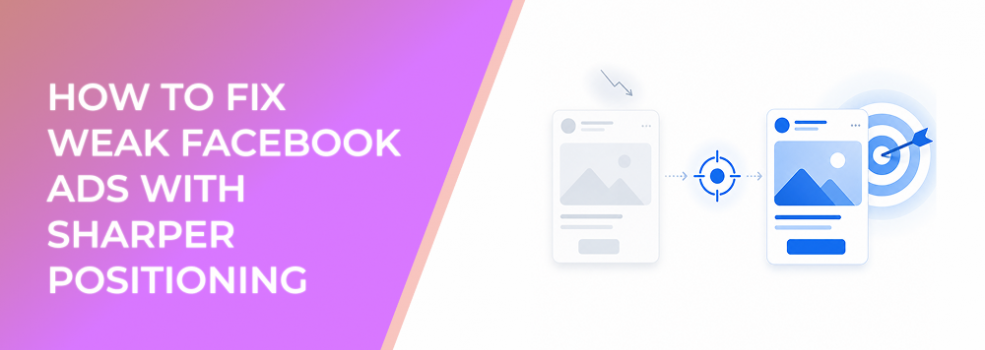
When Facebook ads underperform, many teams immediately test new visuals, shorter copy, different CTAs, or another format.
Sometimes those changes help. Often they do not.
The deeper issue may be positioning.
If the ad does not clearly define who the offer is for, what pain it solves, why it is different, and why the buyer should act now, no amount of creative polishing will fully fix the campaign.
Sharper positioning gives the ad a strategic spine. It turns a vague promotion into a specific argument for a specific buyer.
The Problem
The problem is weak Facebook ads caused by unclear positioning.
A weak ad may still look professional. It may have a clean image, decent copy, and a visible CTA. But it does not create a strong buying reason.
Weak positioning usually shows up in one of five ways:
The audience is too broad.
The problem is too vague.
The benefit sounds like a category claim.
The mechanism is missing.
The proof is not strong enough.
For example, “Get more done with our productivity platform” is easy to understand but hard to care about. It does not say who needs it, what workflow breaks without it, how it solves the problem, or why it is better than current tools.
A sharper version might say:
“Stop client approvals from getting buried in email threads. Centralize feedback, files, and final sign-off in one workspace for agency teams.”
That message has a buyer, a pain, a use case, and a mechanism.
Why This Problem Hurts Performance
Weak positioning damages performance across the funnel.
At the ad level, users do not feel enough relevance to stop scrolling. That can weaken CTR and increase CPC.
At the landing page level, users arrive with unclear expectations. That can reduce conversion rate.
At the lead level, the campaign may attract people who are interested in the category but not committed to the specific problem. That can hurt lead quality and increase CPA.
At the sales level, weak positioning creates extra explanation work. Prospects ask basic questions the ad should have clarified. Sales teams spend time re-qualifying leads instead of advancing serious buyers.
At the scaling level, vague campaigns fatigue quickly because they lack a distinctive angle. Once the initial audience is exhausted, performance becomes unstable.
Common Scenarios Where This Happens
A SaaS advertiser keeps testing carousel vs video but all versions say the same generic thing: “Simplify your workflow.”
A local service provider runs ads with professional photography but does not explain the specific situation where the service is most valuable.
A B2B agency promotes “qualified leads” without defining the qualification standard, target market, or acquisition mechanism.
An ecommerce brand advertises “premium quality” but does not clarify whether the product is better because of materials, fit, durability, design, sourcing, or use case.
A startup copies category language from larger competitors, then wonders why cold audiences do not respond.
These teams are not lacking effort. They are optimizing execution before fixing positioning.
Why the Problem Happens
Weak positioning often happens because teams start from the product instead of the buyer.
They list features, services, and benefits without connecting them to a specific buying situation.
Another reason is pressure to launch quickly. When teams need ads live fast, they often reuse homepage copy, sales deck language, or competitor-inspired hooks.
Weak positioning also happens when businesses avoid tradeoffs. Strong positioning usually chooses one audience, one problem, one mechanism, or one point of difference. That feels risky, but the alternative is a message too broad to persuade anyone strongly.
Finally, performance reports can hide the issue. A campaign may generate clicks, engagement, or low-cost leads, making the ad look acceptable. But if those actions do not turn into qualified pipeline, purchases, or profitable customers, the positioning still needs work.
The Solution
The solution is to rebuild the ad around a sharper positioning statement.
Use this sequence.
1. Choose the strongest buyer segment
Do not write for everyone. Choose the segment with the clearest pain, strongest intent, or best customer value.
Examples:
“Agency founders managing approvals across multiple clients.”
“Homeowners replacing windows before winter.”
“Operations leaders reducing manual reporting.”
“First-time parents buying compact travel gear.”
2. Name the specific pain
Make the pain concrete.
Weak:
“Save time.”
Stronger:
“Stop chasing client feedback across email, Slack, and spreadsheets.”
Specific pain creates recognition. Recognition creates attention.
3. Show the different mechanism
The mechanism explains why your offer is not just another option.
This could be:
A specialized process.
A unique data source.
A product design choice.
A faster workflow.
A niche service model.
A better buyer experience.
A clearer guarantee.
If the ad does not explain the mechanism, the buyer has to assume you are similar to everyone else.
4. Use proof that matches the claim
If the claim is about speed, show process efficiency.
If the claim is about quality, show materials, reviews, before-and-after examples, or customer outcomes.
If the claim is about B2B performance, show relevant use cases, qualification standards, or buyer-fit examples.
Proof should reduce doubt, not decorate the ad.
5. Align the CTA with intent
A cold audience may need “See how it works,” “Compare options,” or “View examples.”
A warmer audience may respond to “Book a call,” “Start trial,” or “Get quote.”
Sharper positioning includes the next step. It does not force every user into the same level of commitment.
Risks and Considerations
Sharper positioning can reduce broad appeal. That is not always bad. The goal is to attract better-fit users, not everyone.
Still, avoid making the positioning too narrow without a reason. If the market segment is too small, delivery and scaling may become difficult.
Avoid claims that cannot be supported. Strong positioning is not aggressive exaggeration. It is clear strategic focus.
Also remember that positioning cannot rescue a weak offer, poor landing page, bad pricing, or broken funnel. It improves the ad’s ability to communicate value, but the offer still has to deliver.
Prerequisites and Dependencies
You need customer insight before positioning can become sharp. Review sales objections, support questions, reviews, competitor comparisons, CRM notes, and past campaign performance.
You need a clear offer and a landing page that reinforces the same positioning.
You also need success metrics beyond surface engagement. Watch qualified conversion rate, CPA, CAC, ROAS, booked-call quality, and sales feedback.
Practical Recommendations
Run a positioning audit before your next creative test.
For each ad, answer:
Who is this for?
What specific problem does it name?
What mechanism makes the offer different?
What proof supports the claim?
What action should this buyer take next?
If any answer is unclear, fix the positioning before testing new formats.
Then build three ad versions around three different positioning angles. Keep the offer consistent but vary the strategic frame. Measure not just which ad gets clicks, but which ad produces the best-fit customers.
Final Takeaway
Weak Facebook ads often need sharper positioning before they need more creative variations.
When the ad names a specific buyer, problem, mechanism, proof point, and next step, it gives users a reason to care. That clarity improves the quality of the test and helps performance teams avoid wasting budget on polished but generic ads.
Related LeadEnforce Articles
- Why Facebook Ad Creative Angle Matters More Than Format — Explains why angle should be fixed before format testing.
- Use Competitor Ads to Find Better Creative Angles — Shows how competitor research can inform stronger positioning without copying.
- Research Instagram Ads Without Copying Competitors — Useful for turning market research into original strategy.
- Why Facebook Ads Blend In When Your Differentiator Is Missing — Helps diagnose whether the ad lacks a clear competitive reason to choose the offer.