Most advertisers argue about format. Video or static, carousel or single image, Stories or Feed.
Format influences delivery mechanics, but it rarely changes business outcomes. Creative angle does.
The angle defines what your ad stands for. It shapes the promise, the tension, and the perceived value. If the angle is weak, production quality cannot compensate.
What Creative Angle Actually Means
Creative angle is the strategic framing of your offer. It highlights one specific problem, desire, or belief.
Format is the execution layer. Angle is the strategic choice behind it.
Two advertisers can sell identical services. One frames the offer around revenue growth. The other frames it around operational inefficiency. Performance will diverge because motivation differs.
If you want a deeper breakdown of how creative influences results, review what makes advertising messages feel trustworthy. Trust is often angle-driven, not format-driven.
Why Users React to Angle First
Users decide relevance before they evaluate aesthetics. The brain filters for personal impact within seconds.
They do not consciously process aspect ratios or transitions first. They react to perceived importance.
An angle answers a direct question: Does this affect me right now? Format only affects how smoothly the message is consumed.
If the answer is unclear, scroll behavior continues. No format adjustment will fix that disconnect.
Why Format Testing Often Misleads Teams
Format changes are visible and easy to deploy. Angle changes require strategic clarity.
Because format is easier to manipulate, teams over-test it.
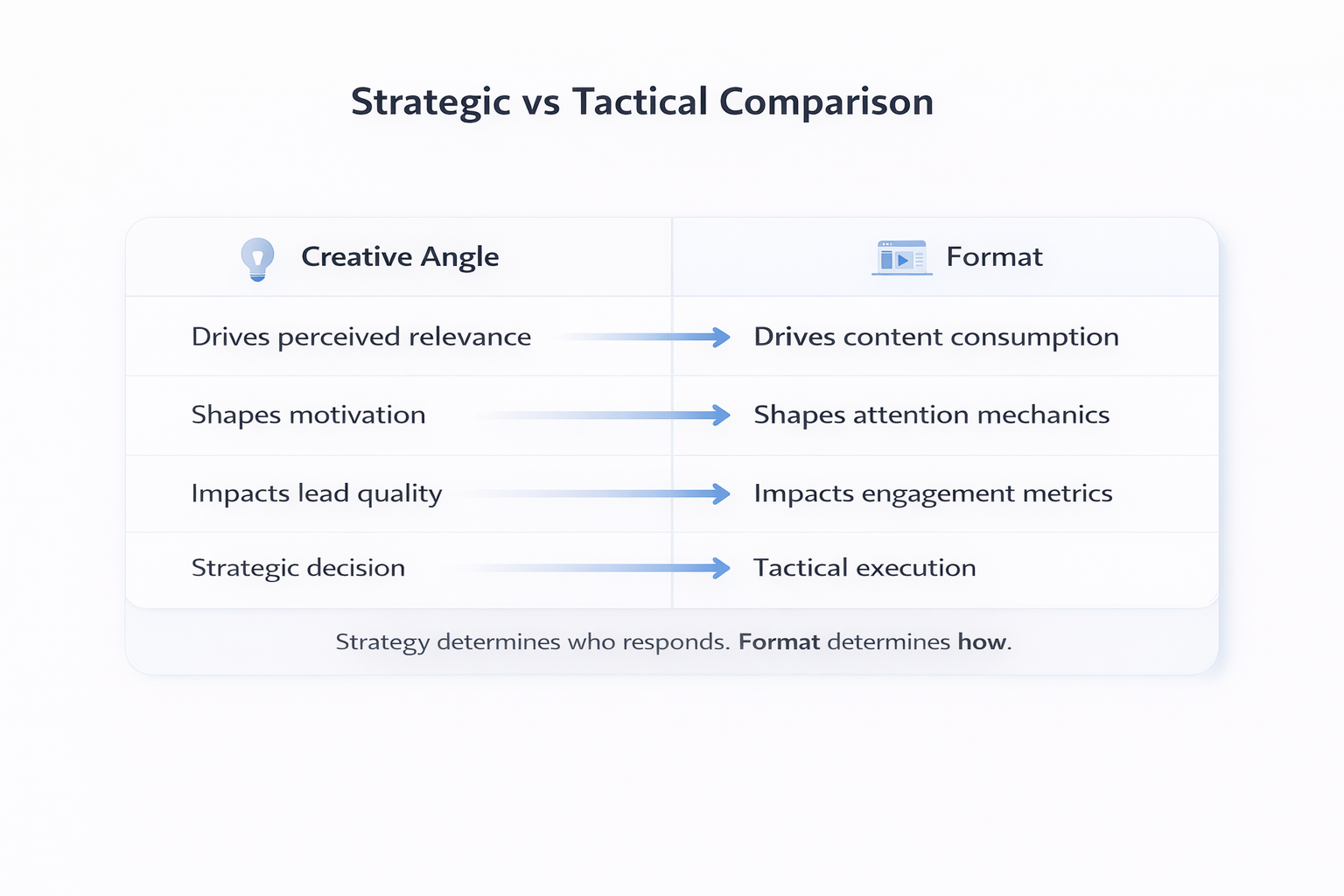
You can rotate five formats with identical messaging. Performance variance will stay narrow because you are optimizing presentation, not persuasion.
Creative angle introduces structural differentiation. Format introduces stylistic differentiation.
For a structured way to approach experimentation, see how to run A/B tests that deliver real insights. Notice how meaningful tests isolate message, not just visuals.
Symptoms of Weak Creative Angle
Weak angles produce subtle but persistent inefficiencies. The account never scales cleanly.
Look for these signals:
-
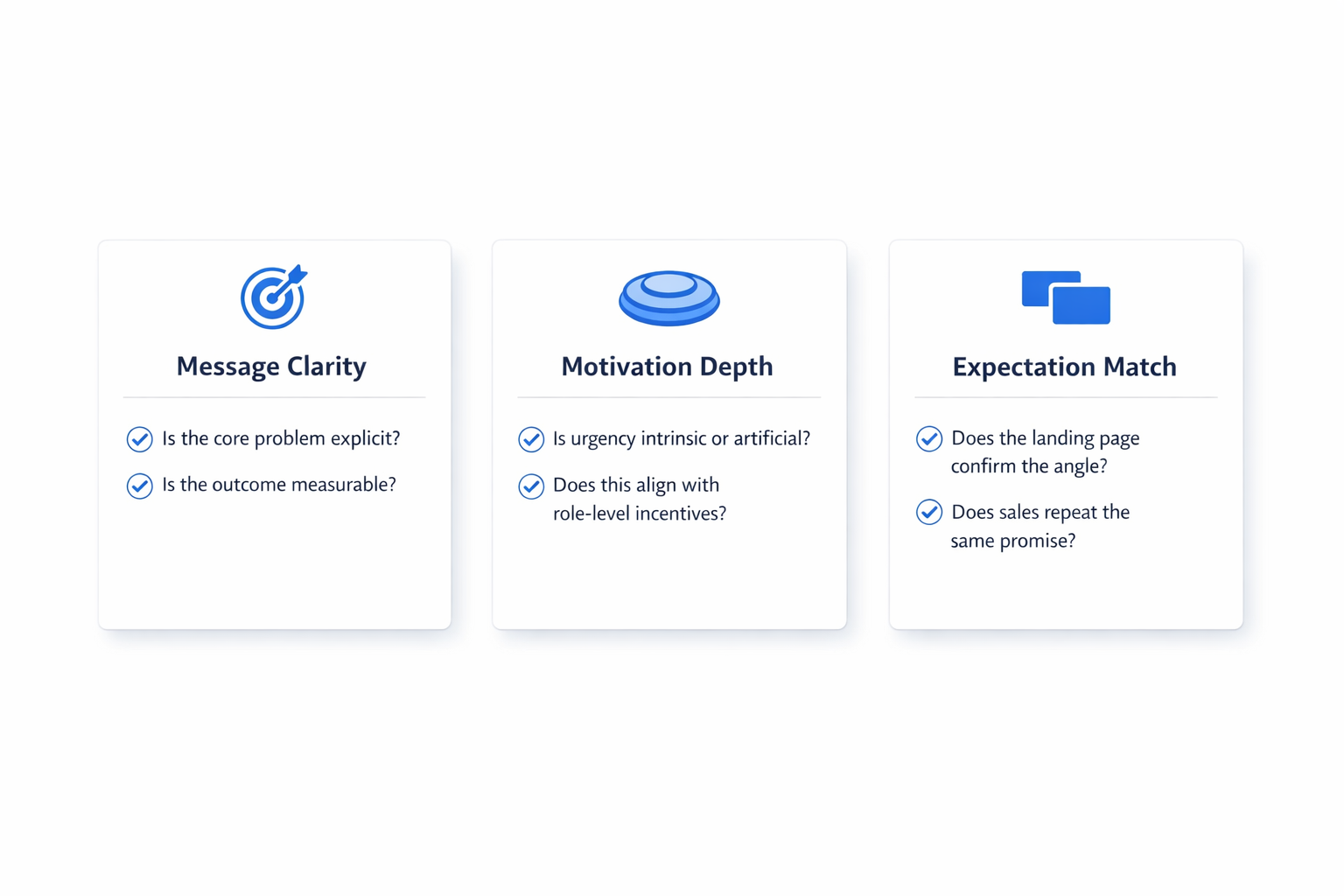
Strong CTR but low conversion rate; the hook creates curiosity without matching landing expectations.
-
High engagement but low lead quality; the message attracts attention outside your target segment.
-
Stable CPM with rising CPA; delivery remains efficient while persuasion degrades.
-
Performance concentrated in one audience segment; resonance is narrow and inconsistent.
These patterns point to misaligned positioning. They do not indicate format failure.
If you see traffic without results, review why clicks don’t equal demand. Angle often drives intent quality more than click volume.
Aligning Creative Angle With Buyer Intent
Creative angle must reflect the audience’s awareness level. Misalignment increases friction.
A cold audience needs problem recognition. A warm audience needs validation. A hot audience needs confidence to act.
If the message jumps ahead of intent, resistance increases. If it lags behind intent, attention drops.
| Stage | Correct Angle | Too Advanced → Result | Too Basic → Result |
|---|---|---|---|
| Unaware | Problem surfacing | Feature-heavy pitch → Confusion | Generic awareness → Ignored |
| Problem-aware | Diagnostic clarity | Immediate product pitch → Resistance | Repetitive pain → Fatigue |
| Solution-aware | Mechanism differentiation | Aggressive urgency → Skepticism | Re-explaining problem → Boredom |
| Product-aware | Risk reduction / proof | Hard close → Pushback | Educational content → Delay |
Matching Angle to Awareness Stage
Use this structure to calibrate messaging:
-
Unaware or lightly aware audiences; surface hidden costs or missed opportunities. Example: lost pipeline value from poor follow-up speed.
-
Problem-aware audiences; clarify root causes and quantify impact. Example: how targeting overlap inflates acquisition costs.
-
Solution-aware audiences; differentiate your mechanism. Example: why your data source improves targeting precision.
-
Product-aware audiences; reduce risk perception. Example: onboarding simplicity or transparent pricing.
Each stage demands a different emphasis. Format remains secondary.
For a practical perspective on intent alignment, explore how to align your ads with buyer intent for better results. Angle refinement usually precedes performance lifts.
How Creative Angle Affects Revenue Quality
Creative angle determines who raises their hand. That choice influences revenue metrics downstream.
An angle built around discounts attracts price-sensitive leads. An angle built around strategic advantage attracts decision-makers.
This difference impacts:
-
Lead-to-meeting rate; qualified framing filters out low-intent clicks.
-
Meeting-to-close rate; aligned expectations reduce friction in sales conversations.
-
Average deal value; strategic positioning supports larger commitments.
-
Sales cycle duration; clarity reduces repetitive objections.
Format does not determine these outcomes. Positioning does.
When analyzing downstream effects, focus on metrics that reflect business impact. The article on advertising KPIs that connect spend to results outlines which signals matter beyond surface performance.
Diagnosing Angle Problems Inside Meta Accounts
Angle issues rarely appear as dramatic failures. They appear as stalled growth.
Watch for these patterns:
-
Frequent creative refresh with no sustained lift; visuals change but narrative remains identical.
-
High performance volatility between similar audiences; message lacks universal resonance.
-
Early performance spike followed by rapid fatigue; curiosity angle lacks depth.
-
Sales feedback about confused leads; ad promise and actual offer diverge.
When these signals appear, revisit the core narrative before adjusting visuals.
Questions That Strengthen Creative Angle
Before testing another format, answer these:
-
What operational pain does this audience experience weekly?
-
What financial metric matters to their specific role?
-
What risk makes them hesitate?
-
What belief about their current solution may be flawed?
Clear answers sharpen strategic framing. Strong framing then benefits from format optimization.
A Practical Testing Sequence
Testing order determines budget efficiency. Most accounts reverse the correct order.
Follow this process:
-
Develop distinct angles that reflect different motivations. Change the core message, not just headlines.
-
Measure downstream metrics, not only CTR. Focus on qualified leads and revenue impact.
-
Identify the angle that produces stable conversion economics.
-
Only then test format variations to improve consumption behavior within that winning angle.
This sequence prevents superficial iteration.
Angle Is Strategic, Format Is Tactical
Creative angle expresses how you compete in the market. It communicates what you believe matters.
Format determines how that belief is delivered inside Meta placements.
When teams prioritize format first, they optimize distribution mechanics. When they prioritize angle first, they optimize persuasion.
Persuasion drives profitable scale. Format amplifies what already works.