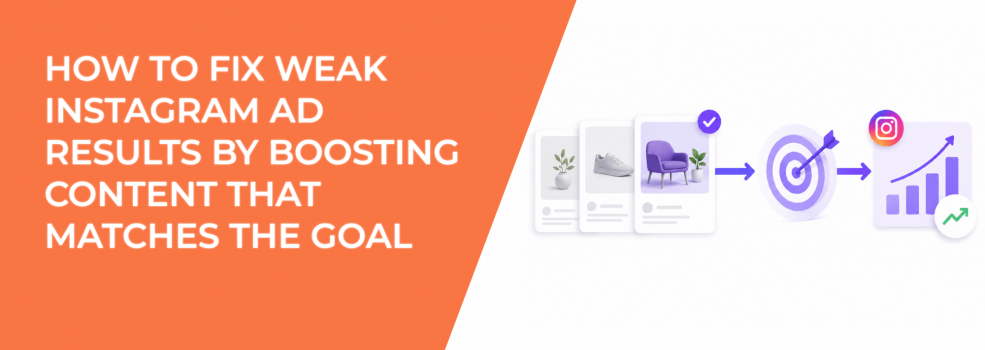
Weak Instagram ad performance often starts before the campaign launches.
Many advertisers focus heavily on targeting, budget, or placements while ignoring whether the boosted content actually supports the campaign goal. The post may look attractive inside the feed, but the behavior it generates can conflict with the objective Meta is trying to optimize.
That mismatch usually produces unstable performance very quickly.
Why The Wrong Instagram Post Creates Weak Ad Results
Different types of Instagram content create different user behaviors.
Some posts encourage passive scrolling. Others generate curiosity clicks without commercial intent. Certain Reels produce strong watch-time because they are entertaining, not because users want the product.
When advertisers boost those posts for purchases or lead generation, Meta starts optimizing around weak behavioral patterns.
Inside Ads Manager, this often creates campaigns where:
- CTR looks healthy
- CPC stays relatively low
- engagement appears strong
- conversion quality remains weak
The campaign attracts activity instead of qualified intent.
This is one reason experienced advertisers constantly analyze Instagram ads performance beyond surface-level engagement metrics.
How Goal-Matched Content Improves Delivery Quality
Instagram posts perform better as ads when the content naturally supports the campaign objective.
For example, a product demonstration usually aligns better with conversion campaigns because users immediately understand the offer and outcome. Educational carousel posts often work well for lead generation because they encourage information-driven engagement.
The content itself helps Meta identify the correct audience faster.
Goal-matched posts usually improve:
- conversion prediction accuracy
- traffic quality
- retargeting efficiency
- scaling stability
- learning phase consistency
The algorithm receives cleaner intent signals from the beginning instead of trying to interpret mixed engagement behavior.
What Advertisers Should Check Before Boosting A Post
Strong advertisers usually evaluate organic behavior patterns before allocating spend. Instead of boosting whichever post received the most engagement, they look for signals connected to the campaign objective.
Useful checks include:
- Review comment quality carefully.
Comments asking about pricing, product use, shipping, or availability often indicate stronger buying intent than generic reactions. - Compare profile visits against engagement volume.
Posts that generate profile exploration usually produce stronger downstream interest than posts that only collect likes. - Check outbound behavior from organic traffic.
If users already click through organically and spend time on-site, the post may support paid delivery more effectively. - Match the content format to the objective.
Short entertainment Reels often support awareness better than direct-response conversion campaigns.
Advertisers who regularly use Instagram Insights to improve ads usually identify these patterns much earlier.
Why Better Content Alignment Improves Retargeting Later
Goal-matched content does more than improve first-touch performance.
It also improves audience quality throughout the funnel.
If the boosted content attracts stronger commercial intent early, future retargeting pools become more valuable. Meta receives clearer signals about which users actually demonstrate buying behavior instead of passive engagement.
Over time this often lowers:
- retargeting CPA
- audience waste
- scaling volatility
- frequency-related performance decline
The opposite also happens. Weak boosted posts often fill retargeting audiences with users who were never likely to convert.
Which Metrics Actually Matter After Boosting
Many advertisers judge boosted posts using the wrong metrics. Likes and shares alone rarely explain campaign quality. Strong Instagram ads usually show healthy downstream behavior after the click.
Experienced media buyers focus more heavily on:
- landing page engagement
- add-to-cart behavior
- lead quality
- conversion consistency
- cost per qualified action
That is why many advertisers eventually learn what Facebook metrics really matter during optimization.
Final Takeaway
Weak Instagram ad results often come from boosting content that conflicts with the campaign goal.
A post that performs well organically does not automatically support conversions, leads, or qualified traffic. Meta’s delivery system responds to the behavioral signals attached to the content itself.
The strongest Instagram campaigns usually start with posts that naturally encourage the exact action the campaign objective is trying to optimize.