A Facebook ad can fail even when the image looks strong and the copy sounds persuasive.
The problem often comes from inconsistency between the visual message and the written message. The user sees one promise in the creative, then reads something completely different in the copy. That disconnect weakens trust immediately.
Meta notices those weak post-click behaviors quickly. Users hesitate, bounce, or stop progressing through the funnel. Over time, CPC rises while conversion rates fall.
What Creative-Copy Mismatch Looks Like in Real Campaigns
This issue is usually easy to miss internally because each ad component looks acceptable on its own.
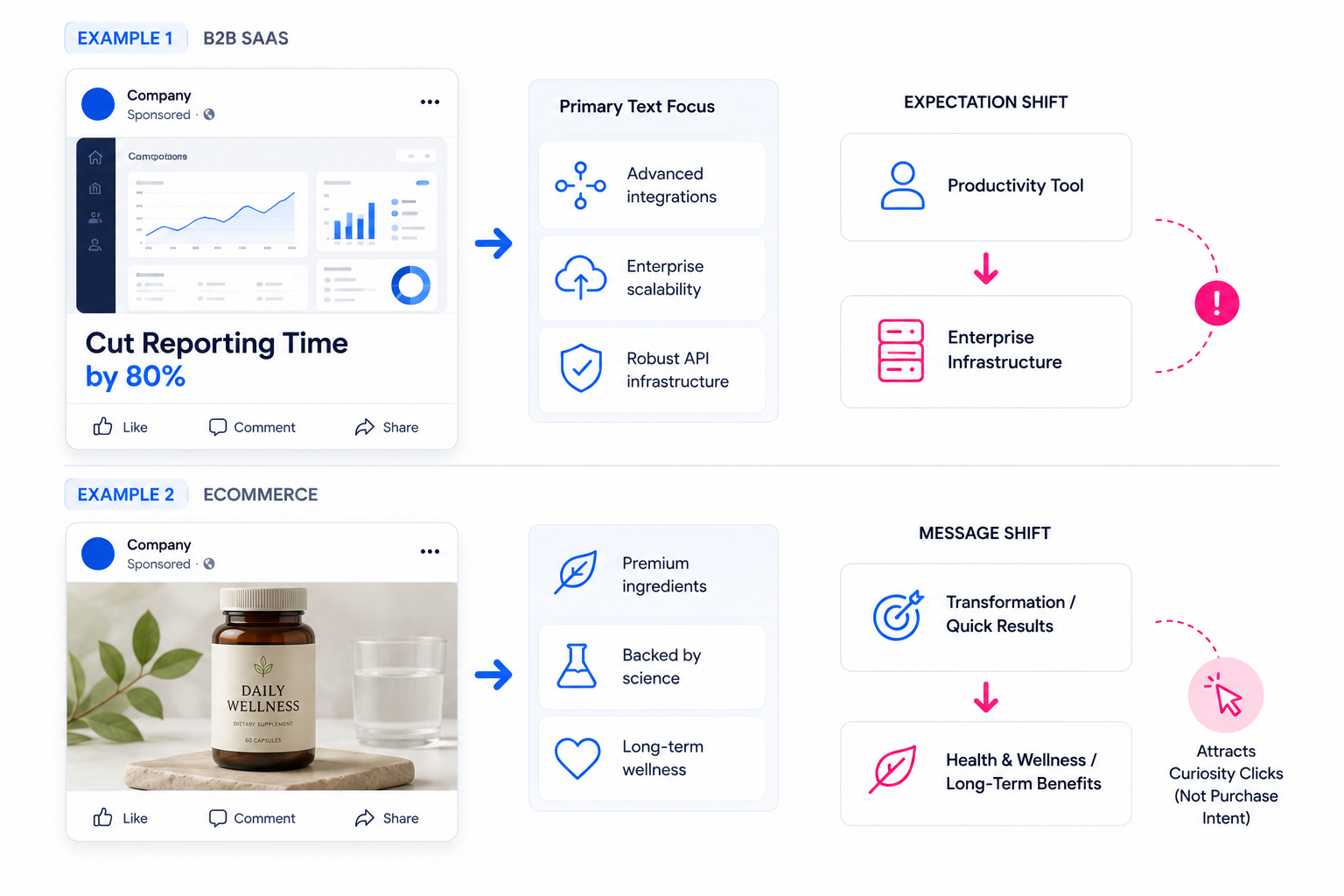
For example, a B2B SaaS company runs a visual showing a simplified dashboard with the headline: “Cut Reporting Time by 80%.”
But the primary text focuses mostly on advanced analytics integrations and enterprise scalability. The user clicked expecting a productivity tool. The copy suddenly shifts toward technical infrastructure. That forces the user to reinterpret the offer mid-scroll.
Another common example appears in ecommerce.
A supplement brand uses a dramatic transformation-style product image while the copy discusses long-term wellness benefits and ingredient quality. The emotional angle changes between the creative and the text, so the ad starts attracting curiosity clicks instead of purchase intent.
Why This Problem Hurts Facebook Ads Performance
Facebook ads rely heavily on expectation continuity.
The user forms an assumption within seconds. Every next element should reinforce that assumption instead of redirecting it.
When the creative and copy drift apart, several things happen simultaneously:
- users spend less time engaging with the landing page,
- outbound click quality drops,
- Meta receives weaker conversion feedback,
- delivery expansion becomes less efficient.
Inside Ads Manager, this often creates patterns like:
- decent CTR but weak ROAS,
- rising CPC after scaling,
- lower-quality ranking over time,
- unstable CPA across placements.
The campaign may still generate traffic, but the traffic becomes less aligned with the actual offer.
Why Scaling Makes This Worse
Small budgets sometimes hide alignment problems.
During early delivery, Meta can still find a narrow pocket of users willing to tolerate the friction. Once the campaign scales into colder audiences, the inconsistency becomes much more damaging.
Cold traffic processes ads faster and with less patience. If the message changes direction halfway through the ad, users simply move on.
This is why some campaigns collapse after budget increases even when nothing changed creatively. The underlying mismatch already existed. Scaling only exposed it to a less forgiving audience pool.
How to Fix Message Consistency Across the Ad
The easiest fix is simplifying the ad around one dominant outcome. Instead of combining multiple angles, build the creative, copy, and CTA around the same user expectation.
For example:
- Visual: A cluttered spreadsheet being replaced by an automated dashboard.
- Primary text: “Stop spending four hours building weekly reports manually.”
- CTA: “See the Workflow”.
Everything reinforces the same operational benefit.
Compare that with a weaker structure:
- Visual: automation dashboard.
- Primary text: “Enterprise analytics platform with advanced integrations”.
- CTA: “Book Consultation”.
The second version changes tone and commitment level too aggressively.
How to Audit Existing Ads for Mismatch
A fast review process usually reveals the problem quickly.
Look at the ad in this order:
- What expectation does the visual create first?
- Does the copy deepen the same idea or introduce a different one?
- Does the CTA feel like the natural next step?
- Does the landing page continue the same conversation?
If any step forces the user to mentally “reset,” the alignment is probably weak.
This becomes even easier to diagnose when paired with session recordings or heatmaps. You often see users pausing near the top of the landing page because the ad prepared them for a different experience.
You can also compare this issue against the frameworks explained in How to Structure a High-Converting Facebook Ad: Hook, Body, CTA and How to Align Ad Copy With Audience Awareness Levels.
Final Takeaway
Most creative-copy mismatch problems are not caused by weak design or weak writing individually.
The problem comes from inconsistent expectations across the ad journey.
The strongest Facebook ads usually feel simple because every component points toward the same outcome. Once the visual, copy, CTA, and landing page reinforce each other, conversion signals become cleaner and campaign performance stabilizes more easily.