Instagram video ads do not need to explain everything to perform well. In many campaigns, the stronger ad is the one that makes the offer clear faster and removes everything that delays action.
Advertisers often create long videos because they want to include every benefit, feature, proof point, and objection. That makes sense in a sales deck. It rarely works the same way inside Instagram placements.
Users move quickly through Reels, Stories, Feed, and Explore. If the video needs too much time before the viewer understands the value, the campaign pays for attention that never becomes intent.
Shorter video creative works best when it is not just a shorter version of a long ad. It needs a tighter message, a cleaner sequence, and one specific job.
The Problem: Instagram Video Ads Are Too Long For The Message They Need To Deliver
Long Instagram video ads often fail because they carry too much information for the placement.
The issue is not length by itself. A longer video can work when the offer is complex, the audience is warm, or the product needs demonstration. The problem starts when the video uses extra time without increasing buying intent.
A 35-second ad that repeats the same benefit in different ways usually creates more drop-off than persuasion. Users may understand the product after eight seconds, but the CTA does not appear until the final frame.
That delay affects performance.
When viewers leave before the CTA, Meta may still record video views, engagement, and partial attention. Those signals can look acceptable, but they do not always translate into clicks, leads, or purchases.
You may see this pattern in Ads Manager:
- ThruPlays or video views look healthy, but outbound CTR stays weak.
- Average watch time drops before the offer appears.
- CPM remains stable, but CPA rises because fewer viewers reach the conversion message.
- Retargeting pools grow, but lead or purchase quality does not improve.
A course creator promoting a paid workshop might make a 45-second video explaining their background, student results, lesson topics, and bonuses. The actual workshop promise appears late.
The ad may attract viewers interested in the creator, but it loses people who needed the outcome first.
This is where advertisers should compare short vs long video ads based on buying context, not personal preference.
The Solution: Cut The Video Around One Clear Conversion Message
Shorter Instagram video ads work when they are built around one specific conversion message.
The creative should not try to explain the full brand, product, and funnel. It should move the viewer from one relevant problem to one clear next step.
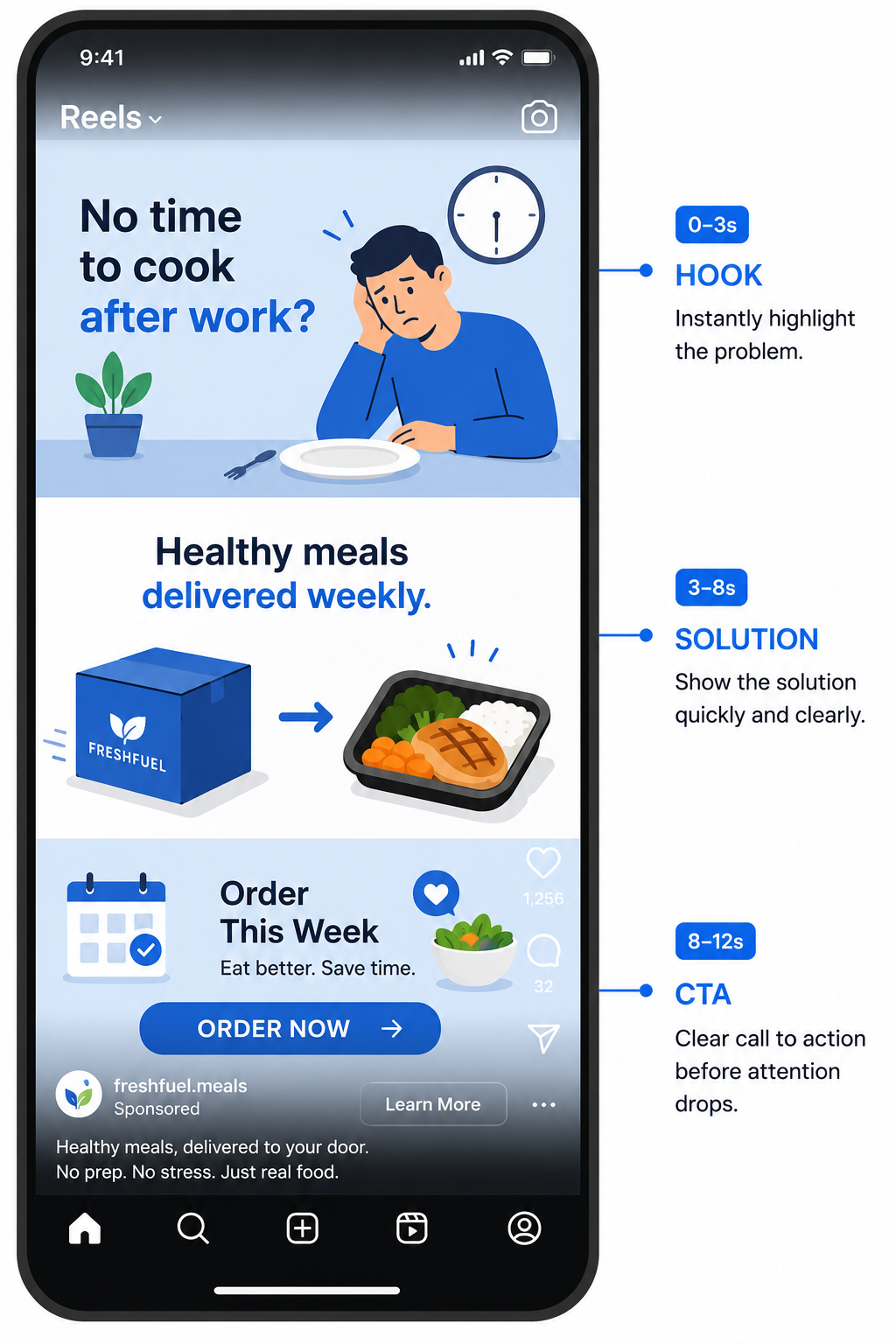
A strong short video usually includes:
- A fast opening that names the problem or desired result.
- A quick product or service reveal.
- One proof point, contrast, or demonstration.
- A CTA that appears before attention drops.
This structure makes the ad easier for users to process and easier for Meta to optimize. Viewers who continue watching after the core message appears are more likely to have real intent.
For example, a local cleaning service could shorten a long brand video into a 12-second ad.
Instead of showing staff introductions, equipment, company history, and service areas, the ad opens with: “Still spending your Saturday cleaning?” It then shows the cleaned room, mentions weekly home cleaning, and ends with a booking CTA.
The shorter version does not say everything. It says the most important thing faster. That is the point.
Advertisers can use principles from scripting short-form video ads to keep the message tight without making the ad feel thin.
Shorter creative also helps with testing. If one video tests one core message, performance data becomes easier to read. You can compare hooks, offers, and proof points without wondering whether the viewer dropped off during filler.
This matters during scaling. Long videos often hide fatigue because the opening still earns attention while later sections stop converting. Monitoring early signs of creative fatigue helps identify when users are watching but no longer responding.
A practical editing rule is simple: remove any scene that does not help the viewer decide whether to click, message, sign up, or buy.
That usually means cutting:
- Brand history unless credibility is the main objection.
- Repeated benefits that do not add new meaning.
- Slow transitions that delay the product reveal.
- CTA placement that appears only at the end.
The final video should feel complete, not compressed. A short ad still needs a clear beginning, middle, and action point.
Final Takeaway
Shorter Instagram video ads perform better when they reduce decision friction.
The goal is not to make every video as short as possible. The goal is to remove anything that delays the viewer from understanding the offer.
When the video focuses on one message, shows value early, and introduces the CTA before attention drops, the campaign gets cleaner signals. That can improve CTR, reduce wasted spend, and support stronger CPA control.