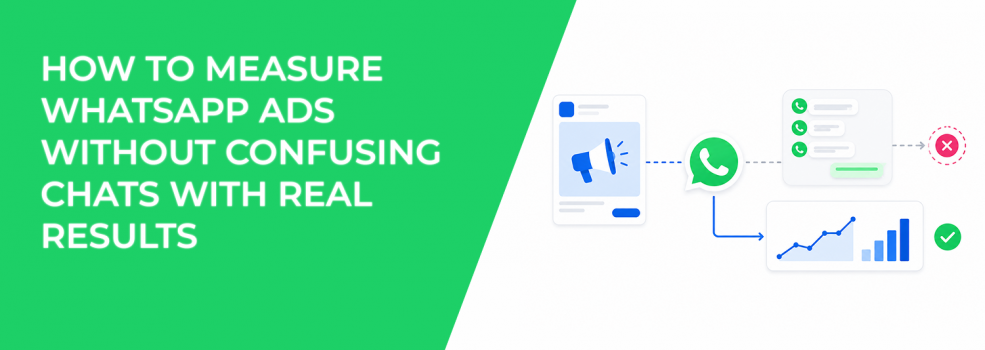
WhatsApp ads can make performance look stronger than it really is. A campaign may generate many chats, fast replies, and low message costs, but still produce few qualified leads or sales.
That usually happens when advertisers treat a WhatsApp conversation as the final result. It is not. A chat only matters when it moves the user toward a clear business outcome, such as a booking, order, consultation, quote request, or closed deal.
The Problem: WhatsApp Ads Get Misread When Chats Are Treated As Conversions
The main problem is that advertisers often count every WhatsApp chat as a successful conversion.
That creates a weak reporting signal. A user can start a conversation for many reasons that have nothing to do with buying. They may ask for a price, request a discount, check availability, or send a vague “Hi” without any real intent.
This is especially common for local businesses, service providers, and e-commerce brands with customer support questions. The campaign may look active, but the actual sales value can be much lower than the message count suggests.
For advertisers learning how WhatsApp ads fit into Meta’s ad ecosystem, this distinction matters. WhatsApp is a conversation channel, not a guaranteed sales channel.
Why Chat Volume Can Hide Poor Lead Quality
A WhatsApp chat is easier to start than a form submission or checkout. That low friction helps response rates, but it also attracts weaker intent.
A language school, for example, might run WhatsApp ads for trial lessons. The campaign generates 200 chats in two weeks. Ads Manager shows a low cost per conversation, but the admissions team finds that many users ask only for the cheapest option, ignore follow-up questions, or live outside the school’s target area.
The media buyer sees volume. The sales team sees noise.
This gap affects performance in several ways:
- CPA becomes unclear. Cost per chat may fall while cost per enrolled student rises.
- Sales capacity gets wasted. Staff spend time answering low-value questions instead of closing serious prospects.
- ROAS becomes harder to read. Revenue may not increase even when campaign activity looks strong.
- Budget scaling becomes risky. More spend can simply produce more unqualified conversations.
This is why advertisers should compare ad performance metrics vs business outcomes before increasing spend.
The Solution: Measure Qualified WhatsApp Conversations By Sales Intent
The solution is to measure qualified WhatsApp conversations, not raw chats.
A qualified conversation should show that the user matches the offer and has a realistic path to conversion. The exact criteria depend on the business, but the logic stays the same. You need to separate people who are ready to act from people who are only asking loose questions.
For a beauty clinic, a qualified WhatsApp chat might include treatment interest, location, preferred appointment window, and budget range. For a restaurant catering campaign, it might include event date, guest count, and delivery area. For a B2B service provider, it might include company type, current need, and decision timeline.
The KPI should shift from “cost per chat” to “cost per qualified WhatsApp conversation.”
That one change makes the campaign much easier to judge.
How To Tag WhatsApp Chats So Campaign Data Becomes Useful
WhatsApp measurement works better when every conversation is tagged by outcome. Without tagging, the media buyer sees only message volume, while sales quality stays hidden inside the inbox.
A simple tagging system can separate conversations into clear groups:
- Qualified lead. The user matches the offer and gives enough information for sales follow-up.
- Sales opportunity. The user asks about pricing, availability, booking, delivery, or next steps.
- Support or service question. The user needs help, but the chat does not represent new demand.
- Unqualified chat. The user is outside the target area, lacks budget, or stops responding early.
These tags do not need to be complicated. Even a shared sheet or CRM field can reveal which ads produce better conversations.
This is especially useful when running click-to-WhatsApp ads for high-intent leads. The goal is not just to start more chats. The goal is to understand which chats show real purchase intent.
What To Track After The First WhatsApp Message
The first message should be treated as the start of the funnel. The important measurement happens after that.
A strong WhatsApp reporting view should include cost per chat, qualified chat rate, cost per qualified chat, booked call rate, purchase rate, and revenue per qualified conversation. These metrics show whether WhatsApp is creating real opportunities or only increasing inbox activity.
For example, one ad may generate chats at $3 each, but only 5% qualify. Another ad may generate chats at $8 each, but 35% qualify and more users book appointments. The second ad is usually the stronger performer, even though the front-end metric looks worse.
That is the difference between measuring activity and measuring sales efficiency.
Final Takeaway
WhatsApp ads underperform when advertisers confuse chat volume with real campaign results.
The fix is to qualify, tag, and track conversations beyond the first message. Measure cost per qualified WhatsApp chat, connect those chats to sales outcomes, and use revenue data to decide what deserves more budget.
A busy WhatsApp inbox is not the goal. A cleaner pipeline with more qualified buyers is.