Scaling a campaign is where many profitable ad accounts begin to behave unpredictably. A campaign that performs consistently at $100 per day can suddenly lose efficiency when the budget rises to $300 or $500.
This instability rarely appears randomly. It usually happens when the algorithm is forced to explore new auctions, new audience segments, or new delivery patterns faster than it can adapt.
Scaling successfully means controlling how fast those changes happen.
Why Campaign Performance Becomes Unstable When You Scale
Most scaling issues come from one structural shift: the campaign must enter auctions it did not compete in before.
At smaller budgets, Meta’s system can concentrate delivery on a narrow cluster of users who closely resemble previous converters. When spend increases, the algorithm must reach beyond that cluster to find enough impressions.
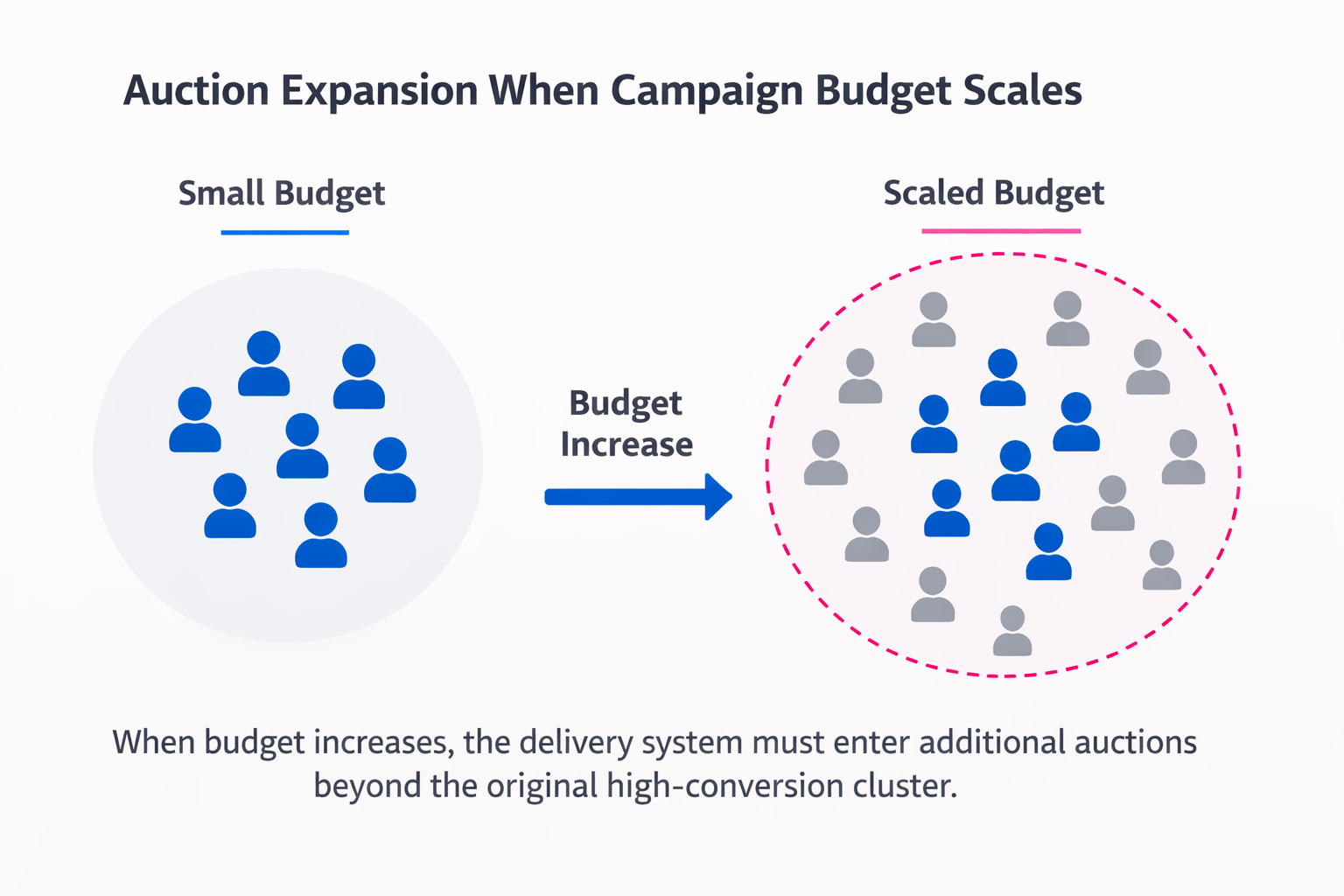
Three changes typically occur at the same time:
-
Auction competition increases.
The system may begin bidding in higher-cost placements or more competitive audience segments, which raises CPM even when targeting settings remain unchanged. -
Audience quality becomes more variable.
Delivery expands to users who resemble the original buyers only partially. -
Conversion signal density declines.
If spend grows faster than conversions, the algorithm receives weaker signals about which users actually convert.
This is why campaigns that perform well at small budgets often struggle when spend expands too quickly.
Budget Increases Can Reset Learning Signals
A common scaling mistake is raising the budget too aggressively.
The delivery system relies on stable conversion patterns. Large budget jumps force the algorithm to reevaluate which users are most likely to convert at the new spending level.
In Ads Manager, this usually appears as:
-
the campaign re-entering the learning phase;
-
sudden CPM fluctuations during the first 24–48 hours;
-
uneven spend distribution throughout the day.
When this happens, the system is effectively retraining its delivery model.
If the change is too large, the algorithm may stop prioritizing the audience cluster that produced the original results.
This is why sudden budget jumps often produce immediate performance drops.
Gradual Budget Expansion Keeps Delivery Stable
Stable scaling usually means expanding the delivery environment slowly instead of forcing the algorithm to restart learning.
A practical scaling rhythm often follows three rules:
-
Increase budgets in controlled increments.
Expanding spend by roughly 10–20% every 24–48 hours allows the algorithm to test additional auctions while preserving the original delivery pattern. -
Monitor conversion velocity after each increase.
If conversions grow proportionally with spend, the campaign is absorbing the extra volume successfully. -
Pause scaling when cost trends worsen.
If cost per acquisition begins drifting upward, the campaign has likely reached the efficiency limit of the current audience.
This is closely related to the mechanics explained in Why Daily Budget Increases Can Hurt Your Performance (and What to Do Instead), where abrupt spend changes disrupt the delivery model.
Campaign Duplication Can Stabilize Scaling
Sometimes performance declines not because the budget is too large, but because a single campaign carries too much delivery expansion.
Duplicating the campaign can reduce this pressure.
When you duplicate a campaign:
-
each campaign competes in auctions independently;
-
separate delivery models learn from different subsets of users;
-
spend expands through multiple auction pathways instead of one.
For example, instead of increasing one campaign from $200/day to $600/day, you might run:
-
three campaigns at roughly $200/day each.
Each campaign explores the market independently, which often produces more stable results.
This strategy aligns with structural scaling methods described in The Ideal Campaign Structure for Scaling Facebook Ads Safely.
Audience Saturation Often Appears During Scaling
Scaling also increases pressure on the existing audience.
If a campaign already reaches most of the high-intent users within its targeting pool, raising the budget forces the system to show ads to the same people repeatedly.
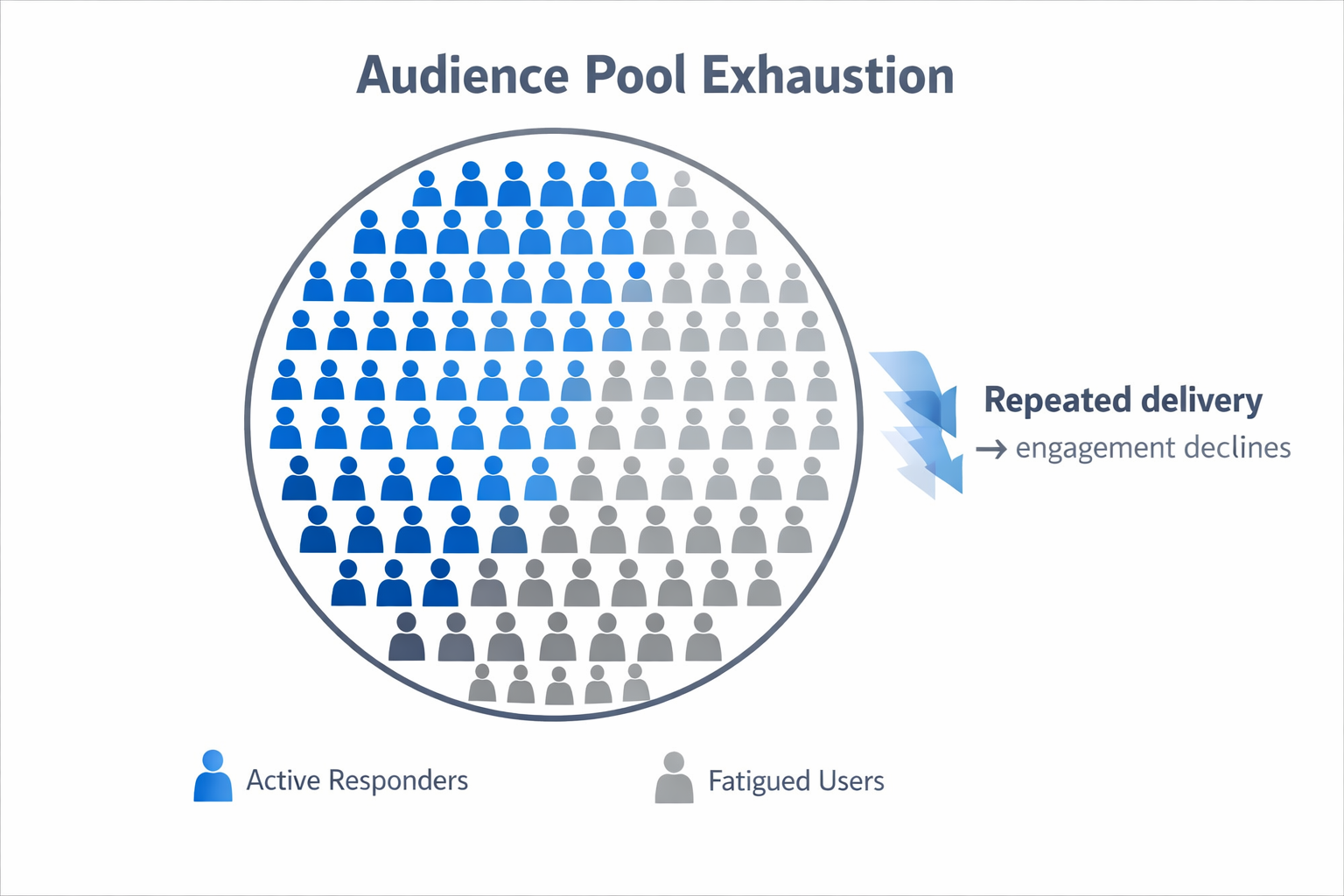
In Ads Manager, audience saturation often shows up as:
-
frequency rising quickly above 2–3;
-
CTR gradually declining;
-
CPM increasing while conversions stay flat.
These signals indicate the campaign is exhausting its most responsive users.
At this point, further scaling rarely works unless the audience itself expands.
This is similar to the delivery limits discussed in Does Audience Size Matter in Facebook Ads? How It Affects Delivery and Cost.
You can address saturation by:
-
expanding targeting parameters;
-
testing creatives that appeal to different motivations;
-
building additional lookalike audiences from new data sources.
Scaling requires new audience supply, not just more budget.
Creative Fatigue Accelerates When Budgets Grow
Higher budgets expose creatives to a larger portion of the audience faster.
An ad that performs well at low spend may quickly reach saturation when delivery expands.
The pattern usually unfolds like this:
-
CTR begins to decline as impressions increase.
-
CPC rises even though targeting remains unchanged.
-
Conversion rate drops as repeated exposure reduces engagement.
When this pattern appears during scaling, the issue is rarely the campaign structure.
The creative simply cannot support the increased delivery volume.
Adding new creative variations allows the algorithm to maintain engagement while expanding reach.
Conversion Signal Density Must Scale With Spend
Scaling requires more than budget increases. It also requires sufficient conversion signals.
If a campaign generates five purchases per day at $100/day, increasing spend to $500/day without improving conversion volume weakens the algorithm’s learning signals.
When signal density declines:
-
the model struggles to identify new high-intent audience clusters;
-
the campaign begins optimizing toward weaker signals such as clicks or engagement.
This is why improving conversion rate on the landing page often helps campaigns scale.
For example:
-
a page converting at 2% generates 10 purchases from 500 clicks;
-
improving conversion rate to 3.5% generates around 17–18 purchases from the same traffic.
Those additional signals strengthen the algorithm’s ability to identify similar users.
Stabilizing Performance Requires Structural Balance
Stable scaling rarely comes from a single adjustment.
Campaigns remain consistent when several elements expand together:
-
budget;
-
audience reach;
-
creative diversity;
-
conversion signal density.
If one element grows while the others remain fixed, delivery becomes unstable.
Scaling works best when the entire system expands gradually.
Final Takeaway
Scaling a campaign does not simply mean spending more money. It means expanding the environment where the algorithm can find conversions.
Performance remains stable when the system can:
-
access additional audiences,
-
gather enough conversion signals,
-
explore multiple auction pathways.
When those conditions exist, scaling becomes controlled growth instead of sudden performance collapse.