A marketing funnel only works when each stage smoothly moves prospects toward the next one. When misalignment occurs, even well-funded advertising campaigns fail to generate meaningful results. Diagnosing funnel misalignment using ad data allows marketers to uncover where prospects drop off and why.
What Funnel Misalignment Means
Funnel misalignment occurs when traffic quality, messaging, targeting, or conversion mechanisms are inconsistent across funnel stages. For example, an ad campaign may generate high click-through rates but extremely low conversion rates on the landing page.
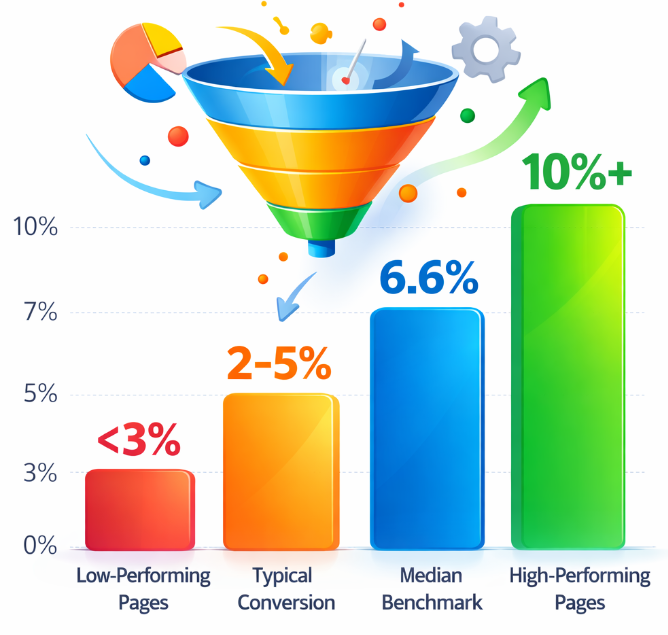
Landing page conversion benchmarks reveal when advertising traffic fails to convert effectively
According to industry benchmarks, average conversion rates across industries are around 2–5%, while landing page conversion rates above 10% are considered strong. If ad engagement is high but conversion is significantly below these ranges, the funnel is likely misaligned.
Key Ad Metrics That Reveal Funnel Issues
Click-Through Rate (CTR)
CTR indicates how compelling your ads are to your target audience. If CTR is low, the problem is usually with targeting or ad creative.
Cost Per Click (CPC)
Rising CPC without improvement in conversions often signals that your targeting is too broad or that competition is increasing without adequate differentiation.
Conversion Rate
Conversion rate connects advertising performance with funnel effectiveness. When high traffic produces minimal conversions, the problem usually lies in the landing page experience or offer clarity.
Cost Per Acquisition (CPA)
If CPA increases despite stable traffic and CTR, this suggests that downstream funnel stages are failing to convert interest into actual leads or customers.
Using Data to Locate Funnel Breakpoints
Compare Traffic vs. Conversion Volume
If ads generate thousands of clicks but only a handful of conversions, the landing page may not match the promise of the ad.
Analyze Audience Segments
Segment performance by location, industry, device, or campaign source. Often only a small portion of traffic actually matches the intended buyer profile.
Track Micro-Conversions
Micro-conversions such as page scroll depth, form engagement, or demo requests help identify whether users are interested but hesitant or completely disengaged.
Common Causes of Funnel Misalignment
Messaging Mismatch
If the ad promises a specific solution but the landing page focuses on something else, users leave immediately. Studies show that message match between ads and landing pages can increase conversion rates by more than 30%.
Poor Audience Targeting
Broad targeting increases impressions but reduces relevance. As a result, engagement metrics may look healthy while actual pipeline growth remains stagnant.
Friction in the Conversion Process
Complex forms, unclear calls-to-action, or slow loading pages create unnecessary barriers. Research indicates that reducing form fields from 11 to 4 can increase conversions by up to 120%.
Steps to Fix Funnel Misalignment
Align Messaging Across Funnel Stages
Ensure that ad copy, landing page headlines, and value propositions communicate the same core message.
Refine Audience Segmentation
Use ad platform data to identify high-performing segments and concentrate budget on those audiences.
Optimize the Conversion Experience
Reduce friction by simplifying forms, improving page speed, and making calls-to-action more visible.
Use Iterative Testing
A/B testing ad creatives, landing pages, and offers allows marketers to validate hypotheses and systematically improve funnel performance.
Conclusion
Diagnosing funnel misalignment is not about guessing what went wrong. Advertising platforms provide extensive performance data that clearly shows where prospects lose interest. By analyzing engagement, conversion, and acquisition metrics together, marketers can identify weak points and rebuild a funnel that consistently converts traffic into measurable business results.
Suggested Articles