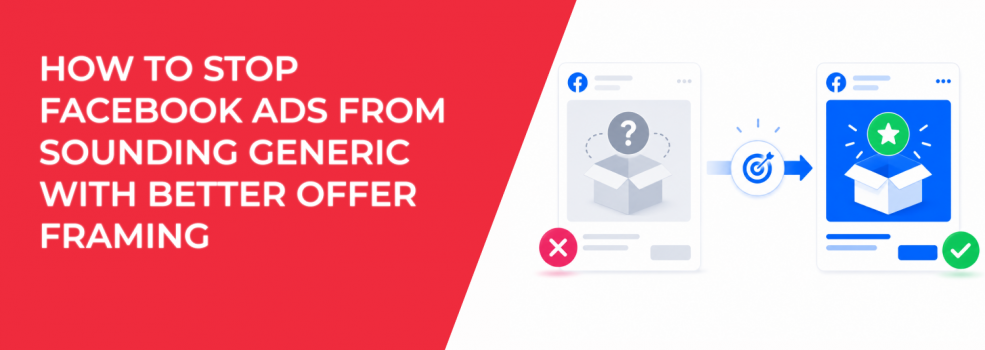
A generic Facebook ad usually sounds safe. That is why it underperforms.
The copy says the right category words. It mentions growth, quality, results, savings, convenience, or expert help. Nothing is technically wrong, but nothing gives the user a reason to stop and compare the offer seriously.
This is an offer framing problem. The business may have a useful product, but the ad presents it in the same language every competitor uses.
The problem: your ad describes the category, not the buying reason
Many Facebook ads fail because they explain what the business sells instead of why the user should care now.
A local cleaning company says, “Professional cleaning services for your home.” A B2B SaaS company says, “Simplify your workflow.” A coach says, “Take your business to the next level.”
These lines describe the category. They do not frame the offer around a specific pain, moment, constraint, or outcome.
A stronger cleaning ad might say: “Book a deep clean before moving into your new apartment.” That version connects the service to a real buying situation.
A stronger SaaS ad might say: “Stop losing client approvals inside email threads.” That version frames the product around a workflow failure the buyer recognizes.
Why generic framing weakens Facebook ad performance
Meta’s delivery system reacts to user behavior, but the ad still has to earn attention. If the framing is too broad, the ad competes against every similar promise in the feed.
This can show up as flat CTR, rising CPC, weak engagement quality, or comments that ask basic questions the ad should have answered. In lead generation campaigns, it often appears as cheap leads that do not remember why they submitted the form.
The issue is not always that the offer is weak. The issue is that the framing hides the reason to act.
That is why it helps to match ad copy with buyer intent before testing more creative formats.
How better offer framing makes the same product feel more specific
Offer framing changes the angle without changing the product. You are not inventing a new service. You are choosing the buying context that makes the offer feel relevant.
| Business type | Generic framing | Stronger offer framing |
|---|---|---|
| Dental practice | Quality dental care | Book a same-week appointment for a chipped or cracked tooth |
| HR software | Simplify employee management | Cut onboarding paperwork for new hires from days to hours |
| Landscaping company | Professional outdoor services | Get your yard ready before summer entertaining season begins |
| Cybersecurity consultant | Protect your business from threats | Identify security gaps before your next compliance audit |
| Online language course | Learn a new language online | Hold basic conversations in Spanish before your upcoming international trip |
The stronger versions work because they create a sharper mental picture. The user can recognize the situation before they evaluate the offer.
Frame the offer around the user’s current problem
A generic ad often starts from the seller’s service. A better ad starts from the buyer’s current friction.
For example, “We provide accounting services for small businesses” is factual, but flat. “Still sorting receipts the night before tax deadlines?” enters the user’s situation first.
This does not mean every ad needs to be negative or pain-heavy. It means the ad should connect to a specific moment in the buyer journey.
For cold traffic, the frame may focus on problem recognition. For warmer audiences, it may focus on comparison, proof, or urgency. This is where it helps to align ad copy with audience awareness.
Use constraints to make the offer feel more believable
Broad claims often sound generic because they avoid constraints. “Get more leads” is easier to write than “book more consultations from homeowners planning kitchen remodels.”
The second line is more constrained, but that is the point. Constraints make the message easier to believe.
Useful framing constraints include:
- Audience constraint: Name the type of buyer, role, business, or customer.
- Situation constraint: Tie the offer to a trigger, deadline, pain point, or buying moment.
- Outcome constraint: Replace broad improvement with a specific result.
- Mechanism constraint: Explain how the result happens without overloading the ad.
For example, “Improve your ads” becomes stronger when framed as “Find higher-intent Meta audiences before raising your daily budget.”
The offer now has a mechanism. It also attracts a more specific advertiser: someone trying to scale without wasting spend.
Why better framing can improve lead quality
Generic ads often attract people who like the idea of the outcome but do not have the problem strongly enough. That creates weak leads.
Better framing filters users earlier. Someone who clicks an ad about “client approvals stalling before launch dates” is not just interested in productivity. They likely recognize a painful workflow issue.
This matters for CPA and CAC. A cheaper lead is not useful if the sales team spends time explaining who the product is for. A more clearly framed ad can produce fewer leads while improving booked-call rate or close rate.
That is the difference between attention and demand. It is also the difference between a clickable offer and a buyable one.
How to rewrite generic Facebook ad copy
The fastest way to fix generic framing is to replace category language with buyer-context language.
Start with the line you would normally write. Then ask what situation makes the offer urgent, useful, or easier to understand.
- Generic copy: “We help restaurants get more customers.”
- Framed copy: “Fill empty weekday tables by reaching locals already engaging with nearby dining pages.”
The framed version explains the business type, the problem, the timing, and the audience signal. It gives the ad more commercial intent before the click.
Final takeaway
Generic Facebook ads usually fail because they describe the product too broadly. Better offer framing makes the same offer feel specific, relevant, and easier to act on.
Before launching, check whether the ad names a real buyer situation. If it only describes your category, rewrite it around the problem, audience, constraint, or moment that makes the offer worth clicking.