A Facebook ads start date is only useful if the ad is approved before that date arrives.
Many marketers schedule ads with confidence, then discover the campaign cannot deliver because Meta review is still pending. The start date passes, the ad remains in review, and the campaign begins late.
This is frustrating because the schedule looked correct. The campaign was built. The date was selected. The budget was assigned. But approval was not complete.
Meta’s ad review system checks ads before they begin delivery, and Meta’s public materials describe review as an automated process that may include ad components such as text, images, video, targeting, landing pages, and other destinations. That means the start date should be planned around review readiness, not just business preference.
The Problem
The problem is that advertisers often confuse “scheduled” with “ready to run.”
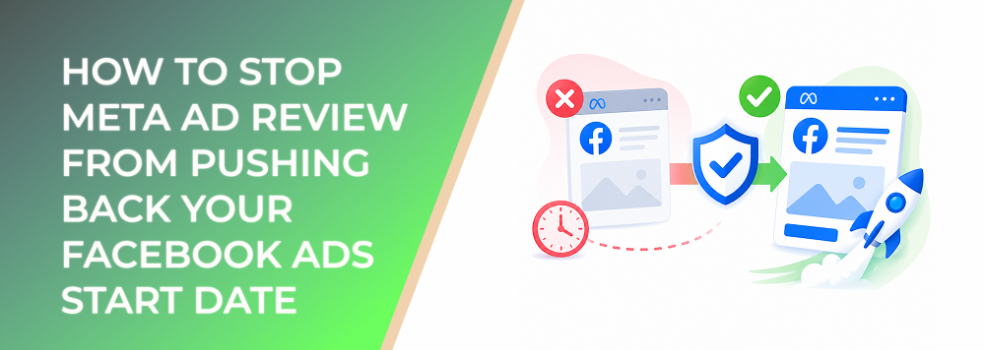
A scheduled Facebook ad is not guaranteed to start at the selected time if review is still pending. The start date tells Meta when you want delivery to begin. It does not override approval.
This creates a hidden launch risk. The campaign may look complete inside Ads Manager, but it is not operationally ready if the ad is still in review, processing, rejected, or missing required setup.
The result is a pushed-back start date. The campaign may still run eventually, but not during the intended window.
Why This Problem Hurts Performance
A pushed-back start date weakens campaign performance in several ways.
First, it shortens the testing period. If you planned to compare creative variations over seven days and review consumes one or two of them, the test becomes less reliable.
Second, it disrupts budget pacing. Campaigns with fixed end dates may have less time to spend the planned budget. That can either reduce volume or pressure the team to increase daily spend.
Third, it delays learning. Meta campaigns need delivery data to optimize. If the campaign starts late, learning starts late.
Fourth, it affects funnel coordination. Email, organic social, sales outreach, influencer content, webinars, and landing-page updates may all be timed around the paid campaign. If Meta ads start late, the entire go-to-market sequence can become uneven.
For lead-generation teams, this can show up as lower registration volume, fewer booked calls, weaker pipeline contribution, or rushed follow-up.
Common Scenarios Where This Happens
A campaign is scheduled to start Monday at 8 a.m., but the ads are created late Sunday night and remain in review Monday morning.
An agency builds ads early but waits for final client approval. The final edits are made right before the scheduled start date, and the updated ads go back through review.
A startup schedules ads around a product launch announcement, but the landing page is updated after submission. Review takes longer than expected.
An ecommerce team creates ads for a short promotional window. The ads clear review after the first day of the sale.
A B2B advertiser duplicates a previous campaign and assumes the new version will behave like the old version. New copy, new targeting, or a new URL triggers fresh review risk.
Why the Problem Happens
The start date gets pushed back because the campaign calendar is built in the wrong order.
Many teams begin with the desired live date, then work forward casually: creative today, stakeholder review tomorrow, ad build later, launch whenever everything is done.
A better process works backward from the start date and includes approval time as a required step.
Meta’s review process starts automatically after creating or editing an ad, and most ads are reviewed within 24 hours, although some take longer. If the ad is created too close to the start date, even a normal review window can become a launch delay.
The problem also happens when teams make significant changes after scheduling. Editing copy, creative, targeting, or destination details can put the ad back into review.
Another cause is incomplete setup. Payment problems, Page access issues, unavailable posts, expired offers, or mismatched landing pages can prevent delivery even after review.
The Solution
The solution is to create an approval-first start-date workflow.
Do not ask, “When do we want this ad to start?” first. Ask, “When must this ad be approved for the start date to be safe?”
Set an internal approval deadline before the platform submission deadline. Stakeholders should approve the final version of the ad before it enters review.
Use drafts when you need to build early but publish later. Drafts can help teams prepare campaigns without submitting unfinished work. But drafts should still be reviewed carefully before publishing.
Submit ads before the scheduled start date. For important campaigns, use a buffer that allows for review, rejection, edits, and resubmission.
Create backup versions before launch. If the primary ad is delayed or rejected, you should have another version ready with clearer wording and lower policy risk.
Watch status at the ad level, not just the campaign level. A campaign may appear scheduled while individual ads are still in review or rejected.
Finally, avoid last-minute edits unless they are essential. Every late change can turn a safe start date into a missed start date.
Risks and Considerations
There is a tradeoff between speed and control.
Submitting earlier helps protect the start date, but only if the ad is actually ready. Early submission of weak, unclear, or non-final creative can create more problems.
Backup ads also need quality control. A backup version should not be generic filler. It should preserve the offer while reducing avoidable review friction.
Do not assume that one approved ad means the campaign is healthy. If other ads are still pending, the test may be incomplete.
Do not rely only on approval. A campaign can be approved and still fail to deliver because of budget, bid, audience size, schedule, account status, or auction competitiveness.
Prerequisites and Dependencies
To protect your start date, you need a complete launch checklist.
Confirm the campaign objective, budget, start date, end date, audience, placements, ad creative, copy, CTA, destination, tracking visibility, and conversion event.
Make sure the Facebook Page and ad account are active. Confirm the payment method works. Check whether the post or creative asset can be used in an ad.
The landing page should be live, fast enough to use, consistent with the ad promise, and free of obvious trust issues.
For lead-generation campaigns, confirm the lead form, CRM workflow, notification process, and follow-up owner before launch.
For agencies, confirm that the client has approved the actual ad, not just a creative concept.
Practical Recommendations
Use a “review-ready before start-date-ready” rule.
An ad should not be considered ready to launch until it has been submitted, reviewed, and cleared for delivery.
For time-sensitive campaigns, separate four dates: creative due date, stakeholder approval date, Meta submission date, and delivery start date.
Check ad status at least once before the start date. For critical launches, check more than once.
Avoid editing approved ads right before launch. If a change is needed, duplicate and edit a new version when appropriate instead of risking the only approved ad.
Build campaign timelines with room for mistakes. The right question is not whether most ads clear quickly. The right question is whether your launch can survive when one does not.
Final Takeaway
Meta ad review pushes back Facebook ads start dates when approval is treated as optional timing instead of required timing.
To prevent that, plan backward from the desired start date, finalize assets early, submit ads before launch, prepare backup creative, and monitor status before delivery is expected to begin.
Related LeadEnforce Articles
- Understanding Facebook Ad Statuses: Common Issues and How to Fix Them — Helps advertisers distinguish scheduled, in-review, active, rejected, and delivery-related statuses.
- What to Do When Meta Ads Are Stuck in Review — Provides a practical path when review threatens campaign timing.
- How to Use Meta Ad Drafts Without Publishing Costly Campaign Mistakes — Useful for building campaigns early while keeping launch control.
- Facebook Page Ads Can Launch Fast—But Rushed Setup Can Waste Budget — Relevant for advertisers creating ads from a Facebook Page and moving too quickly.