The Facebook boost workflow can look like a simple publishing shortcut. That is exactly why advertisers misread it.
A boosted post is not just an organic post with money attached. It is a paid promotion setup with decisions that affect delivery, targeting, budget, and measurement. When marketers misunderstand what each step means, they launch with the wrong expectations.
This affects small business owners, agencies, startup marketers, B2B teams, ecommerce brands, affiliate marketers, and freelance marketers. The campaign may run smoothly, but the setup may not support the result the business actually needs.
The Problem
The problem is misreading the boost workflow before launch.
Advertisers often interpret the setup screens as basic admin choices: choose a post, pick a goal, select an audience, add budget, review, publish.
That reading is too shallow.
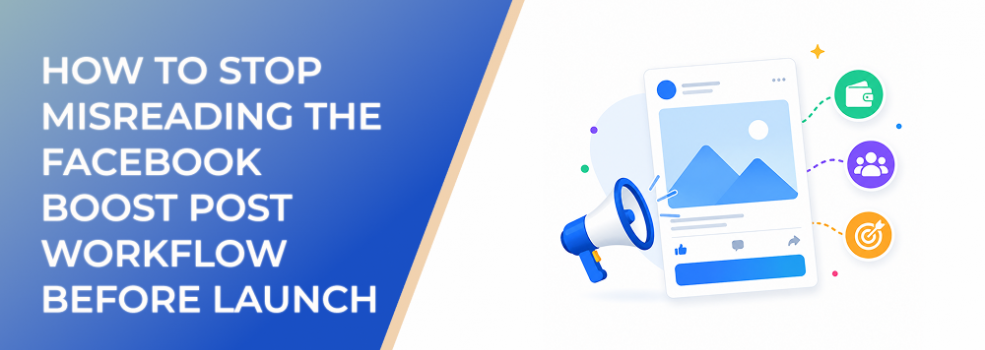
Each step changes how the campaign behaves. The post is the creative asset. The goal is the delivery instruction. The audience is the market hypothesis. The budget and duration are the test design. The CTA and destination are the conversion path. The final review is the last chance to catch misalignment.
When marketers misunderstand these steps, they often expect the wrong outcome. They may choose an engagement-style setup and expect sales. They may choose a traffic-style setup and expect qualified leads. They may select a broad audience and expect precise buyer intent.
The workflow was completed, but it was not understood.
Why This Problem Hurts Performance
Misreading the workflow hurts performance because it leads to wrong decisions before the campaign begins spending.
If the campaign is optimized for the wrong behavior, CPC may look good while CPA worsens. If the audience is misunderstood, the campaign may reach people who respond to the content but do not match the ICP. If budget is treated as a spending limit rather than a learning tool, the advertiser may underfund the test or scale too soon.
The biggest danger is false confidence.
A boosted post can generate visible activity quickly: reach, impressions, reactions, comments, clicks, or messages. Those metrics can make the campaign feel successful. But if the business wanted purchases, qualified leads, booked calls, or pipeline, activity alone is not enough.
Misreading the workflow also creates reporting problems. Agencies may report engagement as success when the client expected revenue. Internal teams may scale a boost because CPC is low even though downstream conversion quality is weak.
Common Scenarios Where This Happens
A small business owner sees the boost button under a strong post and assumes the workflow will automatically find buyers.
An agency boosts a client’s content because it wants quick visibility, then struggles to explain why the campaign did not produce qualified leads.
A B2B marketer promotes an educational post and assumes comments indicate buying intent, even though most users are early-stage readers.
An ecommerce brand boosts a product image and judges the campaign by engagement, not add-to-cart behavior, purchase rate, or ROAS.
A startup uses a boosted post to test market demand but changes the post, audience, goal, and budget at the same time, making the result impossible to interpret.
In each case, the setup flow was followed, but the strategic meaning of the flow was missed.
Why the Problem Happens
This problem happens because the boost workflow is intentionally simplified.
Simple interfaces are useful. They reduce friction and help more businesses advertise. But simplified workflows can hide the weight of each decision.
The word “boost” also creates confusion. It sounds like the advertiser is only increasing reach. In reality, the advertiser is making paid media decisions that affect optimization, audience selection, pacing, and reporting.
Another cause is surface-metric bias. Reach, engagement, and clicks are visible quickly. Conversion quality, lead quality, CAC, and ROAS take more discipline to measure.
Finally, many advertisers confuse a boosted post with a full campaign. Both can appear as ads, but they do not offer the same level of control, testing structure, or optimization depth.
The Solution
The solution is to read the boost workflow as a sequence of campaign decisions.
Read Post Selection as a Creative Decision
The selected post is not just the content being amplified. It is the ad creative.
Before boosting, ask whether the post has a clear message, a visible value proposition, and a reason for the target audience to act. A post that entertains followers may not be strong enough for paid prospecting.
Read Goal Selection as a Delivery Instruction
The goal tells Meta what kind of result to pursue.
Do not choose a goal because it sounds easy to achieve. Choose it because it matches the business outcome. If the campaign needs attention, engagement may be appropriate. If it needs pipeline or purchases, the setup must support deeper performance goals.
Read Audience Selection as a Market Hypothesis
The audience is not just “who can see the post.” It is the market segment being tested.
Ask why this audience should care. If the reason is vague, the audience is probably too weak. A good audience hypothesis connects the offer to a real behavior, interest, community, role, geography, or buying context.
Read Budget and Duration as Test Design
Budget is not only a spending cap. It determines how much evidence the campaign can collect.
A short, low-budget boost can be useful for directional learning, but it should not be treated as proof of scalable performance. A larger budget should be used only when the setup is clear enough to justify the spend.
Read Final Review as Quality Control
The final review is not a formality. It is where the advertiser checks whether the setup makes sense as a whole.
Before launch, ask: does the post match the goal? Does the audience match the ICP? Does the CTA match the destination? Does the budget match the learning objective? Does the KPI match the business outcome?
If the answer is no, pause before publishing.
Risks and Considerations
Do not overcomplicate every boosted post. Some boosts are simple awareness plays, and they do not need a full acquisition framework.
The risk is expecting more from the boost than the setup can reasonably produce. A visibility boost should not be judged like a sales campaign. A content-engagement boost should not be expected to generate qualified pipeline without a conversion path.
Also avoid over-reading small tests. A boosted post can provide directional learning, but small budgets and short durations may not support confident scaling decisions.
Prerequisites and Dependencies
To interpret the workflow correctly, you need a clear campaign goal, target audience definition, post-level rationale, budget range, CTA, destination, and success metric.
You also need agreement on what the boost is meant to prove. Is it validating content traction? Building awareness? Testing an audience? Driving traffic? Generating leads? Supporting sales?
For commercial goals, you need a destination or follow-up path that can convert interest into action. Without that, the boosted post may create attention but not business value.
Practical Recommendations
Before launching, translate every setup field into a strategic question.
Post: is this creative worth paying to distribute?
Goal: what behavior are we asking Meta to find?
Audience: why should these people care?
Budget: how much signal do we need?
Duration: how long does the test need to run?
CTA: what should users do next?
Final review: does the whole setup support one outcome?
Use boosted posts for fast distribution, content validation, awareness, or simple engagement when those are the real goals. Move into a fuller campaign structure when you need controlled testing, lead generation, sales optimization, retargeting, exclusions, or more precise measurement.
Final Takeaway
The Facebook boost workflow is easy to complete but easy to misread.
Do not treat the setup as a series of harmless clicks. Treat it as a compressed campaign build. When you understand what each step controls, you can launch with clearer expectations, better metrics, and fewer expensive surprises.
Related LeadEnforce Articles
- Stop Confusing Facebook Boosted Posts With Ads Manager Campaigns — Helps clarify the strategic difference between quick boosts and fuller campaign structures.
- Boosted Post or Full Ad? How to Choose Based on Campaign Goals — Useful for deciding whether the boost workflow can support the desired outcome.
- Boosted Post or Full Facebook Ad? How to Avoid Control Problems Before You Spend — Explains when simplified promotion creates control limitations.
- Limited by Boosted Posts? How to Move Into Full Meta Campaigns for More Control — Helps advertisers transition when the boost workflow is no longer enough.