Instagram ads often start strong, then slowly flatten out. At first, clicks look affordable, leads come in, and the campaign feels stable. Then CPA stops improving, ROAS gets stuck, and every change seems to make only a small difference.
When this happens, many advertisers blame the creative. They rewrite the copy, swap the visual, or launch another version of the same ad. Sometimes that helps. But if the campaign is still showing ads to the same narrow audience, the real problem may be the audience pool.
A single audience can only give Meta so much useful data. Once the easiest buyers have been reached, the campaign starts looking for conversions in weaker parts of that same group. That is when performance starts to plateau.
Why one narrow Instagram audience stops improving
A narrow audience can work well at launch because Meta quickly finds the most responsive users inside it. These people may already follow similar brands, engage with niche content, or show interest in the problem your offer solves.
The issue comes later. After Meta reaches that first strong pocket, the campaign has fewer good users left to find. Frequency starts rising, CTR may drop, and cost per result slowly climbs.
You might see signs like:
- Frequency keeps increasing. The same people are seeing the ad too often, which usually means the audience is getting tired.
- CTR gets weaker. Fewer people are reacting because the strongest users already noticed the ad.
- CPA rises without a clear reason. The ad still delivers, but it no longer finds enough users likely to convert.
- Lead quality drops. The campaign may still generate forms, but fewer leads become real opportunities.
This is not always creative fatigue. Sometimes the ad is fine, but the audience has stopped giving Meta enough strong signals.
The problem with testing only one audience
If you run one audience, every result becomes a blended average. You do not know which type of user is helping the campaign and which type is wasting spend.
For example, a B2B advertiser may target one broad “business owner” audience on Instagram. The campaign gets leads at $70 each, which looks acceptable. But after splitting audiences, they may find that agency owners convert at $45, startup founders convert at $95, and local business owners rarely book calls.
Without audience testing, all of that gets hidden inside one number.
This is why Instagram ads can feel stuck. The campaign is not learning which segment has real buying intent. It is only learning from the same mixed audience again and again.
Test audience segments before changing everything else
Audience segment testing helps you find out whether the problem is targeting, creative, offer fit, or funnel quality. Instead of guessing, you compare different audience groups under similar conditions.
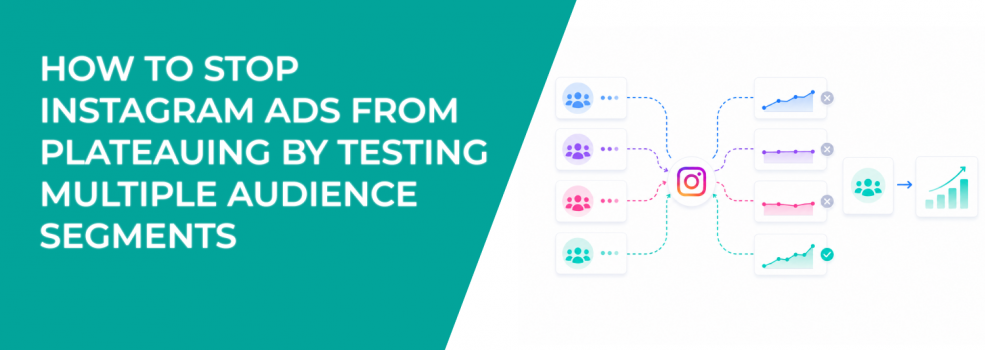
The key is to keep the test simple. Use the same creative, offer, landing page, objective, and conversion event. Change the audience only. This makes the results easier to read.
Good Instagram audience segments may include:
- Competitor follower audiences. These users already pay attention to similar brands or solutions.
- Niche Instagram profile audiences. These can show stronger interest than broad Meta interests.
- Instagram engagers. People who interact with relevant profiles, posts, or communities may be warmer than general cold traffic.
- Adjacent interest groups. These help you expand reach without moving too far away from the original buyer profile.
This is where LeadEnforce can be useful. It helps advertisers build high-intent audiences from Instagram followers, engagers, Facebook groups, and social profile data. Instead of relying only on broad targeting, you can test audiences based on clearer social behavior.
If your current audience is too limited, you can also use this process to reach the right Instagram audience without broad targeting.
Keep the test clean enough to trust the results
A messy audience test creates more confusion, not more insight. If every ad set has a different audience, creative, placement, and budget, you will not know what caused the result.
Start with three or four audience segments. Give each one enough budget to collect meaningful clicks and conversions. Do not judge the winner after a few hours unless the spend is high enough to support the decision.
The goal is not to find a perfect audience immediately. The goal is to see which segment gives Meta the best starting signal.
Watch for these signals while the test runs:
- Spend distribution. If one segment barely spends, it may be too small or too hard to reach.
- CTR and conversion rate together. Cheap clicks do not matter if users do not convert.
- CPA and lead quality. A low CPL can still be a bad result if the leads never become customers.
- Frequency growth. If frequency rises too quickly, the segment may not be large enough to scale.
This is why audience quality matters more than audience size. A bigger audience is not always better. A smaller audience with stronger intent can produce fewer leads but better customers.
Don’t judge Instagram audiences by CPC alone
CPC can be misleading on Instagram. A strong-looking ad can attract cheap clicks from people who like the visual but have no real interest in buying. This is especially common with lifestyle content, Reels, and curiosity-based hooks.
For e-commerce, look beyond clicks. Check add-to-cart rate, checkout starts, purchases, AOV, and ROAS. For B2B lead generation, check booked calls, qualified leads, sales acceptance rate, and pipeline value.
A segment with a $40 CPL may look better than a segment with a $70 CPL. But if the cheaper leads never answer sales calls, the more expensive segment may still be more profitable.
This is where many Instagram campaigns plateau quietly. Ads Manager shows activity, but the business does not see better revenue. The campaign is producing motion, not progress.
Use winning segments to guide the next test
Once you find a stronger segment, do not just raise the budget and hope it scales. That can push Meta past the best part of the audience and bring the same plateau back.
Use the winning segment as a clue. If competitor followers perform best, test more competitor-based audiences. If Instagram engagers perform best, build more audiences around related profiles and communities. If adjacent interests perform better than direct interests, your original targeting may have been too narrow.
You can also validate new audience segments quickly before adding them to your main campaign. This keeps weak audiences from polluting your best-performing campaigns.
The best advertisers treat audience testing as a loop. They test, compare, keep the winners, remove weak segments, and use each result to build the next test.
Final takeaway
Instagram ads plateau when one audience has already given you its easiest conversions. If you keep spending on the same narrow segment, Meta has fewer strong signals to work with, and performance starts to flatten.
Before changing every creative or increasing the budget, test multiple audience segments. Compare intent, not just reach. A better audience test can show you where the real buyers are, why CPA is rising, and how to scale without wasting spend.