High-AOV businesses face a structural challenge in paid acquisition: the number of potential buyers is small relative to the value of each purchase.
When the average order value is $1,000, $5,000, or more, most users do not convert immediately. They research, compare options, and return multiple times before making a decision.
Because of this longer buying cycle, campaign structure plays a larger role than it does in lower-priced ecommerce.
If campaigns are organized poorly, the platform receives weak conversion signals and struggles to identify qualified buyers. Spend increases, but delivery gradually shifts toward users with lower purchase intent.
A clear structure solves this problem by separating intent levels, preserving signal quality, and allowing the algorithm to scale without distorting performance.
Why High-AOV Campaigns Need a Different Structure
Low-ticket ecommerce accounts generate frequent conversion signals.
A store selling $40 products may produce dozens of purchases per day, giving the algorithm enough data to detect behavioral patterns quickly.
High-AOV businesses rarely produce that level of signal density.
Instead, the platform must interpret smaller clusters of conversions while distributing impressions across a broader research audience.
Two operational consequences follow:
-
Early conversion signals strongly influence delivery.
-
Mixed-intent campaigns confuse optimization.
If prospecting, research traffic, and retargeting audiences exist in the same campaign structure, the algorithm often prioritizes easy engagement signals rather than real buyers.
Clicks increase, but qualified conversions do not.
Separating users by behavioral stage becomes essential.
Separate Campaigns by Intent Level
Most high-AOV purchases follow three stages:
-
Awareness — the user learns about the product category.
-
Evaluation — the user compares solutions.
-
Purchase readiness — the user is considering a transaction.
Each stage produces different signals for the ad platform. Mixing them inside a single campaign weakens optimization.
Structuring campaigns around these stages follows the funnel logic explained in Facebook Ads Funnel Strategy: From Audience Identification to Conversion.
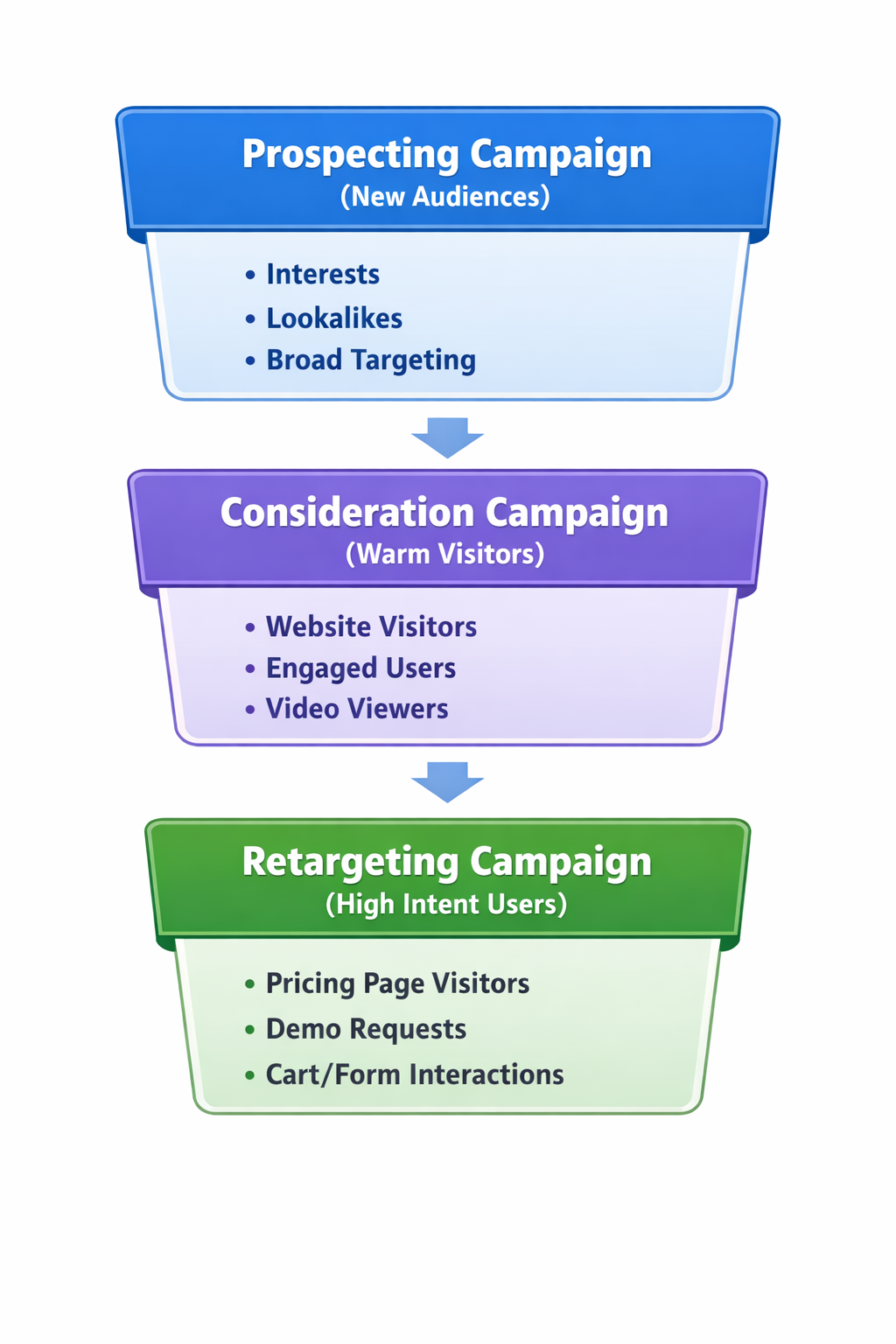
A practical structure usually includes three campaign groups.
Prospecting Campaigns (New Audience Discovery)
Prospecting introduces the offer to users who have never interacted with the brand.
The algorithm relies on indirect behavioral patterns such as:
-
related interests,
-
industry browsing behavior,
-
engagement with similar companies.
Conversion volume from this group is typically low at first.
The objective is signal formation, not immediate scale.
To maintain signal clarity:
-
keep prospecting separate from warm traffic,
-
limit early creative variation,
-
allow the campaign to collect several meaningful conversions before restructuring.
Early volatility is normal while the model identifies clusters of potential buyers.
Consideration Campaigns (Warm Traffic)
Users who visit the site but do not convert often enter a comparison phase that can last days or weeks.
These users already understand the product category and typically revisit the site multiple times.
A separate campaign allows the platform to focus on these behaviors without interference from cold traffic.
Typical audiences include:
-
website visitors (7–30 days),
-
social engagement audiences,
-
video viewers with meaningful watch time.
Creative messaging should address evaluation concerns such as pricing structure, implementation complexity, or results.
Mixing this audience with cold traffic often leads to rising frequency and declining click-through rates as impressions repeatedly reach users already familiar with the brand.
Retargeting Campaigns (High-Intent Users)
Retargeting focuses on users showing strong purchase signals:
-
product or pricing page visits,
-
demo requests,
-
cart or form interactions.
These audiences are small but highly valuable.
Campaign settings should therefore control frequency carefully:
-
shorter retargeting windows (for example 7–14 days),
-
moderate budgets,
-
fewer creatives.
If spend exceeds available audience size, frequency rises quickly and performance drops.
A deeper explanation of retargeting mechanics is covered in How Retargeting Works on Facebook: Best Facebook Retargeting Strategies.
A useful diagnostic inside Ads Manager is the frequency-to-conversion ratio. When frequency exceeds roughly 6–8 impressions without additional conversions, the audience is usually saturated.
Avoid Over-Fragmented Campaign Structures
Some advertisers react to weak performance by splitting campaigns into many small ad sets.
In high-AOV accounts this often prevents the platform from gathering enough signals to stabilize delivery.
Common symptoms include:
-
ad sets repeatedly leaving the learning phase,
-
unstable daily spend distribution,
-
sudden CPM fluctuations.
These problems also appear when campaigns compete in the same auctions, as explained in Facebook Ad Auction: Do Ad Sets Compete Against Each Other?.
A healthier structure balances separation with signal concentration.
Instead of dozens of segments, many accounts perform better with three broader clusters:
-
industry-relevant interests,
-
lookalike audiences based on converters,
-
broad targeting supported by strong creative signals.
Align Budget With the Buying Cycle
Budget allocation should reflect how long the purchase process takes.
Because most users do not convert immediately, prospecting typically requires the largest share of spend.
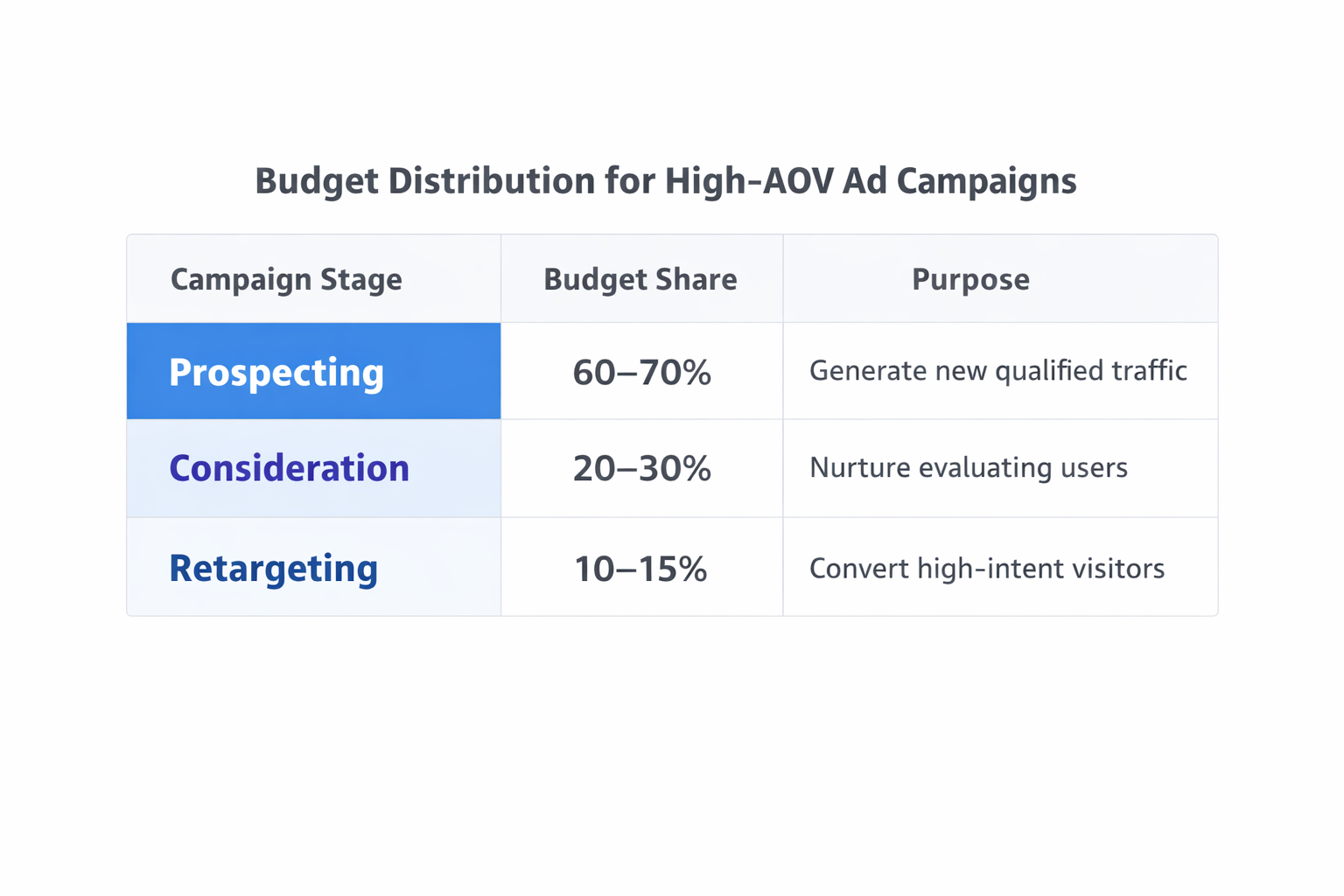
A common allocation pattern:
-
Prospecting: 60–70%
-
Consideration: 20–30%
-
Retargeting: 10–15%
Problems occur when retargeting budgets exceed available audience size. Frequency increases while prospecting remains underfunded.
The account then recycles impressions among the same users instead of reaching new buyers.
This situation often occurs when targeting becomes overly restricted, as discussed in Facebook Ads Audience Too Narrow? How to Troubleshoot a Limited Audience.
Use Conversion Signals That Match Purchase Value
High-AOV businesses often struggle with limited purchase data.
For example, a company selling $5,000 services may generate only a few confirmed purchases per week. Optimizing directly for purchases provides very little signal.
Intermediate events can help increase signal density, including:
-
qualified lead submissions,
-
booked consultations,
-
product configuration completions.
These actions occur earlier in the buying cycle but still represent meaningful buyer intent.
Signal quality remains critical. If low-intent users trigger the event, the algorithm will prioritize the wrong behaviors.
One diagnostic metric is the lead-to-purchase ratio. If fewer than 10–15% of leads convert into customers, the optimization event may be too broad.
Monitor Delivery Signals That Reveal Structural Problems
Structural issues often appear first in delivery metrics.
Three patterns are especially common:
- Rapid frequency growth in prospecting.
If frequency exceeds 3–4 impressions quickly, the audience pool may be too small. - Frequent learning phase resets.
This usually indicates excessive structural edits or fragmented ad sets. - CPM volatility.
Sharp CPM changes across similar audiences often mean campaigns are competing against each other.
These signals often appear before revenue declines, making them useful early warnings.
Practical Takeaway
High-AOV campaigns rarely fail because of creative quality alone.
More often, the campaign structure prevents the algorithm from identifying real buyers.
Separating campaigns by intent level, concentrating conversion signals, and aligning budgets with the buying cycle gives the platform the data it needs to scale effectively.
Once this structure is in place, creative testing and targeting improvements become far more reliable.