Many advertisers move from manual targeting to Advantage+ Audience too quickly. They remove interests, open the audience, and expect Meta to figure everything out on its own.
That can work when the account has strong data. But if you remove all structure without keeping the logic behind your audience, Meta may start learning from weak or mixed signals.
The goal is not to copy your old manual setup inside Advantage+ Audience. The goal is to keep the useful customer patterns and remove the guesses that were only limiting delivery.
Why manual targeting often becomes guesswork
Manual targeting feels controlled because you choose the interests, behaviors, demographics, and exclusions yourself. But many of those choices are based on assumptions, not customer data.
For example, a company selling project management software may target “entrepreneurship,” “small business,” and “marketing.” These interests sound relevant, but they do not prove that someone needs the product.
This is where manual targeting becomes risky. The audience may look logical in Ads Manager, but it may not match the people who actually buy, book calls, or stay as customers.
Before switching to Advantage+ Audience, it helps to understand why audience research is often overlooked in Facebook Ads. If the original targeting was built on guesses, Advantage+ will not magically turn those guesses into a strong signal.
Keep the customer pattern, not every targeting layer
When moving to Advantage+ Audience, do not treat every manual targeting setting as important. Some settings reflect real customer patterns, while others are just leftovers from past tests.
A useful customer pattern usually comes from behavior. Past buyers, qualified leads, repeat customers, demo requests, high-intent website visits, and strong engagement are more useful than broad interests.
A weak targeting layer is usually harder to defend. If an interest was added because it “seemed relevant,” it probably should not guide the new setup.
A simple way to clean the logic:
- Keep proven buyer signals. Use past purchasers, qualified leads, high-value customers, or strong website actions when available.
- Remove weak assumptions. Do not carry over interests only because they were part of the old ad set.
- Keep real business limits. Location, language, product availability, and compliance rules still matter.
- Use suggestions carefully. Audience suggestions should guide Meta, not rebuild the old manual audience.
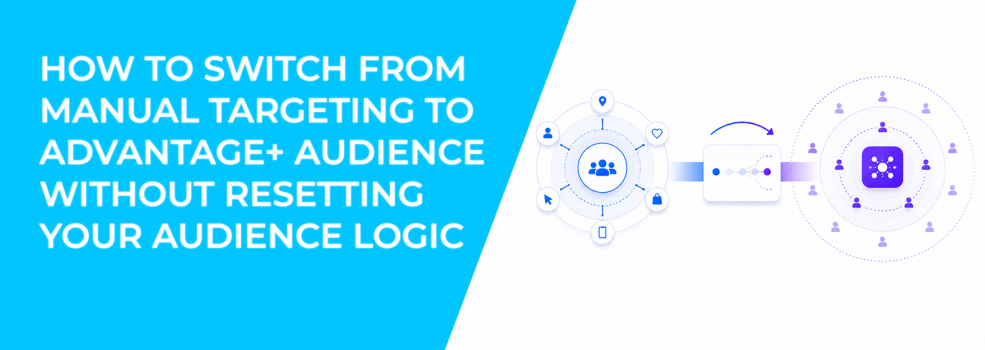
This is how you move toward automation without losing control. You are not starting from zero. You are separating real customer logic from targeting habits.
How to switch without confusing Meta
The biggest mistake is changing targeting, creative, budget, and conversion events at the same time. If performance changes, you will not know what caused it.
Start with a clean transition. Keep the offer, creative, objective, and conversion event stable while you test the audience setup. This makes the result easier to read.
If your manual campaign had one strong audience, test it against an Advantage+ Audience version with similar customer signals. Do not add five new creatives or change the landing page during the same test.
This is also where campaign structure matters. A messy account makes it harder to understand whether Meta is learning from the right people. If the account is already overloaded, review how to structure Facebook campaigns for faster learning before changing the audience setup again.
What to watch after switching
Do not judge the new setup only by CPC. Advantage+ Audience may find cheaper clicks, but those clicks still need to turn into qualified leads or sales.
Watch the relationship between reach, CPM, conversion rate, CPA, and lead quality. If reach grows but qualified leads drop, Meta may be expanding into weaker traffic.
A better test looks at:
- cost per qualified lead;
- booked call rate;
- purchase rate;
- average order value;
- ROAS;
- sales feedback.
If the campaign gets more volume but weaker quality, the audience input may be too loose. If quality improves but delivery stays low, Meta may need broader signals or more budget stability.
When manual targeting still has a role
Manual targeting is not useless. It can still help when you are testing a specific niche, working with limited data, or trying to understand which customer segment responds best.
For example, a local service business may still need tight location control. A B2B advertiser may want to test one clear industry segment before opening delivery wider.
The mistake is not using manual targeting. The mistake is treating every manual setting as a proven customer insight.
A good transition keeps the useful parts of manual targeting while letting Meta test beyond your assumptions. That is the balance behind smarter audience building beyond Meta’s built-in targeting tools.
Final takeaway
Switching to Advantage+ Audience should not mean deleting your audience logic. It should mean cleaning it.
Keep the signals that come from real customers. Remove the settings based on guesses. Then give Meta enough room to learn from better inputs instead of forcing it to follow an old manual setup.