Today’s customers move fast. They scroll past your ad, check your social feed, and open an email — all within minutes.
If your message changes from one channel to the next, you lose their trust and attention. But if your message feels consistent, you gain momentum and improve results.
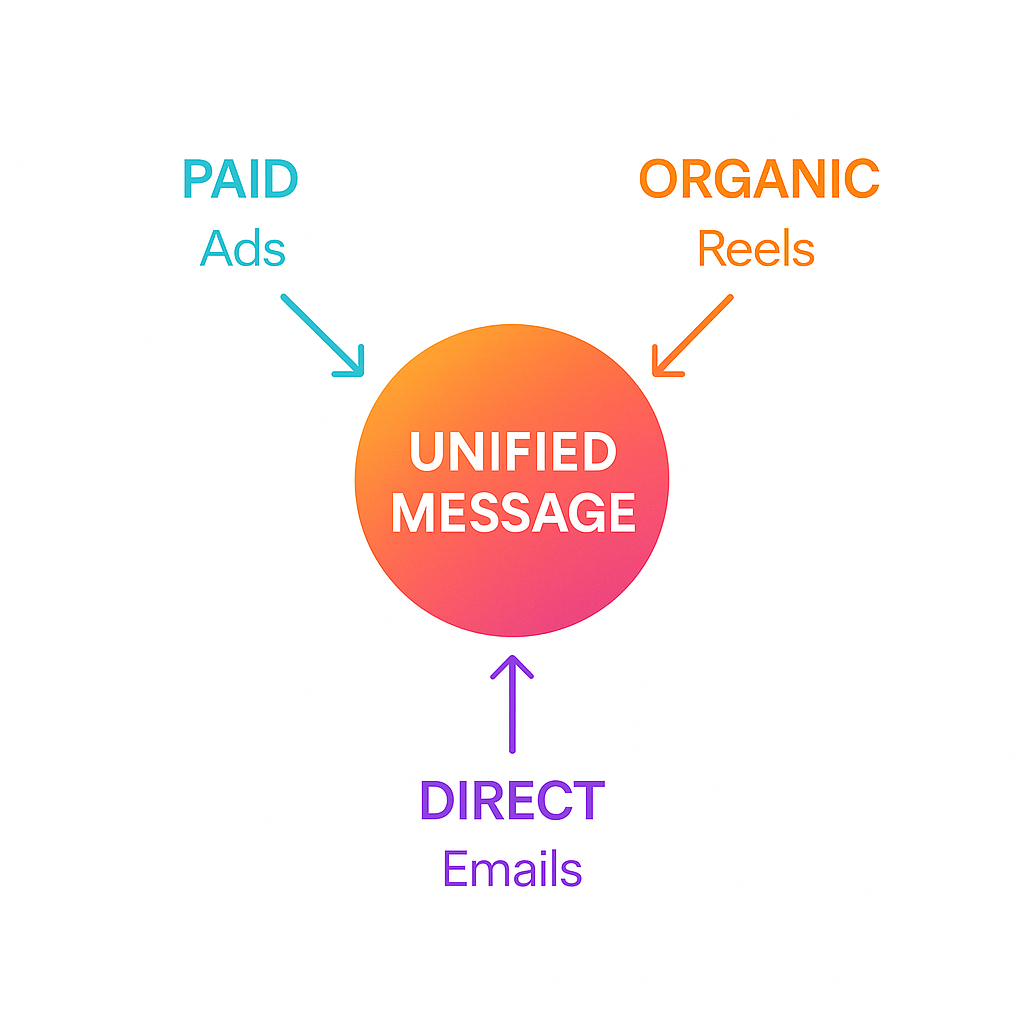
In this guide, you'll learn how to align your messaging across:
-
Paid ads (Meta, Google, and other platforms);
-
Organic content (social media, SEO, blogs);
-
Direct channels (email, SMS, DMs).
If you’re wondering why this matters now more than ever, see Why Organic and Paid Social Need to Work Together.
Why Consistent Messaging Leads to Higher Performance
Each platform may seem different, but your customer sees only one brand — yours. Mixed messages create confusion. Unified messages create clarity and confidence.
Consistent messaging gives you:
-
Stronger brand trust
When your voice and value stay the same across platforms, you feel more credible. -
Better conversions
Repetition removes doubt. It reinforces what you offer and makes the next step easier. -
Easier content planning
With one core message, your team can adapt it to fit each channel instead of starting from scratch.
This kind of alignment reduces friction across the customer journey and that leads to better results.
Step 1: Define a Clear Core Message
Every campaign should start with one core idea. This message is the foundation for everything else: your ads, posts, emails, and landing pages.
If you’re not sure how to match your message with your ad type, review Meta Ad Campaign Objectives Explained.
A strong core message is:
-
Clear — It avoids jargon and speaks in plain language.
-
Specific — It includes outcomes, benefits, or timelines your audience cares about.
-
Repeatable — It’s short enough to use in many formats, from headlines to captions.
Examples include:
-
“Cut dry skin in 7 days — or your money back.”
-
“Switch to solar and save 25% by spring.”
-
“Get 10 hours back every week with our tool.”
Start every campaign by writing your core message down. Share it across teams. Everything else should align with it.
Step 2: Adjust the Message for Each Channel
You don’t need to repeat the same sentence on every platform. Instead, adjust the message while keeping the meaning the same.
Each channel has a different audience mood, format, and purpose. Your job is to make the message feel natural in that space.
How to adapt your message:
-
Paid Ads (Meta/Instagram)
Use short, punchy copy focused on one benefit.
Example: “See results in 7 days — or it’s free.” -
Organic Instagram or Facebook Posts
Use visuals or storytelling. Make the message feel like a conversation.
Example: A carousel of before-and-after photos with a caption: “Real results. Just 7 days.”
(Need more ideas? Read Social Media Strategies Every Small Business Should Use.) -
Email or SMS
Be personal and direct. Make it feel like a one-on-one message.
Example: “Your skin could look better by next week. Here’s how to start.”
These versions all support the same message. But they’re tuned to feel native in their format, which makes them more effective.
Step 3: Align Messaging to Funnel Stages
Even with the same core message, not everyone should hear it in the same way. Customers are in different stages of the funnel — and your message should reflect that.
If you want a deep dive into this, check out Facebook Ads Funnel Strategy: From Audience Identification to Conversion.
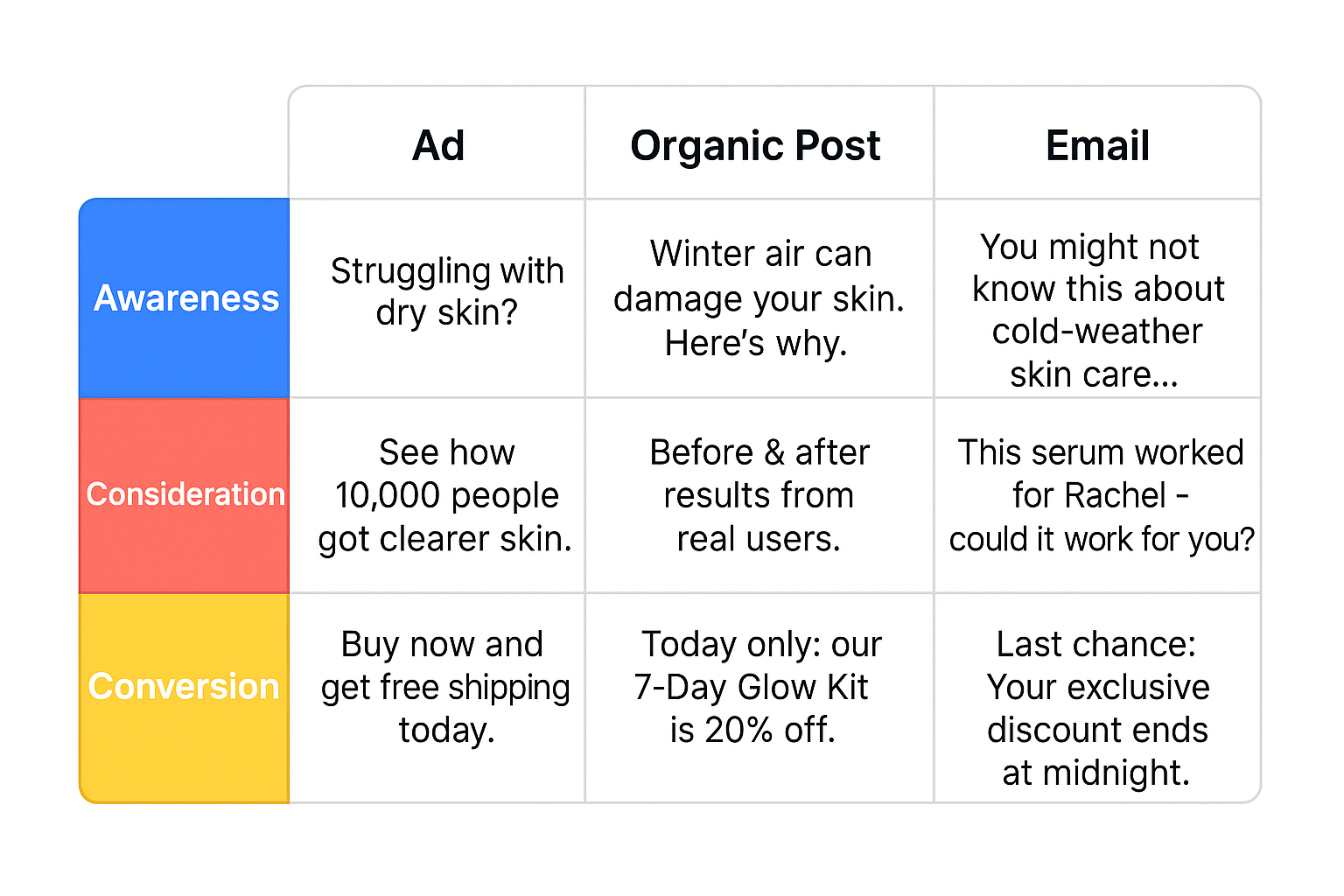
How to align messaging by funnel stage:
-
Top of Funnel (Awareness)
Focus on education and curiosity.
Example: “Why winter makes your skin worse — and what you can do about it.” -
Middle of Funnel (Consideration)
Build trust with proof and solutions.
Example: “How 10,000 people improved their skin in 7 days with our product.” -
Bottom of Funnel (Conversion)
Add urgency and incentives.
Example: “Limited-time offer: free shipping ends tonight.”
This layered approach helps you meet customers where they are. It also prevents over-selling to people who aren’t ready — or under-selling to those who are.
Step 4: Use a Shared Calendar to Coordinate Teams
Even with a clear message, campaigns can fall apart when teams work in silos. The ads team may push one angle, while the email team promotes another.
A shared calendar solves this problem by showing everyone the full picture.
Your calendar should include:
-
Themes by week or campaign
Example: “Winter skincare,” “Holiday gift guide,” or “Q1 demo drive.” -
Planned content per channel
Example: Reel on Monday, email on Tuesday, retargeting ad on Thursday. -
Deadlines and launch dates
Everyone knows when content goes live, so timing stays tight.
If you’re coordinating paid and email efforts, also read How to Sync Your Meta Ads With Email Marketing for Higher Conversions.
This simple tool prevents misalignment and keeps your messaging rhythm steady across platforms.
Step 5: Track What Works and Refine Over Time
Consistency doesn’t mean repeating weak messages. You still need to test different angles and see what performs.
Each channel gives different data — and those signals help you refine your core message.
What to track by channel:
-
Paid Ads
Watch CTR, conversion rate, and cost per result.
Ask: Which messages drive clicks and purchases? -
Organic Posts
Watch saves, shares, and comments.
Ask: What topics or visuals get people to engage? -
Email/SMS
Watch open rate, click rate, and replies.
Ask: Which subject lines or offers drive action?
Once you find a message that performs, double down on it. Use it as your new standard and build the next campaign around it.
Examples: How Brands Sync Messaging
Let’s look at how two fictional brands keep their message consistent — but channel-appropriate.
Skincare Brand Example
-
Paid Ad: “7-Day Glow Guarantee — Try risk-free today.”
-
Instagram Reel: Customer testimonial with before-and-after shots labeled “7-Day Glow Challenge.”
-
Email: Subject line: “Get glowing skin in one week — here’s how.”
SaaS Tool for Freelancers
-
Paid Ad: “Save 10+ hours per week on admin work — Try free.”
-
LinkedIn Post: A freelancer shares their success using the tool to automate billing.
-
Email: Case study with the headline “How Jess cut her admin time in half.”
Each message supports the same promise — but it’s tailored to match the content format and the platform tone.
Conclusion: Say the Same Thing, the Smart Way
Your audience doesn’t think in “channels.” They think in experiences. Whether they’re seeing your ad, reading your post, or opening your email, they expect one thing: clarity.
Consistency doesn’t mean repetition. It means delivering the same core message — adapted for each stage, platform, and moment.
To make that happen:
-
Start with one core message;
-
Adapt it by channel, not copy-paste;
-
Tailor it to funnel stages;
-
Use a shared calendar to stay aligned;
-
Track performance and improve the message over time.
Want to go deeper on building messaging alignment? Explore How to Sync Your Meta Ads With Email Marketing for Higher Conversions for real-world strategies.