The opening line of your ad — your hook — determines whether people stop scrolling or ignore your message completely. But while strong hooks can dramatically lift results, testing them can quickly drain your budget if done inefficiently. Here’s how to validate your angles, messages, and scroll-stoppers without unnecessary spend.
Why Hooks Matter More Than Ever
Across industries, advertisers report that up to 70% of an ad’s performance is driven by creative, and the hook is responsible for the first 1–2 seconds of engagement. Meta’s internal benchmark data shows that ads capturing attention early can reduce cost per result by up to 40%.
Still, testing hooks blindly or in full campaigns can lead to wasted impressions and increased CPM. A lean, structured testing workflow is essential.
Step 1: Start With 3–5 Distinct Hook Angles
Instead of testing dozens of variations, begin with a tight set of hooks that represent different emotional or logical triggers:
-
Problem-first
-
Benefit-first
-
Curiosity
-
Contrarian
-
Urgency
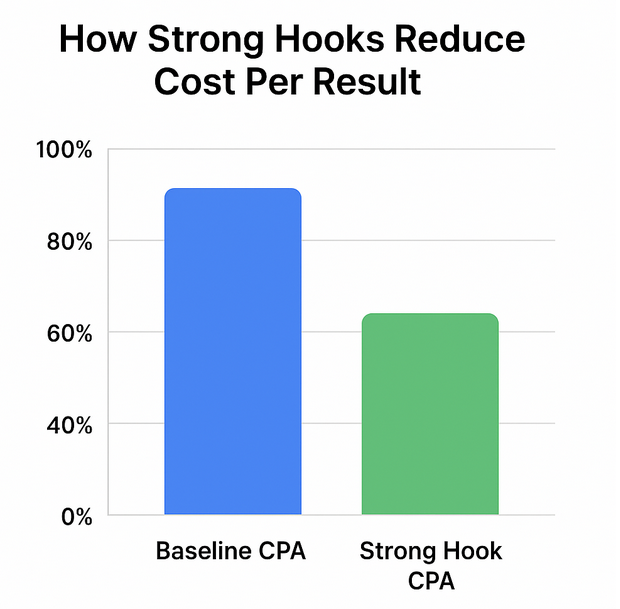
Ads with strong, validated hooks can reduce cost per result by up to 40%, making hook testing one of the highest-ROI creative optimization steps
Advertisers who limit initial tests to 3–5 angles see 20–30% lower test costs compared to those launching broad, unstructured variations.
Step 2: Run Hook Tests in Short Bursts
Instead of running hooks for days, evaluate performance quickly — usually within the first 500–1,000 impressions per variation. This ensures you:
-
Stop unproductive hooks early
-
Preserve budget for promising angles
-
Avoid forcing the algorithm to overspend before learning
Meta data suggests that early engagement metrics within the first 24 hours reliably predict long-term performance 80% of the time.
Step 3: Measure Success With Micro-Metrics
Instead of optimizing on conversions at this phase, judge hooks by metrics closest to the scroll:
-
Thumb-stop ratio
-
3-second views
-
Click-through rate
-
Cost per click
A good rule: any hook delivering 25–50% higher thumb-stop rates than your baseline is worth moving forward into deeper testing.
Step 4: Keep Creative Constant Except for the Hook
To attribute results accurately, isolate the hook. Keep:
-
The same visual style
-
The same script or message structure
-
The same CTA
Only the first 1–3 seconds should change. This ensures your insights are about hook quality — not broader creative differences.
Step 5: Promote Only the Winners
Once top performers emerge, build new creatives that fully lean into those validated angles. These have a much higher chance of scaling profitably.
In many cases, campaigns using tested hooks achieve 15–35% lower CPA compared to creatives launched without pre-validation.
Step 6: Re-Test Regularly
Audience fatigue affects hooks faster than full creative concepts. Even strong performers may lose effectiveness after a few weeks. Regular testing cycles — ideally every 2–4 weeks — help maintain stable cost performance.
Useful Statistics for Visuals
-
Hook Impact on Cost Efficiency: Ads with a strong hook reduce cost per result by up to 40%.
-
Predictive Performance: Early engagement (first 24 hours) predicts long-term outcomes 80% of the time.
These can be used for charts or graphics illustrating creative efficiency trends.