
Testing is one of the few reliable ways to improve ad performance, but many advertisers unintentionally sabotage their own experiments. When too many variables change at once, it becomes nearly impossible to understand which change influenced the outcome. The 4-variable rule offers a simple, disciplined approach for designing tests that produce clean, trustworthy insights.
Below, we break down how the rule works, why it matters, and how you can apply it to any advertising channel.
What Is the 4-Variable Rule?
The 4-variable rule states that every ad experiment should control for all variables except the one being tested. In practice, advertisers should focus on four core components:
-
Audience
-
Creative
-
Placement
-
Optimization event
A clean test changes just one of these variables at a time while keeping the other three identical. This structure ensures that any performance difference has a clear, singular source.
Why the Rule Matters
Clean tests dramatically increase the chance of extracting real, repeatable insights. Research across advertising platforms shows how volatile metrics can be when multiple factors shift simultaneously. For instance:
-
A Meta study found that inconsistent audience segments can create up to 3× variation in cost per result, even with the same creative.
-
Internal analyses across large ad accounts show that changing two variables at once decreases result reliability by 40–60%, leading to misleading conclusions.
When variables are isolated, insights sharpen and budgets stop being wasted on guesswork.
The Four Variables Explained
1. Audience
Keep audience size, targeting logic, and filters identical when the test is not about audience differences. Even small audience deviations can skew CTR and conversion rate.
2. Creative
If testing creative, all other components must remain unchanged. The structure, messaging, and design of the creative itself become the only influencing factor.
3. Placement
Placements affect CPM, CPC, and conversion rate. When running placement tests, ads should be carbon copies aside from where they appear.
4. Optimization Event
Testing for link clicks versus conversions, for example, fundamentally changes delivery. That single switch should be the only variable adjusted.
How to Apply the Rule in Real Campaigns
Step 1: Choose the single variable you want to test
Start with the variable you think has the highest performance leverage—often creative or audience.
Step 2: Create two or more variations where everything but one variable remains identical
For example: two creatives, one audience.
Step 3: Ensure both groups receive similar spend and run simultaneously
Running tests sequentially often introduces seasonality bias.
Step 4: Collect data long enough to reach statistical confidence
For most campaigns, this usually requires at least 7–14 days depending on spend.
Step 5: Apply the learning to the next experiment
Clean testing is a continuous cycle, not a one-time task.
Common Mistakes to Avoid
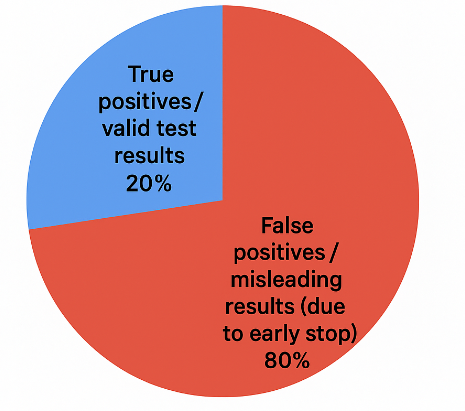
Stopping a test too early can lead to as much as 80% of ‘winning’ results being false-positives
-
Changing creative and audience simultaneously — impossible to isolate the winning factor.
-
Switching placements mid-test — resets learning and corrupts results.
-
Stopping tests early — premature decisions often reverse once more data accumulates.
Final Thoughts
Consistent, disciplined application of the 4-variable rule leads to cleaner experiments and stronger performance insights. Clear results create a stable foundation for scaling campaigns and increasing return on ad spend.