If you're running ads on Facebook or Instagram, testing your message isn’t just a nice‑to‑have — it’s essential. You can have great targeting and visuals, but if the message doesn’t match what your audience needs to hear, your results won’t scale.
In this guide, we’ll walk you through how to test messaging across the three main stages of the funnel — Top, Middle, and Bottom. Whether you're just launching campaigns or managing a large ad account, these strategies will help you run more profitable, message‑driven ads.
Why Messaging Should Match Funnel Stage
A lot of marketers know how to target cold, warm, and hot audiences. But many use the same message across all audiences. That’s a common mistake.
Using one message across all funnel stages usually leads to:
-
Low engagement from cold users;
-
Warm leads getting confused or bored;
-
Hot buyers clicking — then bouncing.
When you align your message with where someone is in their buying journey, you’ll start to see:
-
Lower CPMs — because your ads feel more relevant;
-
Higher engagement — since your message resonates;
-
Better conversion rates — because your timing is right.
Meta’s ad system rewards relevance — and so do your potential customers. If you're still focusing mostly on visuals, it may be time to rethink your approach. Here's why you should A/B test your messaging — not just your creative.
Know the Funnel Before You Test
Before you run your tests, it’s important to understand what users at each funnel stage are thinking and what kind of message they need. The way you talk to someone who just discovered you should be very different from how you talk to someone who’s ready to buy.
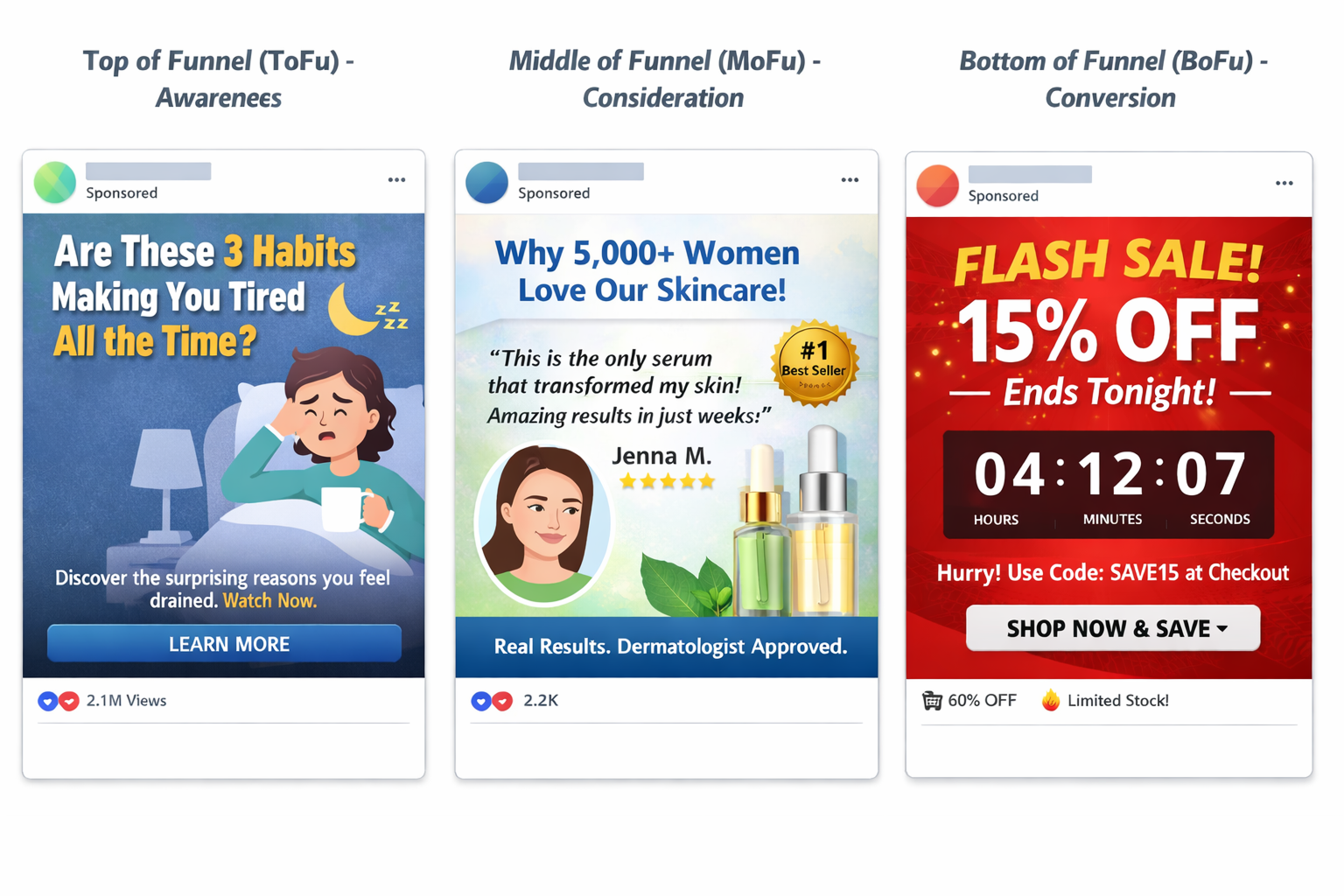
Top of Funnel (ToFu) – Awareness
At this stage, users are just discovering your brand. They don’t know you yet — and they’re not looking to buy. Your job here is simple: get attention and create interest.
Here’s what usually works well in ToFu messaging:
-
Education — Share something useful, interesting, or surprising that relates to the problem you solve;
-
Curiosity — Ask a question or make a bold claim that gets people thinking;
-
Entertainment — Use humor, trending content, or storytelling to connect emotionally.
Example: a wellness brand might say, “Are These 3 Habits Draining Your Energy Every Day?” Or use a fast‑paced video with a hook like, “If you’re over 35, this might explain why you’re not sleeping well.”
Your goal is to stop the scroll and spark curiosity. Encourage soft actions like watching, saving, or clicking to learn more. If you're not sure how to structure your creative for these types of tests, check out our guide on how to A/B test your Facebook ad creative for better results.
Middle of Funnel (MoFu) – Consideration
Now you’re talking to people who’ve seen your ads, clicked through, or visited your site. They’re curious — but not sold. This is where you build trust and show why you’re different.
Effective MoFu messages often focus on:
-
Social proof — Reviews, testimonials, influencer quotes, or client success stories;
-
Clear benefits — What makes your product or service better or different;
-
Added value — Free guides, product previews, demos, or quizzes.
Example:
A skincare brand might run a carousel ad with the headline, “Why Over 3,000 Women Switched to Our Skincare Line.” Or a fitness coach might post a video titled, “How This Busy Dad Lost 15lbs Without a Gym or Diet.”
This is the time to answer common questions and reduce doubt. Show that you understand your audience’s problems and have the solution.
Bottom of Funnel (BoFu) – Conversion
At BoFu, people are ready to take action. They’ve been to your website, added something to their cart, or visited your pricing page. Your job now is to remove hesitation and drive the final decision.
BoFu messaging works best when it includes:
-
Urgency — Limited‑time offers, deadlines, or low inventory warnings;
-
Reassurance — Money‑back guarantees, trust badges, or secure checkout cues;
-
Strong CTAs — Clear, direct calls to action like “Buy Now,” “Claim Discount,” or “Finish Checkout.”
Example: you might run a retargeting ad that says, “Still Thinking It Over? Get 15% Off If You Order Today.” Or show a clean, product‑focused image with the line, “Your Cart Is Still Waiting — Free Shipping Ends Tonight.”
Don’t overcomplicate things at this point. Clarity and confidence matter most.
How to Test Messaging the Right Way
Now that you know how messaging should shift by funnel stage, let’s break down how to test it strategically.
Step 1: Break Out Your Audiences
First, create separate audiences for each funnel stage. This ensures your messaging goes only to the right users at the right time.
In Meta Ads Manager, try this:
-
ToFu — Interest‑based audiences, broad lookalikes (5–10%), or new demographic/geographic segments;
-
MoFu — Video viewers (25%+), engaged Instagram users, recent website visitors (last 30 days);
-
BoFu — Cart abandoners, product page viewers, checkout initiators (last 1–7 days).
With this structure, you can tailor messaging and track performance accurately across stages.
To keep your messaging consistent as users move across platforms, learn how to create unified messaging across Facebook and Instagram ads.
Step 2: Write a Clear Hypothesis
Before launching any new ad, define what you’re testing and why. This keeps your message focused and your data meaningful.
Here are simple examples of clear hypotheses:
-
MoFu: “Will a customer testimonial video get more clicks than a product explainer carousel?”
-
BoFu: “Does a 24‑hour discount convert better than a money‑back guarantee offer?”
When you know your goal, you’ll know exactly what success looks like.
Step 3: Keep Each Test Focused
When testing messaging, change only one thing — the core message. Keep format, CTA, and targeting consistent.
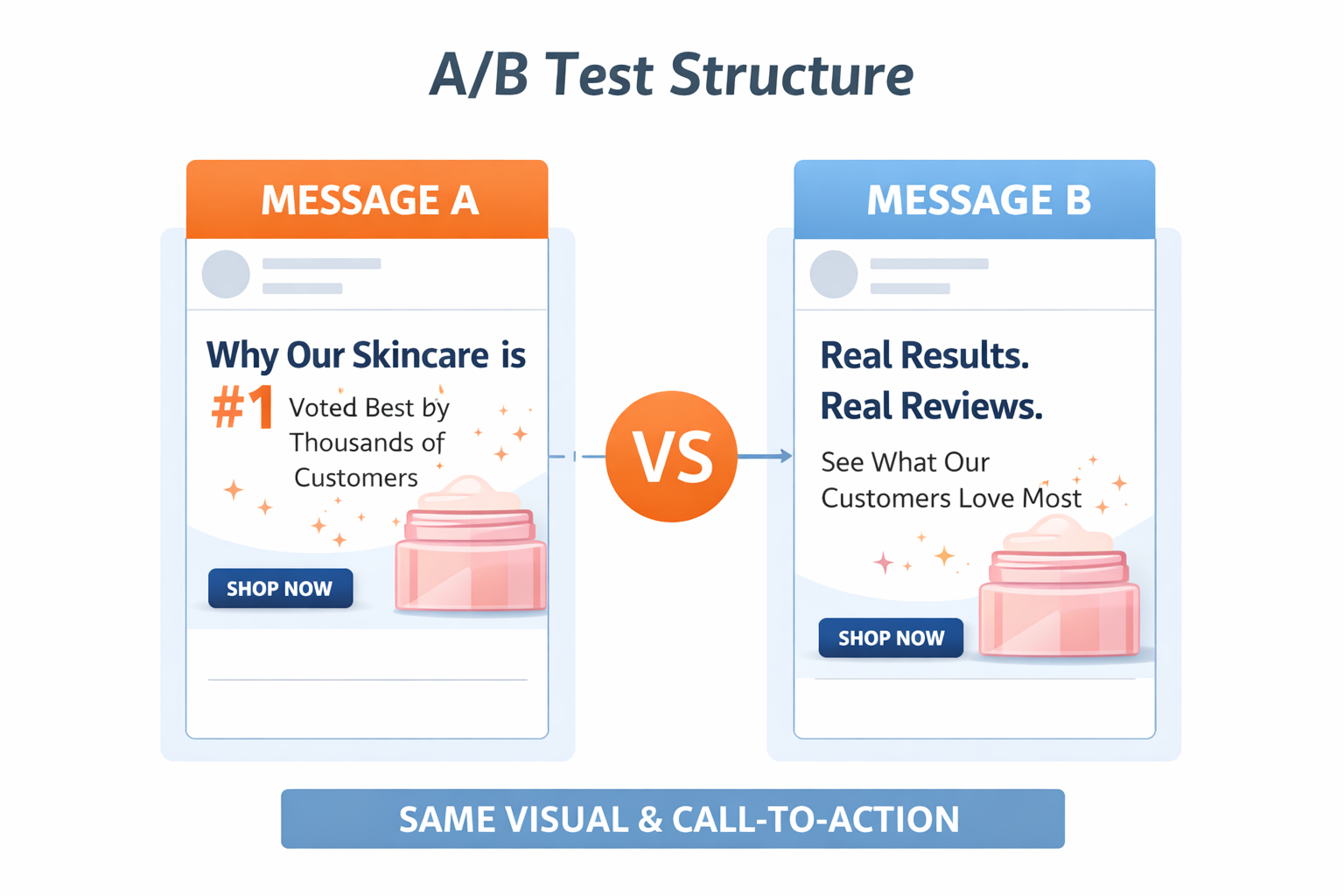
Here are good variant ideas by stage:
ToFu:
-
Emotional hook vs. curiosity‑based headline;
-
Educational video vs. storytelling carousel.
MoFu:
-
Customer quote vs. benefit list;
-
Product how‑to video vs. behind‑the‑scenes image.
BoFu:
-
Discount offer vs. free shipping;
-
“Low stock” urgency vs. “24‑hour countdown.”
This approach makes it much easier to see what actually works.
Step 4: Track the Right Metrics
Each funnel stage has a different goal. Don’t judge a ToFu ad by its sales or a BoFu ad by its reach.
Here’s a simple breakdown:
| Funnel Stage | Main Goal | Focus Metrics |
|---|---|---|
| ToFu | Reach & Engagement | CPM, Video Views, Engagement %, CTR (all) |
| MoFu | Clicks & Leads | Link CTR, Landing Page Views, Cost per Lead |
| BoFu | Sales & ROAS | Cost per Purchase, Conversion Rate, ROAS |
Use these benchmarks to measure each test accurately and objectively.
Step 5: Analyze, Learn, and Improve
Let each test run at least 5–7 days or until you have enough data. Then:
-
Turn off underperformers to free up budget;
-
Scale winners into higher‑budget campaigns;
-
Retest with improved variations based on what you learned.
Keep a simple tracker — note each ad’s funnel stage, audience, test idea, result, and next step.
Pro Tips to Get the Most from Messaging Tests
Label Your Ads Clearly
Clear naming helps you stay organized and speeds up performance analysis. Try something like:
-
TOFU_Curiosity_Hook_Video_V1 -
BOFU_Urgency_Discount_Static_V2
Clean naming also helps when teammates or clients review performance.
Keep Test Campaigns Separate
Run tests in dedicated campaigns with smaller budgets. Once a message proves successful, then move it into your main scaling campaigns.
This protects your best audiences and budgets while you explore new ideas.
Refresh Creatives Before They Fatigue
Even the strongest message will wear out over time. Rotate in new variants every few weeks:
-
ToFu ads often need fresh content every 2–3 weeks;
-
MoFu/BoFu ads can last a bit longer but still need monitoring for rising costs.
Leverage your top‑performing messages to build the next round of creative.
Final Thoughts: Better Messaging = Better Results
If you want your ads to work harder — not cost more — you need better messaging.
When your message matches your audience’s stage:
-
Cold users pay attention;
-
Warm users engage and learn more;
-
Hot users convert with confidence.
Message testing is a key part of scaling profitable campaigns. Start simple, stay focused, and let the data guide your next move.