Most advertisers obsess over Cost per Lead (CPL). It’s easy to track, compare, and scale around. But here’s the hard truth: CPL is a misleading metric when used in isolation.
Optimizing for lead value — not just lead volume — is what separates average campaigns from profit-driving ones.
In this article, we’ll break down why CPL alone leads to flawed decisions, how to calculate and act on true lead value, and when to prioritize each metric depending on your business model.
What Is Cost per Lead (CPL)?
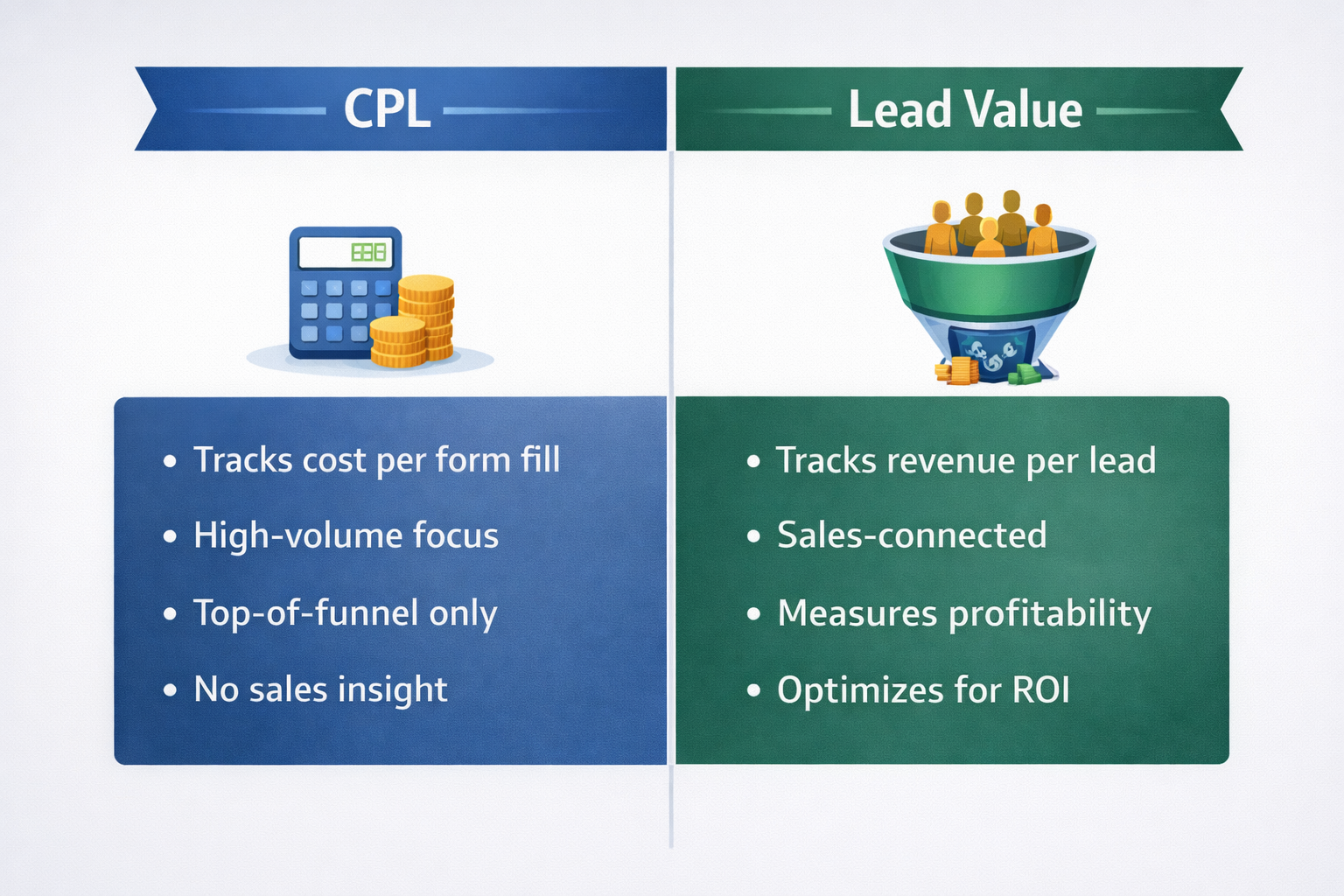
Cost per Lead is a top-of-funnel metric that measures how much it costs you to acquire a new lead.
Formula: CPL = Total Ad Spend ÷ Number of Leads
It tells you how efficiently you’re capturing leads — but it tells you nothing about what happens next.
When CPL Is Useful
-
During creative testing, to see which ads hook attention;
-
In early-stage campaigns, when building a list or audience pool;
-
When comparing top-of-funnel offers like lead magnets, quizzes, or gated content.
If you’re still refining your acquisition strategy, check out our guide to mastering lead generation, where we outline tactical ways to build higher-quality pipelines.
What Is Lead Value?
Lead Value measures the average revenue or profit each lead generates once they move through your sales pipeline.
Formula:
Lead Value = Total Revenue from Leads ÷ Number of Leads
This metric ties ad performance directly to revenue — allowing you to assess actual profitability instead of surface-level efficiency.
Why Lead Value Is a Strategic Metric
-
It connects marketing to sales, showing which campaigns bring in buyers — not just contacts;
-
It enables accurate ROAS and CAC calculations, which are essential for scaling;
-
It prevents false positives — high-volume campaigns that burn budget but never convert.
If your CPL is low but you’re still not seeing conversions, you might be facing deeper funnel issues. Learn how to fix that in Why Your Facebook Ads Aren’t Generating Leads.
CPL vs. Lead Value: The Misleading Nature of "Cheap" Leads
Let’s say you're running two ad sets.
| Ad Set | CPL | Leads | Revenue | Lead Value | ROAS |
|---|---|---|---|---|---|
| A | $4 | 200 | $800 | $4 | 1.0 |
| B | $9 | 100 | $2,000 | $20 | 2.2 |
On the surface, Ad Set A seems more efficient — cheaper CPL, more leads.
But Ad Set B generates 2.5x the revenue with half the leads. Its leads are higher intent, better qualified, and more likely to convert.
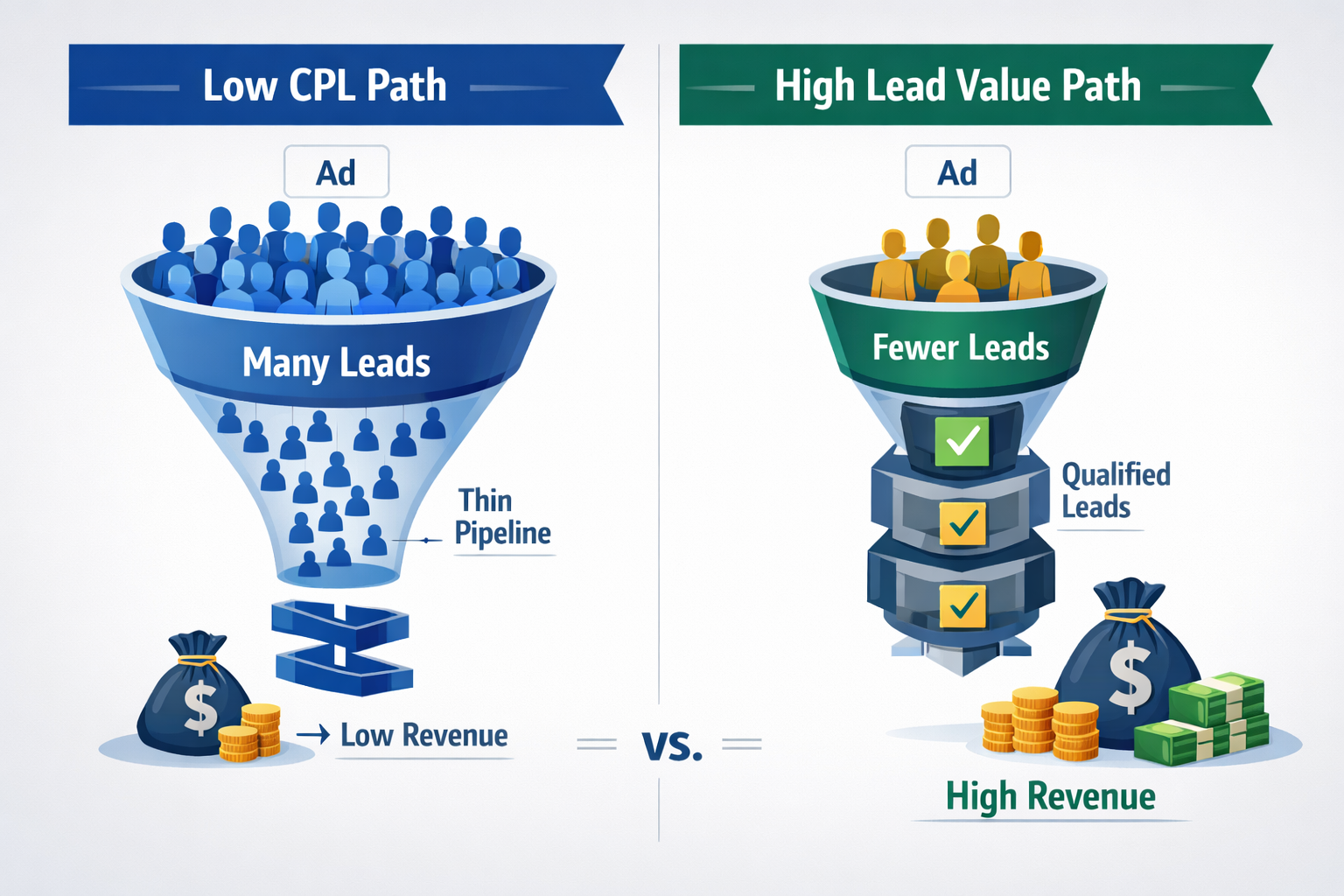
If you optimize for CPL, you scale A.
If you optimize for Lead Value, you scale B.
Which one grows your business?
How to Accurately Measure Lead Value
1. Track the Full Customer Journey
The most common mistake advertisers make: tracking the lead, but not the sale.
Fix it:
Connect your ad platform (Meta Ads) with your CRM or sales system.
-
Use Meta’s Conversions API and Offline Events;
-
Sync with CRMs like Salesforce, HubSpot, or Pipedrive;
-
Use Zapier, Make, or Segment to bridge platforms if native integration isn’t available.
If you’re using Meta’s tools, explore how to leverage Meta Advantage Lead Campaigns to get stronger outcomes from the start.
2. Assign Revenue and Weight to Each Lead
Not all leads are equal. Assign dollar values to leads using one of these methods:
-
Static average value — e.g., each closed lead is worth $500, and your close rate is 10%, so the average lead value is $50.
-
Dynamic lead value — track actual closed revenue from each campaign or ad set using CRM data and attribution.
3. Segment Lead Value by Key Variables
To make data actionable, segment lead value across:
-
Audience types: Cold vs. warm, lookalike vs. interest-based;
-
Campaign structures: Lead magnets, booking flows, direct offers;
-
Creative themes: Proof-driven, emotional, educational, urgency-based;
-
Lifecycle stage: Are these first-time leads or retargeted users?
When to Optimize for CPL vs Lead Value
There are cases where optimizing for CPL makes sense. But for most revenue-focused businesses, lead value is the north star.
Prioritize CPL When:
-
You’re in discovery or testing mode;
-
You’re running lead generation for nurturing (email lists, webinars, guides);
-
Your sales process happens later, outside of campaign attribution windows.
If your business is B2B, we recommend these quick Facebook lead generation tips to make early-stage CPL optimization more strategic.
Prioritize Lead Value When:
-
You have mature funnels with revenue tracking;
-
You're running mid- to bottom-funnel campaigns;
-
You want to scale profitably, not just fill the pipeline.
How to Optimize for High Lead Value
To shift from surface metrics to revenue-focused optimization, you’ll need structural and strategic changes.
1. Set Conversion Events Beyond the Lead
In Meta Ads Manager:
-
Create custom events for Booked Call, Checkout Initiated, Form Step 2, or Application Submitted.
-
Set these events as your campaign optimization goals, not just “Lead.”
This trains Meta’s algorithm to seek users likely to convert, not just fill a form.
2. Improve Your Pre-Qualifying Funnel
High-value leads are selective. Your funnel must:
-
Set expectations (timeline, budget, offer fit);
-
Include filters or questions that discourage poor-fit users;
-
Align language and design with your ideal customer profile (ICP).
3. Use Creative That Attracts Buyers, Not Browsers
Shift away from clickbait or over-simplified hooks. Instead:
-
Use proof: Client wins, real outcomes, testimonials;
-
Speak to pain points: Highlight urgency and problems your ICP actually faces;
-
Add friction: Use copy that makes your offer exclusive or premium.
Forecast Lead Value Before Scaling
When testing new campaigns, use predictive data to estimate lead value early:
-
Combine early conversion metrics with historical sales data;
-
Use first-party data and modeled probabilities to forecast outcomes;
-
Set minimum lead value thresholds for scaling.
Why it matters? It prevents you from scaling low-quality campaigns that fill your CRM with dead leads.
Final Thoughts: Lead Quality Is the New Performance Metric
If you want to run profitable, scalable ad campaigns in 2025 and beyond, stop optimizing just for CPL.
Modern ad platforms reward volume — but your business survives on revenue. That means shifting your tracking, reporting, and decision-making to reflect lead value, not just lead cost.
So,
-
Low CPL without high lead value = wasted ad spend;
-
High CPL with strong lead value = scalable profit,
Lead value ties marketing to business outcomes — and that’s what matters most.