
Benchmarks can help you make better advertising decisions. But if you treat them as goals instead of guides, they’ll often lead you in the wrong direction.
In this article, we’ll look at how to use performance benchmarks without falling into the trap of chasing “average” results.
Why Advertisers Use Benchmarks
Benchmarks are used to get a rough idea of how your ads are doing. They give you a point of comparison and help you know whether your results are unusually high or low.
Most marketers use them to:
-
Spot performance gaps that need attention;
-
Set expectations for new campaigns;
-
Help explain results to clients or team members.
All of that is helpful, as long as you don’t rely on them too heavily.
The Problem With Chasing Averages
Benchmarks are based on averages. But in advertising, averages don’t always tell the full story.
You might be tempted to fix something that doesn’t actually need fixing. Or worse, you could keep running a campaign that looks great on paper but isn’t bringing in real results. This often happens when advertisers focus too much on surface metrics instead of deeper performance signals, as explained in How to Analyze Facebook Ad Performance Beyond CTR and CPC.
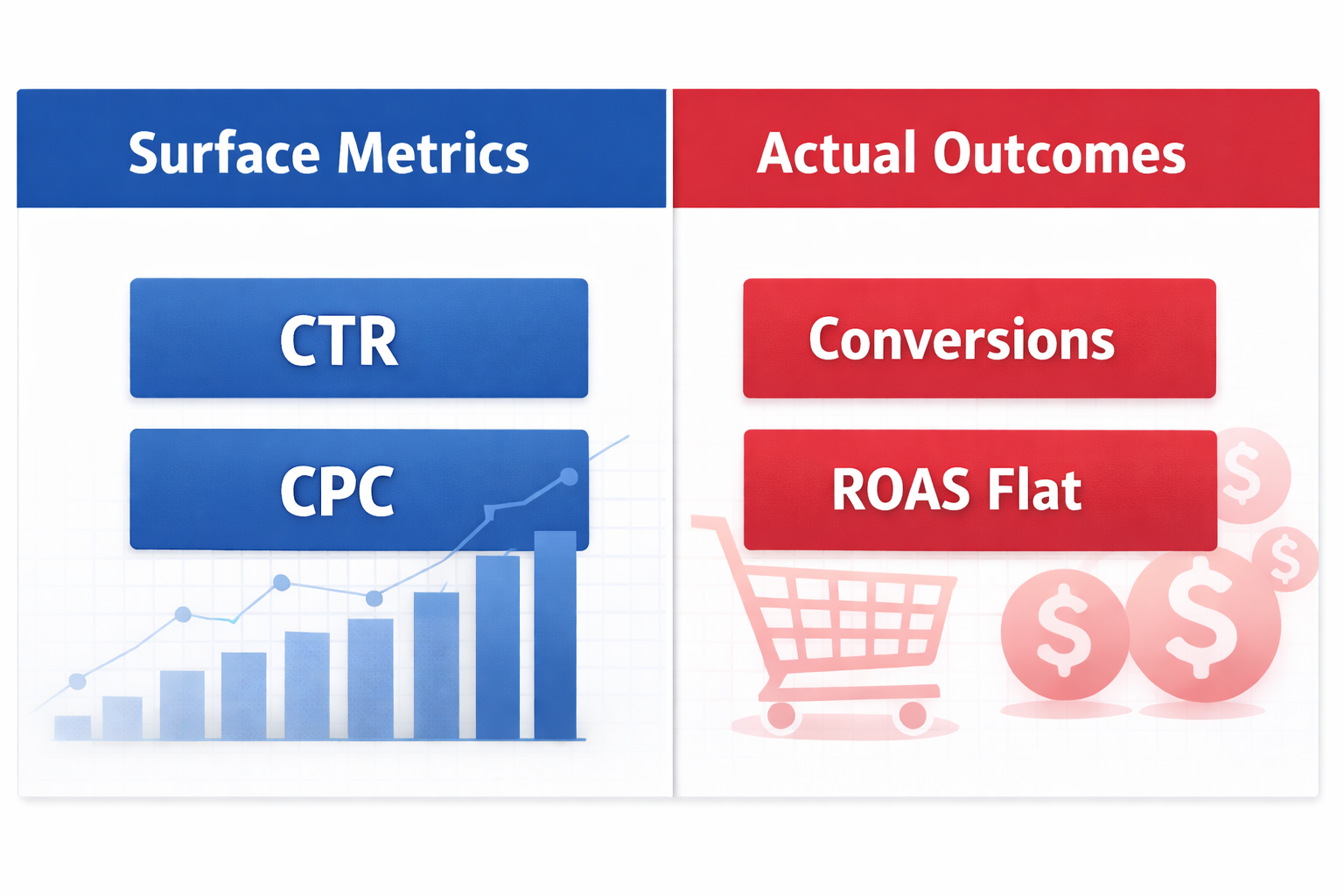
Here are a few things that can go wrong when you treat benchmarks as targets:
-
They create pressure to “fix” good campaigns. A slightly low CTR might look bad, but if the ad is converting well, it’s not a problem.
-
They simplify complex results. A low CPC feels like a win, until you realize those clicks aren’t converting. This situation is common and covered in What to Do When Your CPC Is Low But Conversions Are Flat.
-
They ignore context. A brand-new audience won’t perform the same as your most engaged followers, and that’s expected.
It’s easy to chase numbers that look right instead of focusing on what’s actually working.
When Benchmarks Are Actually Useful
That said, benchmarks do have their place. They’re useful when you apply them in the right situations and with the right mindset.
Use Them as a Rough Health Check
If your results are way off from what’s typical, that’s a signal something might be wrong. For example, if your CPC is $10 and your industry average is closer to $1.50, you should look deeper.
You might want to check for things like:
-
Incorrect or missing tracking events (like misfiring pixels);
-
Targeting issues that are too broad or too narrow;
-
Creative that doesn’t match what your audience expects or wants.
These are all fixable once you know where the problem is coming from.
Compare Within the Same Funnel Stage
Benchmarks are more helpful when you use them within the same part of your funnel. Otherwise, you’re comparing totally different things.
Think of it this way:
-
Top-of-funnel ads usually get more impressions, but lower CTR and conversion;
-
Middle-funnel ads often see better engagement, but not always direct sales;
-
Bottom-funnel ads typically have high CTR, high CPM, and strong conversion rates.
If you’re comparing a cold-audience awareness ad to a retargeting campaign, the numbers will naturally look very different.
Use Your Own Data First
The most relevant benchmark is often your own performance history. If you’ve run similar campaigns in the past, compare against those numbers first.
You might notice things like:
-
“This new creative has a slightly lower CTR, but leads are better quality.”
-
“CPC went up, but conversion rate improved, so the cost per purchase actually dropped.”
This is also where many advertisers fall into the ROAS trap. A strong ROAS number can still hide inefficiencies, which is explained in The ROAS Trap: Why High ROAS Isn’t Always Profitable.
How to Build a Smarter Benchmark Strategy
To get the most out of benchmarks without letting them mislead you, create your own internal system based on how your funnel works and what your goals are. This approach aligns closely with the framework described in How to Build a Facebook Ads Framework That Scales Over Time.
1. Define Success Based on Funnel Stage
Not every ad needs to generate a sale. Your expectations should match what the ad is designed to do.
Here’s an example of what that might look like:
-
Top-of-funnel video ad → Goal: $0.02 per 3-second view
-
Lead generation campaign → Goal: $6–$8 cost per lead
-
Retargeting offer → Goal: 4–6x return on ad spend (ROAS)
These benchmarks are specific to your business and stage of the funnel. That’s far more useful than chasing a general average.
2. Group Campaigns by Audience and Objective
Benchmarks are only helpful when you’re comparing similar types of campaigns. Don’t expect cold audiences to perform the same as warm leads or past customers.
Organize campaigns based on:
-
Objective (traffic, leads, sales);
-
Audience type (cold, warm, retargeting);
-
Platform and placement (Facebook Feed vs Instagram Reels);
-
Campaign structure (broad vs narrow targeting).
This makes your comparisons fairer and your decisions more accurate.
3. Focus on Progress Over Static Metrics
Benchmarks are static. But good marketing is about improvement.
Look for patterns over time:
-
If CTR is going up, your creative is likely improving;
-
If CPC is falling, your targeting might be more efficient;
-
If ROAS is climbing, your messaging and offer are aligning well.
Focus on what’s moving in the right direction, not just whether you’ve hit a certain number.
What to Do If You’re Below Benchmark
It’s easy to panic when your numbers don’t match the “norm.” But don’t assume that lower means worse.
Instead, take a step back and ask a few key questions.
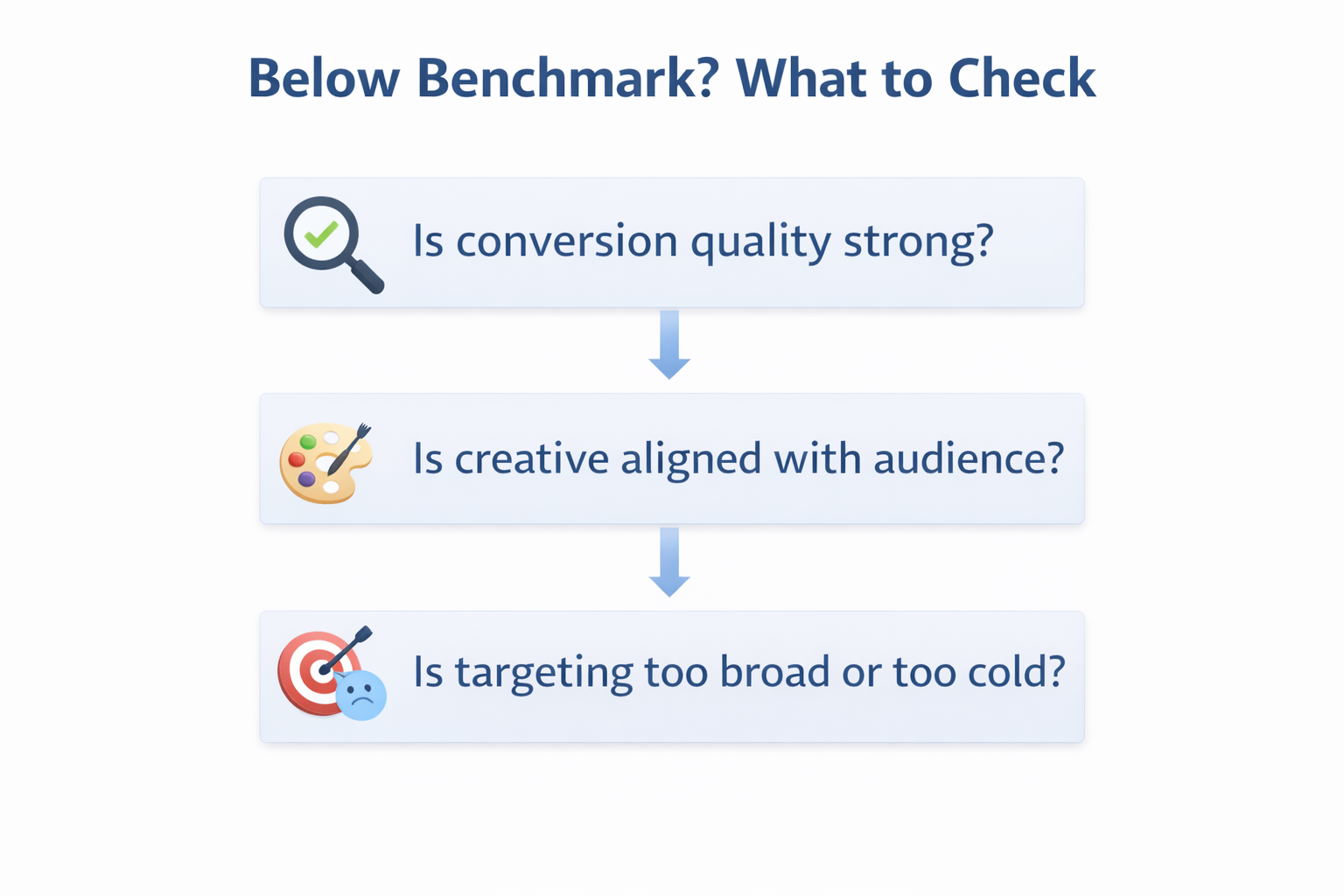
Start With Lead or Sale Quality
Are the clicks converting? If your CTR is low but you’re getting valuable leads or purchases, the ad may still be working just fine.
Experiment With Creative Changes
If engagement seems weak, try making small creative tweaks:
-
Simplify the headline or clarify the call to action;
-
Use visuals that stand out more in-feed;
-
Match your message more closely to the audience’s intent.
Sometimes even a small change can make a big impact.
Revisit Targeting Strategy
Your audience may be too cold, too broad, or simply not ready to convert.
Try adjusting:
-
Audience size or source (for example, switching from interests to lookalikes);
-
Frequency caps to reduce fatigue;
-
Timing and placements for better context.
Good results often come from testing, not from matching a number.
Final Takeaway: Let Benchmarks Guide, Not Decide
Benchmarks are just one piece of the puzzle. They can help you see how your ads are performing, but they shouldn’t be the only thing you focus on.
Instead of chasing averages, build your own performance standards based on what works for your business.
Use benchmarks to ask better questions. But let your own data, goals, and results drive the answers.
