Many advertisers build awareness campaigns that are far more complicated than necessary.
A business wants more visibility for a product launch, local event, educational post, or announcement. Instead of running a simple reach-focused campaign, the setup turns into:
- multiple audience stacks;
- several placement splits;
- duplicated ad sets;
- layered interests;
- aggressive exclusions;
- unnecessary creative variations.
The campaign becomes difficult to manage before delivery even stabilizes. This is one situation where boosted posts can actually work well.
Not because boosted posts are “better” than Ads Manager campaigns, but because some reach objectives simply do not require advanced campaign architecture.
The mistake is assuming every campaign needs conversion-level complexity.
Problem: Overbuilt awareness campaigns slow delivery and waste budget
Meta’s system performs best when campaign signals stay clear. Awareness campaigns often fail because advertisers overload them with too many variables despite having relatively small budgets.
A common example looks like this: a local restaurant wants to increase visibility around a seasonal menu launch. The campaign budget is $25/day.
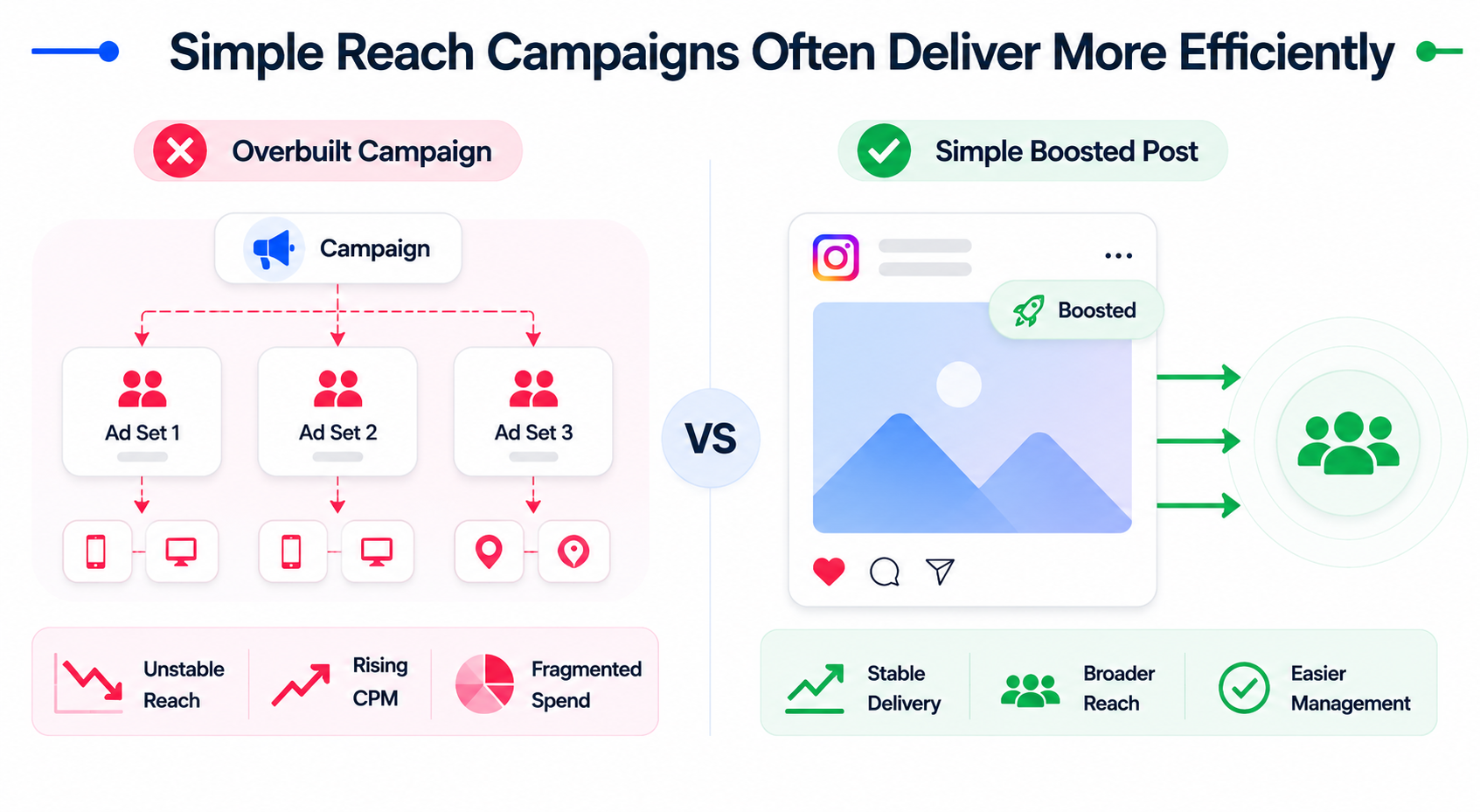
Instead of running one clean awareness campaign, the advertiser creates:
- five interest-based audiences;
- separate mobile and desktop ad sets;
- manual placement splits;
- multiple geographic variations;
- three creative versions inside each ad set.
The budget fragments immediately.
Now each ad set receives too little spend to stabilize properly. CPM rises because delivery efficiency weakens. Reach slows down. Frequency becomes inconsistent.
The advertiser assumes Meta “isn’t working.”
In reality, the structure itself created the inefficiency.
This happens constantly in smaller awareness campaigns because advertisers copy campaign structures designed for large-scale acquisition systems.
Meta’s algorithm already handles much of the distribution logic automatically during awareness optimization. Excessive segmentation often reduces efficiency instead of improving it.
That is one reason why simpler campaign setups often perform better has become a growing discussion among performance marketers managing smaller or mid-sized budgets.
Solution: Use boosted posts when the objective is simple visibility
Boosted posts work best when the campaign goal is straightforward:
- reach more people;
- amplify existing engagement;
- increase local visibility;
- distribute educational content;
- support awareness before retargeting.
In those situations, simplicity becomes an advantage.
For example, a fitness studio promoting a free open-house weekend may not need:
- funnel segmentation;
- advanced audience layering;
- complex attribution setup;
- detailed conversion tracking.
The primary goal is visibility inside a local radius.
A boosted post can often achieve that efficiently because the optimization requirements remain simple.
This is especially true for campaigns tied to:
- announcements;
- events;
- community engagement;
- organic content amplification;
- brand familiarity.
The key difference is expectation. Boosted posts should not be treated like direct-response acquisition systems. They function best as lightweight distribution tools.
Once advertisers expect boosted posts to drive highly qualified leads or scalable purchases, the limitations become obvious. But for pure reach campaigns, overbuilding structure often hurts performance more than it helps.
Why operational simplicity improves awareness performance
Every additional layer inside a campaign increases management overhead.
More ad sets create:
- slower optimization;
- noisier reporting;
- audience overlap risks;
- fragmented spend distribution.
For awareness objectives, those tradeoffs rarely produce meaningful advantages.
A simple boosted-post workflow allows advertisers to:
- launch faster;
- maintain stable delivery;
- avoid budget fragmentation;
- keep reporting easier to interpret.
This matters more than many advertisers realize.
Meta’s awareness optimization system prioritizes delivery efficiency heavily. Once campaigns become structurally cluttered, the algorithm spends more effort balancing internal variables instead of maximizing reach quality.
That is also why many advertisers eventually move toward structuring Facebook campaigns without unnecessary complexity after struggling with unstable delivery inside heavily segmented accounts.
When boosted posts stop being the right tool
Boosted posts become less effective once the campaign objective shifts toward:
- purchases;
- qualified leads;
- demo bookings;
- conversion optimization;
- sales attribution.
At that stage, advertisers usually need:
- stronger audience control;
- conversion-event optimization;
- advanced exclusions;
- structured retargeting logic;
- cleaner funnel segmentation.
That is where Ads Manager campaigns outperform boosted workflows.
The problem is not boosted posts themselves. The problem is using them beyond the role they were designed for.
Awareness campaigns and conversion campaigns operate differently inside Meta’s delivery system.
Trying to combine both goals into a simplified boosted-post setup usually creates weak optimization signals and unstable performance.
That distinction becomes much easier to manage once advertisers understand why awareness campaigns still matter in Meta advertising, especially for brands building familiarity before retargeting later in the funnel.
Final takeaway
Boosted posts work well when advertisers keep the objective simple.
They are useful for:
- awareness;
- visibility;
- lightweight engagement;
- local exposure;
- content amplification.
Many awareness campaigns fail because advertisers apply conversion-campaign complexity to goals that only require distribution efficiency.
In those cases, simpler campaign structures often perform better than heavily segmented setups.
The smartest approach is usually straightforward: use boosted posts for reach. Use structured campaigns for conversions. Avoid mixing both objectives into the same simplified workflow.