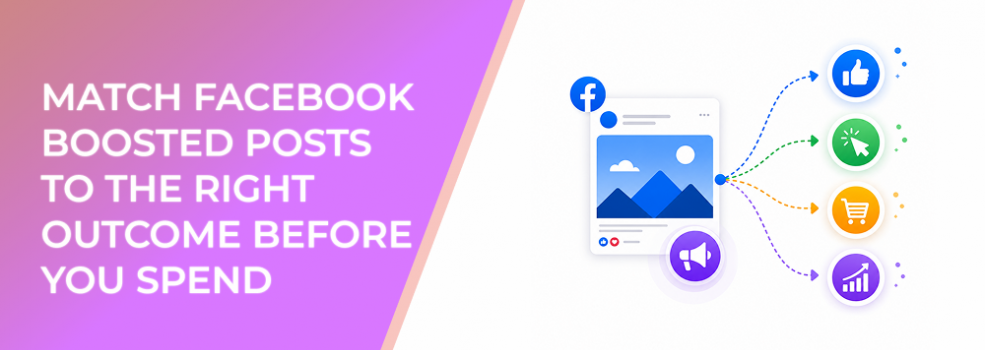
Facebook boosted posts are convenient, but convenience can become expensive when the outcome is wrong.
A boost can generate reach, engagement, website visits, messages, or other simple actions depending on the available setup. The problem starts when marketers choose the easiest-looking option instead of the outcome that matches the business goal.
LeadEnforce’s own Page promotion article summarizes the issue well: a goal is a signal, and if the selected goal points toward low-value behavior, the campaign can optimize efficiently in the wrong direction.
The Problem
The problem is not that boosted posts are bad.
The problem is using a boosted post for the wrong outcome.
A visibility-focused boost will not necessarily create qualified leads. An engagement-focused boost will not necessarily create sales. A traffic-focused boost will not necessarily generate conversions. A message-focused boost will not necessarily create sales-ready conversations.
The campaign may be doing exactly what it was asked to do. The issue is that the ask was wrong.
Why This Problem Hurts Performance
Wrong-outcome boosts create misleading metrics.
Low CPC can hide weak conversion rate.
High engagement can hide poor lead quality.
Strong reach can hide low commercial intent.
Cheap messages can hide unqualified conversations.
This affects CPA, CAC, ROAS, and scaling decisions. If the campaign learns from the wrong behavior, more budget simply buys more of the wrong result.
For agencies, this creates reporting problems. For SMB owners, it burns limited budget. For growth teams, it produces bad learning data.
Common Scenarios Where This Happens
A local business wants bookings but boosts a post for engagement because the post already has likes.
A startup wants signups but chooses traffic without checking whether visitors convert.
A B2B team wants pipeline but promotes a thought-leadership post without a lead-focused next step.
An ecommerce brand wants purchases but boosts a lifestyle post that does not communicate product value or buying urgency.
An affiliate marketer wants offer conversions but optimizes for clicks from broad curiosity-driven users.
Why the Problem Happens
This happens for four practical reasons.
First, boosted-post tools are designed for speed. Speed is useful, but it can encourage shallow setup decisions.
Second, goal labels can sound similar. “More engagement” may feel close to “more demand.” “More website visitors” may feel close to “more sales.” They are not the same.
Third, advertisers often choose the metric that looks cheapest. Cheap activity feels efficient until post-click behavior exposes the real cost.
Fourth, the audience is often too broad. Even the right outcome struggles if the ad reaches people who do not match the ICP or offer.
The Solution
The solution is to work backward from the business outcome.
Before boosting, finish this sentence:
“This campaign is worth funding if it produces ______.”
If the answer is visibility, a boosted post may fit.
If the answer is comments, social proof, or content validation, a boosted post may fit.
If the answer is qualified leads, booked calls, purchases, trials, or predictable ROAS, the campaign likely needs a more structured setup.
Then match the outcome to the funnel stage.
Cold audiences often need awareness or education.
Warm audiences may be ready for traffic, lead capture, or messages.
Retargeting audiences may be ready for stronger offers.
Finally, define the KPI before launch. A campaign without a KPI is just spend with hope attached.
How LeadEnforce Helps
LeadEnforce helps when the outcome depends on reaching a more relevant audience.
If the selected outcome is engagement, the audience should be likely to engage meaningfully. If the outcome is leads, the audience should match the buyer profile. If the outcome is sales, the audience should be close enough to the buying context.
LeadEnforce supports this by helping advertisers create audience inputs from Facebook groups, Instagram profile followers, LinkedIn job-title and company data, and custom social-profile links.
This is especially useful when a simple boosted post is not precise enough for the business goal.
A B2B lead-generation team can build audiences around professional traits. An ecommerce advertiser can focus on followers of niche product accounts. A local business can target community-based sources that better reflect likely buyers.
Risks and Considerations
Do not assume better targeting can fix the wrong outcome.
If you optimize for engagement, Meta will still prioritize engagement. If you want leads, sales, or bookings, the campaign setup must support that action.
Also, audience precision can create delivery limits if the audience is too small. A strong offer, clear creative, relevant landing page, and reliable tracking still matter.
LeadEnforce supports audience relevance. It does not replace conversion tracking, sales follow-up, creative quality, or landing page alignment.
Prerequisites and Dependencies
Before launching, define the ICP, funnel stage, primary KPI, and quality metric.
Make sure the post matches the intended action. A post built for discussion may not be strong enough for purchases. A product post may need pricing, proof, urgency, or a landing page.
If LeadEnforce is used, source communities, profiles, or data segments must match real buyer intent.
Practical Recommendations
Do not boost until the desired outcome is clear.
Reject goals that only create vanity activity unless vanity activity is the actual objective.
Use boosted posts for visibility, engagement validation, simple traffic, or lightweight content amplification.
Use structured campaigns when the outcome must prove revenue, pipeline, qualified acquisition, or ROAS.
If the outcome depends on audience quality, improve the audience before increasing budget.
Final Takeaway
Poor boosted-post results often come from outcome mismatch.
The fix is to define the business result first, choose the campaign outcome second, and support that outcome with relevant creative, audience, and measurement. The right boost is not the fastest one to launch. It is the one that matches the action you actually need.
To create more relevant audiences before your next outcome-driven campaign test, join the free 7-day LeadEnforce trial period.
Related LeadEnforce Articles
- Avoid Facebook Page Promotion Goals That Don’t Fit Your Campaign — Closely related to matching Page promotion goals with commercial outcomes.
- Choose the Right Facebook Page Ad Goal Before You Spend Budget — Helps advertisers choose goals from the business outcome backward.
- What Meta’s Updated Ad Objectives Mean for Campaign Setup and Performance — Explains how objectives affect campaign setup and performance.
- Use Facebook Page Ads as a Real Performance Test, Not Just a Quick Boost — Shows how Page-created ads can be used for structured testing instead of vague promotion.