You’ve optimized audiences. You’ve tested formats. You’ve cycled through dozens of ad creatives.
Still, results fall short.
Before you tweak another bid cap or launch another creative test, consider this: the issue might not be tactical. It might be your value proposition.
Too often, advertisers focus on how they deliver the message — the visual, the targeting, the timing — without asking if the message itself is convincing.
Your value proposition is the foundation. If it’s unclear, weak, or misaligned, every dollar you spend becomes harder to justify.
For a deeper dive, read How Value Propositions Make or Break Facebook and Instagram Ads.
What Exactly Is a Value Proposition?
A value proposition is not a tagline. It’s not your mission statement. And it’s not a list of product features.
It is the core reason why someone should choose your product over another.
It must answer three simple but essential questions:
-
What are you offering?
-
Who is it for?
-
Why does it matter right now?
In a high-noise environment like Facebook or Instagram, your message has to deliver this in seconds. Clarity beats cleverness. Relevance beats polish.
Most users don’t know who you are. Your value proposition must earn attention by solving a real problem or promising a desirable outcome — fast.
The Business Impact of a Weak Value Proposition
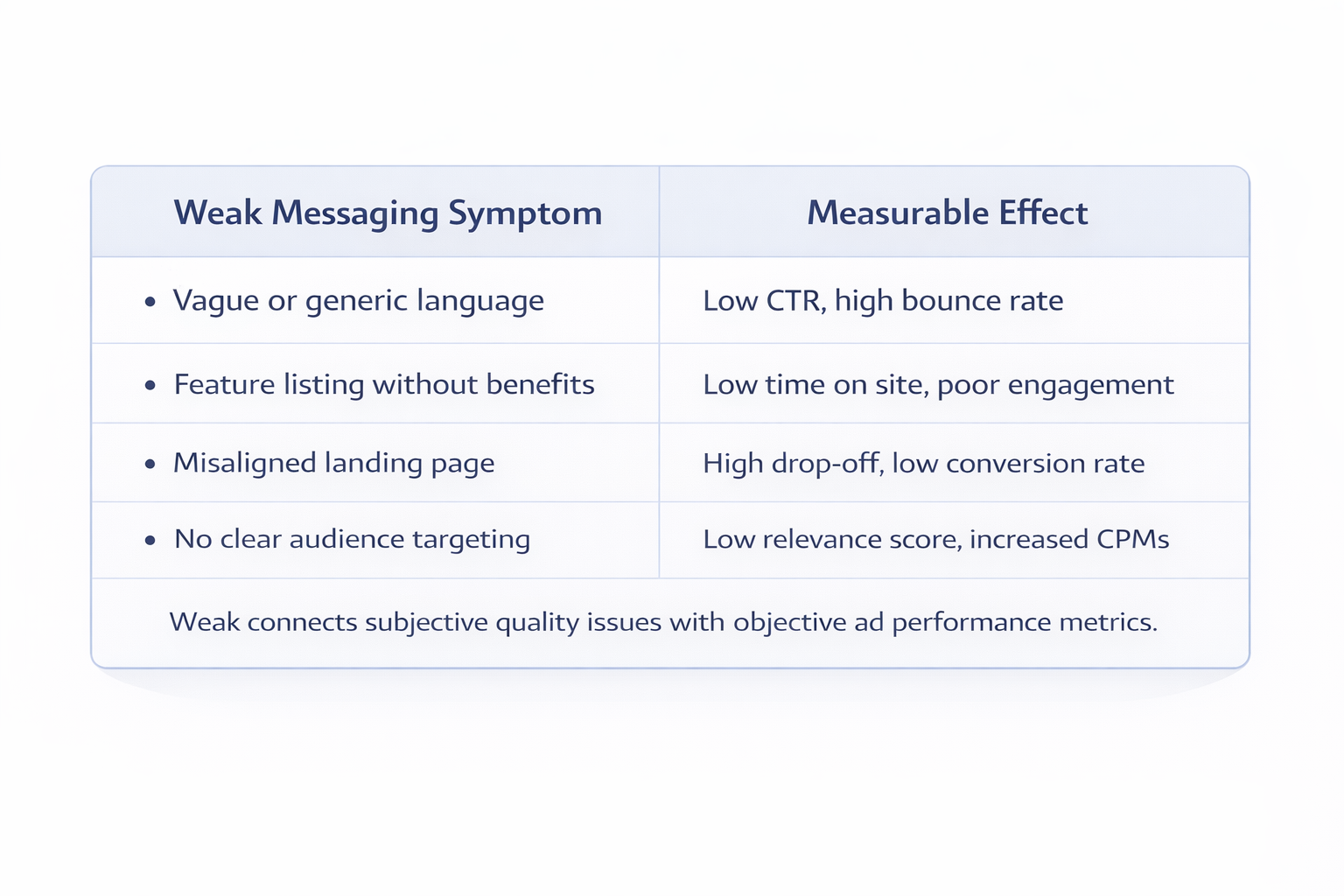
A weak or vague value proposition doesn’t just make your ad boring. It breaks performance across the entire funnel.
Let’s look at how.
1. Lower Click-Through Rates
When the benefit isn’t obvious or feels irrelevant, people scroll past. This leads to lower CTRs, which hurt your ad ranking and inflate CPMs. Facebook’s algorithm rewards engagement, not effort.
Check out How to Solve Low Click-Through Rates (CTR) on Facebook Ads to troubleshoot this further.
2. Higher Cost per Action
If users do click but don’t see a clear benefit after the click, they leave. This makes your CPA rise — not just because of traffic loss, but because you’re paying for the wrong kind of attention.
3. Unreliable Creative Testing
When your core offer isn’t strong, testing different visuals or formats produces misleading results. You’re not testing design or copy nuances — you’re masking a message that never worked.
4. Short Campaign Lifespan
Even if you generate some early traction, weak value props tend to fatigue fast. You burn through audiences who never saw real value, making it harder to scale or retarget effectively.
Weak positioning compounds over time. It’s not just a messaging issue — it’s a performance bottleneck.
How to Recognize a Weak Value Proposition
Many advertisers assume their value proposition is clear because it makes sense to them. That’s the blind spot.
Here are signs yours may not be working:
-
Users ask basic questions after reading your ad or visiting your landing page.
-
You rely on adjectives (“best,” “easy,” “powerful”) instead of evidence or outcomes.
-
Your messaging could easily describe ten other products in the same category.
-
There's a mismatch between ad expectations and the landing page experience.
One useful test is to show your ad and landing page to someone outside your team. Ask them to explain what your product does, who it’s for, and what the benefit is. If they pause, guess, or need to scroll around — your value proposition likely needs work.
Also review Why Your Ads Get Clicks But No Sales to better understand what might be going wrong post-click.
Common Value Proposition Failures (With Practical Fixes)
Let’s walk through the most common issues advertisers face when defining or communicating value.
1. Using Vague, Overused Language
Phrases like “next-generation,” “all-in-one,” or “innovative solution” sound impressive but lack specificity. They do not tell the audience what to expect.
- Example of a weak proposition: “Revolutionizing project management with powerful tools.”
- Improved version: “Plan, assign, and track team tasks in one view — no spreadsheets or status meetings.”
Fix: Focus on clarity. Describe what changes for the user and why that matters. Be specific about the outcome or benefit.
2. Listing Features Without Linking to Outcomes
Features are important, but only when connected to real-world benefits. Audiences don't care about technical specs unless they understand what those specs do for them.
- Example of a feature list: “24/7 monitoring. AI analytics. Cloud-based dashboard.”
- Better approach: “Get instant alerts when your home security is triggered. Stay informed, no matter where you are.”
Fix: For every feature you want to highlight, ask yourself: So what? Then reframe it in terms of the user's experience.
3. Skipping the Problem
If your value proposition jumps straight into benefits or product details, you miss the opportunity to show empathy. You also miss the chance to hook attention.
- Example of skipping the problem: “Reach your fitness goals with our app.”
- More effective version: “Struggling to stay consistent? Our app helps you build better habits with 10-minute daily workouts and smart reminders.”
Fix: Lead with a pain point your target audience knows. Then position your product as the answer.
Where Your Value Proposition Needs to Show Up (And Often Fails)
You don’t need to plaster your value proposition everywhere — but it must be embedded in the key conversion points of your funnel. Let’s look at two.
In Your Ad Creative
Paid social ads are often the first and only exposure someone will have to your brand. Your value proposition must do the heavy lifting here.
Key places to integrate your message:
-
Headline: This is where the core benefit should be most visible. Avoid cleverness in favor of clarity.
-
Primary text: Reinforce the benefit and build relevance. Mention your audience directly if possible.
-
Visuals: Make sure the image or video supports the proposition instead of distracting from it.
- Example of weak creative: Image of a busy dashboard. Headline: “All-in-One Marketing Tool.”
- Better version: Image of a marketer checking off tasks. Headline: “Launch campaigns in half the time — without the back and forth.”
If your ads look good but don’t convert, read Why Your Facebook Ads Look Great But Still Don’t Sell.
On Your Landing Page
The transition from ad to page is critical. If your value proposition is strong in the ad but disappears on the landing page, users will drop off. They need to see immediate alignment between what was promised and what they’re seeing.
Checklist for your landing page:
-
The headline should clearly state the core value — ideally in the first screen.
-
Subheadlines or bullets should translate features into results.
-
Visuals should reinforce use cases or outcomes.
-
You should not need a full scroll or demo to understand what the product does.
For help syncing your landing page with your ads, read How to Translate Your High-Converting Landing Page into a Facebook Ad.
How to Strengthen Your Value Proposition Without Rewriting Everything
You don’t need a new brand strategy to improve your value prop. You need better inputs and sharper framing. Here’s a practical approach.
Step 1: Use Customer Language, Not Marketing Language
Interview recent customers. Ask:
-
Why did you choose us?
-
What problem were you trying to solve?
-
What changed after using the product?
Document their actual phrases and patterns. These are often more powerful than anything you’ll come up with in a creative brainstorm.
Step 2: Map Value to Context
A great value prop isn’t just about benefits — it’s about benefits in context.
Think about the user’s environment. Are they at work? On mobile? In a rush? Frustrated?
Then refine your message accordingly. For example:
-
Instead of “Save time with automation,” try “Schedule next week’s content in 6 minutes — before your meeting starts.”
-
Instead of “Custom reports,” try “Deliver campaign results your boss can understand — no extra formatting.”
Step 3: Validate with Data, Not Opinions
Once you’ve drafted two or three sharpened value propositions, test them.
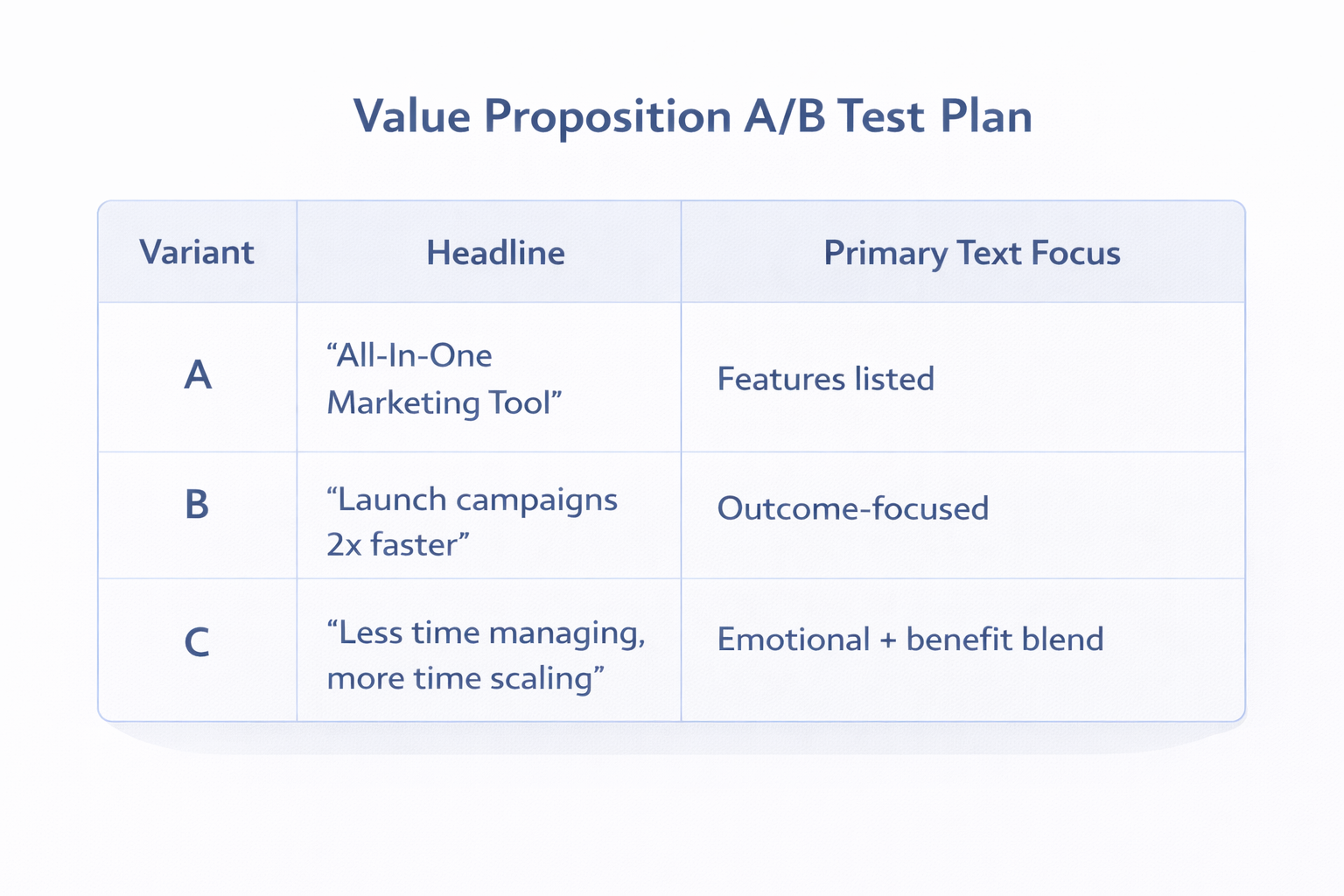
Use the same visual and format for your ads. Change only the core messaging. Track:
-
Click-through rate,
-
Time on site,
-
Conversion rate.
If one version leads on all three, you have a strong signal. Let the audience vote with behavior — not internal preferences.
Final Thoughts: Better Performance Starts With a Better Offer
Strong campaigns aren’t built on tactics alone. They’re built on clear, relevant, and specific value propositions that meet people where they are.
When your message is off, everything else becomes harder — targeting, creative, scaling, and optimization.
But when your value proposition is clear, every ad becomes easier to write. Every landing page becomes easier to structure. And every campaign has a stronger chance to convert.