Many marketers launch Facebook or Instagram campaigns and hope the numbers will speak for themselves.
But when metrics come in, they’re not always clear — or useful. That’s because performance data without proper context can be misleading.
A campaign might look “active” but still fail to deliver meaningful results. To know if your marketing strategy is truly working, you need to ask sharper questions — and look at more than just the ads.
Start With Strategic Clarity — Not Tactics
Before launching anything, take a step back. What exactly do you want the campaign to accomplish?
This may sound basic, but a surprising number of campaigns go live with vague or conflicting goals. That’s a fast track to confusion when results come in.
Define Strategy by Outcome — Not Activity
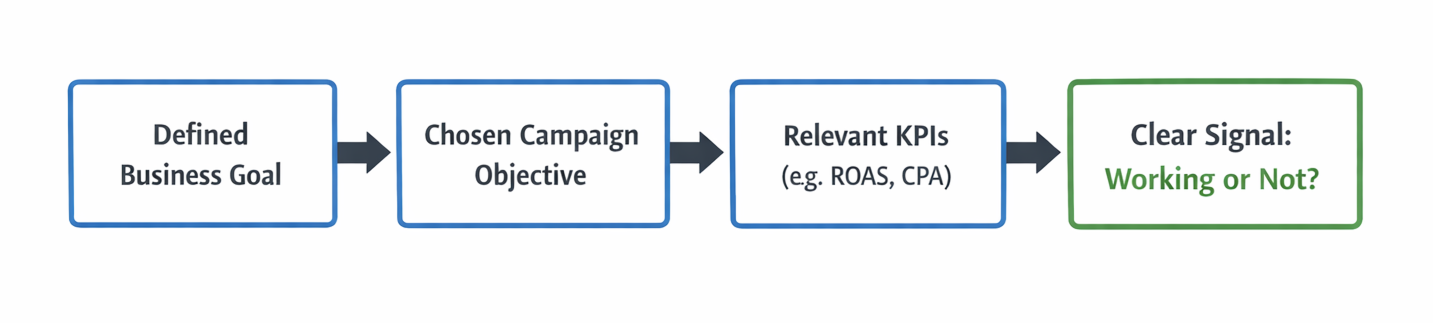
Your strategy should lead to a specific business result. Without that, measurement becomes guesswork.
Ask yourself:
-
What are we trying to achieve — brand visibility, lead capture, customer acquisition?
-
What behavior are we trying to influence — sign-ups, purchases, page visits?
-
How will we know it's working — which key numbers will confirm we're making progress?
Not sure how to approach that? Start with these simple questions to measure Facebook ad effectiveness.
Getting clear on this early helps every piece — targeting, creative, optimization — align around a shared direction.
Don’t Let Vanity Metrics Set the Narrative
Clicks, likes, reach — they all have their place. But they often tell you less than you think.
If you’re only tracking what’s visible on the surface, you’ll miss deeper performance signals. Metrics should be used to evaluate, not decorate.
Make Metrics Work Harder
Think about what each number is actually telling you. For example:
-
If your CTR is low, the ad likely isn’t resonating — either the visual, message, or both need work.
-
If CPC is rising, it may suggest growing competition or poor audience-match — time to review targeting.
-
If conversion rate is steady but ROAS is falling, your offer or pricing structure might not be profitable at scale.
Want a deeper view into how to read these numbers properly? Here’s how to analyze ad performance beyond CTR and CPC.
Data isn’t just about reporting performance — it’s how you diagnose problems and opportunities.
Align Metrics With the Funnel — Not All Metrics Matter Equally
Not every campaign is built for conversions. Some are designed to warm up audiences, others to close.
Evaluating a top-of-funnel campaign using bottom-funnel KPIs (like ROAS) is one of the most common mistakes advertisers make.
| Funnel Stage | Key Metrics | Common Mistakes |
|---|---|---|
| Top of Funnel (TOFU) | CPM, Video View % | Judging performance by ROAS |
| Middle of Funnel (MOFU) | CTR, CPC | Ignoring bounce rate or session quality |
| Bottom of Funnel (BOFU) | CPA, ROAS | Over-focusing on clicks |
Understand Funnel-Specific Metrics
Here’s how to align your expectations with your funnel stage:
Top of Funnel (Awareness):
These campaigns are built to attract attention. Focus on metrics like:
-
CPM (Cost per 1,000 impressions) — Tells you how efficiently you’re reaching new eyes. Rising CPMs might indicate poor ad relevance or narrow targeting.
-
Video view rates — Especially 3-second or 15-second views. They show how well your creative captures interest.
Mid-Funnel (Consideration):
This is where people start engaging more meaningfully. Track:
-
CTR (Click-through rate) — Measures whether people care enough to learn more. Less than 1% often suggests a weak hook.
-
CPC (Cost per click) — High costs may point to poor audience relevance or unclear messaging.
Bottom of Funnel (Conversion):
This is where the money is. Metrics to watch include:
-
CPA (Cost per acquisition) — If it keeps rising while traffic stays the same, conversion friction could be the issue.
-
ROAS (Return on ad spend) — If your ROAS is under 1.0 for extended periods, the campaign is likely unprofitable.
This campaign-level view of funnel structure can help you visualize how these stages stack up.
Use the right yardstick for the job — that’s how expert marketers avoid false negatives or false positives.
Stop Obsessing Over Daily Results — Patterns Matter More
It’s tempting to react when a campaign dips for a day. But a single data point is never the full story.
Instead, zoom out and look for trends over time. Patterns give you far better insight than snapshots.
Weekly Reviews Beat Daily Panic
Here’s what you can learn by tracking data week over week:
-
If CTR declines steadily, you may have ad fatigue — it’s time to refresh creatives.
-
If CPA rises while clicks hold steady, something is going wrong after the click — check your landing page or form.
-
If ROAS improves with spend, that campaign has room to scale — fast.
For more on creative performance plateaus and how to fix them, check out why ads stop performing after two weeks.
Avoid reacting to noise. Smart marketers respond to patterns — not panic.
Campaign Data Isn’t Enough — Track Business Impact
Campaign performance is just one piece. It only matters if it contributes to real business goals.
Plenty of ads perform well on paper but have little impact in practice. That’s where many marketing strategies fall apart.
Match Campaign Data to Business Signals
Ask questions like:
-
Are new leads converting into revenue within a reasonable timeframe — or just sitting in the CRM?
-
Is ad-driven growth matched by customer retention — or is churn canceling out acquisition?
-
Are you attracting high-LTV buyers — or discount hunters who never return?
This disconnect between ad metrics and real results is covered well in this breakdown of why pretty ads don’t always sell.
Use data from other systems — Shopify, Stripe, HubSpot, GA4 — to check if your ad performance is translating to business performance.
Segment and Test — Don’t Assume
Performance metrics are averages. And averages hide what’s really happening. If you don’t segment, you won’t see what’s actually working — and where your budget’s being wasted.
Run Tests With Clear Purpose
Don’t test everything at once. Instead:
-
Start with audience segmentation — For example, test high-value lookalikes vs. broad interest targeting.
-
Try creative variation — Test direct-response copy against softer, brand-first messaging. Track CTR, but also bounce rate and time on site.
-
Adjust placement settings — Compare performance on Stories vs. Reels vs. Feed. See where attention actually converts.
Need structure? Follow this guide on how to test ads effectively in Meta’s Experiments section.
The point of testing isn’t novelty — it’s clarity.
Fix What Happens After the Click
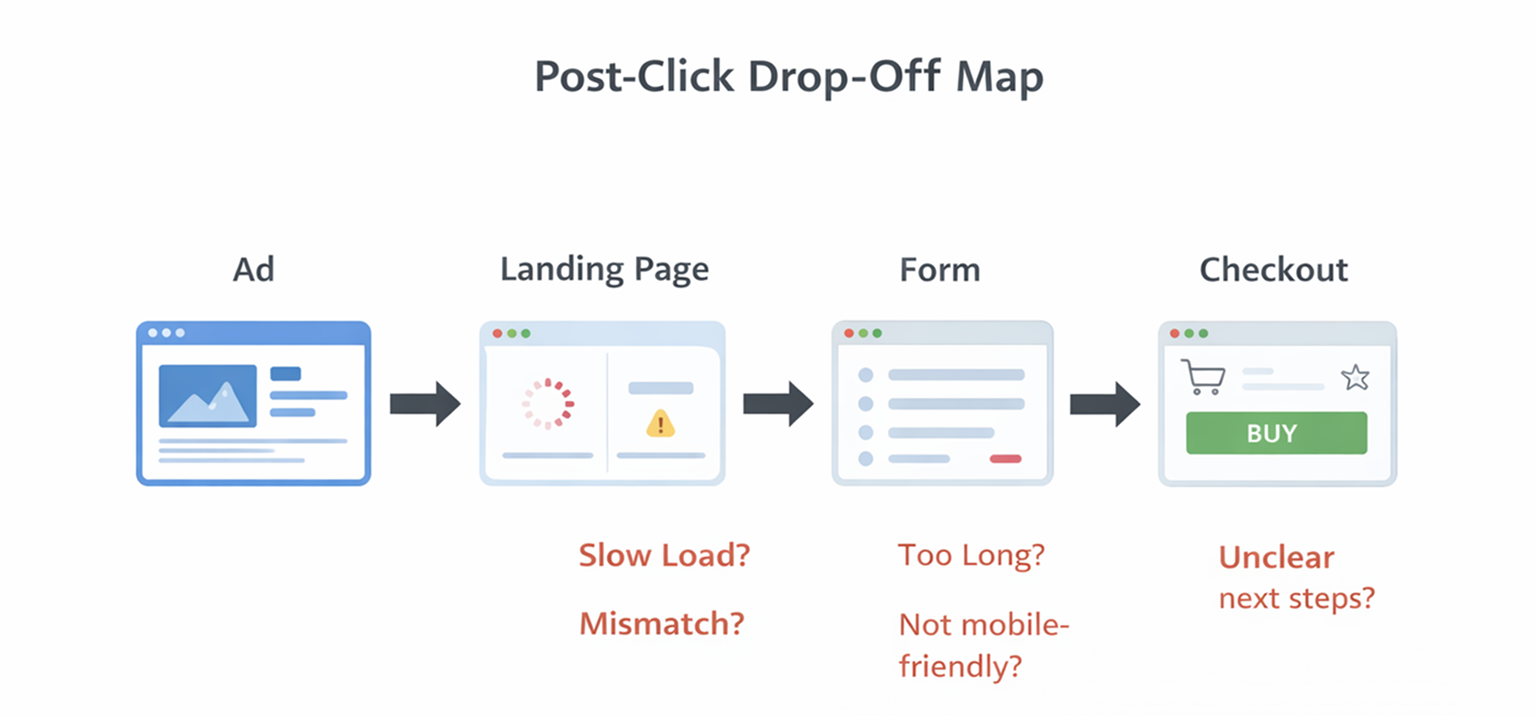
Your ad isn’t a standalone experience. It’s the front door to your funnel. If what follows doesn’t hold up, even great ads will fail.
Audit the Post-Click Journey
Common weak points include:
-
Slow load times — Meta penalizes landing pages that take too long. So do users. Use tools like PageSpeed Insights to test.
-
Mismatch between ad and page — If the promise in your ad isn’t clearly visible on the page, trust breaks.
-
Clunky conversion flows — Complicated forms, mobile issues, or unclear CTAs create drop-off. Walk through your funnel on mobile — end to end.
This process is central to post-click optimization best practices that can recover lost conversions.
If you’re losing people after they click, you’re not measuring strategy — you’re measuring damage control.
Know When to Pivot — Not Every Strategy Can Be “Optimized”
Some campaigns just aren’t fixable. But it’s better to admit that quickly than to drag them out and waste budget.
The key is knowing what failure looks like — and recognizing it early.
Clear Signals That It’s Time to Change Course
-
ROAS is consistently under 1.0 — even after audience and creative changes;
-
You’re scaling spend, but returns flatten — and CPA climbs instead of drops;
-
You’ve tested multiple creative angles — and none lift engagement or conversion.
Here’s a framework for when to stop optimizing and start over.
When you see these signs, stop patching — and rethink the strategy entirely.
Final Thought — You Can’t Improve What You Don’t Understand
Performance marketing isn’t about making guesses look good. It’s about using data to make smarter, faster decisions.
The only way to know if your marketing strategy is working is to measure the right things — with the right context. If you can connect campaign performance to actual business value, you’ll know where to double down and where to cut losses.
And that’s what separates high-performing advertisers from everyone else.