Choosing between global and local campaign structures is not a strategic preference — it’s a delivery system decision. The way you structure geography directly affects how auctions are entered, how budgets are distributed, and how quickly the algorithm stabilizes.
If you’ve ever seen one country dominate spend while others barely deliver, or noticed that local campaigns plateau while global ones scale unpredictably, you’ve already encountered the tradeoffs.
Why This Decision Is Not Just About Geography
A campaign’s geographic setup controls how signals are aggregated and how budgets compete internally.
In a global campaign, all countries feed into one learning system. Conversion signals from one region immediately influence delivery elsewhere. That shared signal pool accelerates learning but removes control.
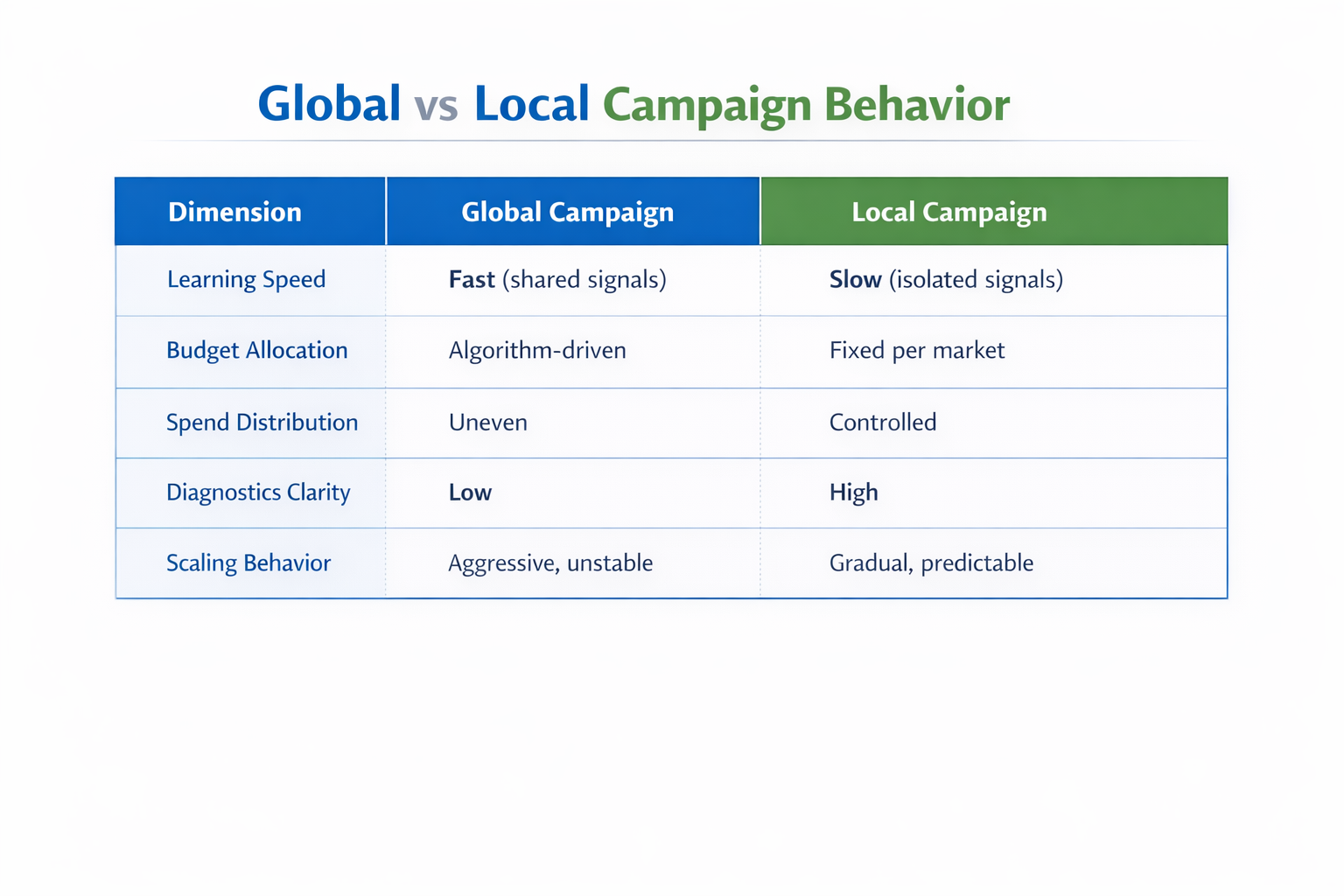
In a local campaign structure, each country operates independently. The algorithm learns slower, but decisions are more stable and easier to interpret.
This is closely related to how platforms structure campaigns overall — something covered in Meta Campaigns Explained: How to Structure High-Performance Campaigns.
This is why performance differences often show up in:
-
Spend concentration, where one market absorbs most of the budget because it wins auctions more efficiently.
-
Signal dilution, where high-performing regions mask weak ones inside a global pool.
-
Learning fragmentation, where smaller countries struggle to exit the learning phase due to low volume.
You’re not just choosing targeting — you’re choosing how the system learns.
How Global Campaigns Actually Behave
Global campaigns tend to optimize toward the easiest conversions first. That usually means:
-
Lower CPM regions with cheaper auctions.
-
Higher baseline conversion rates driven by local demand.
-
Less saturated competition environments.
Once the algorithm detects these patterns, it reallocates budget aggressively. This behavior is driven by the auction logic explained in Facebook Ad Auction: Do Ad Sets Compete Against Each Other?
In practice, this creates a few predictable outcomes:
-
Budget clustering in 1–3 countries.
You may target 20 regions, but most spend concentrates in a small subset of markets that consistently win auctions. -
Fast scaling early, unstable later.
Initial performance looks strong because the system finds easy conversions quickly. Over time, performance becomes volatile as those pockets saturate. -
Limited visibility into weak markets.
Underperforming regions receive minimal delivery, which makes diagnostics nearly impossible.
A common scenario: a global campaign shows strong CPL, but when broken down, only a few countries contribute meaningful pipeline.
How Local Campaigns Actually Behave
Local campaigns isolate learning by geography. Each market has its own budget, auction participation, and optimization path.
This changes how performance evolves:
-
Slower ramp-up.
Smaller markets often stay in the learning phase longer due to limited conversion volume. -
More predictable spend distribution.
Budgets remain fixed per region, preventing the algorithm from shifting spend aggressively. -
Clear diagnostics.
You can directly compare CPM, CTR, and conversion rates across markets without interference. -
Alignment with local economics.
Pricing, lead quality, and sales cycles often vary significantly by region — local campaigns make these differences visible and actionable.
This becomes especially important when you start evaluating deeper metrics, as explained in How to Analyze Facebook Ad Performance Beyond CTR and CPC.
When Local Campaigns Work Best
Local structures are not about scaling faster — they’re about controlling performance.
They’re the better choice when:
-
Lead quality varies by country.
A global CPL may look efficient, but downstream metrics like qualification rate or revenue per lead reveal large gaps. -
Sales processes differ across regions.
Language, pricing, and buying cycles affect conversion behavior and require separate optimization. -
Budget allocation is strategic.
Some regions matter more than others, regardless of short-term efficiency. -
You’re optimizing beyond surface metrics.
Campaigns focused on pipeline or revenue require clean segmentation to avoid misleading signals.
The Hidden Tradeoff: Efficiency vs Control
Most teams frame this decision incorrectly as scale versus granularity. The real tradeoff is:
-
Global campaigns maximize short-term efficiency.
-
Local campaigns maximize long-term control and clarity.
This becomes visible in real campaign signals:
-
In global setups, CPM may drop while lead quality declines, because the system shifts toward cheaper but less qualified markets.
-
In local setups, CPL may increase initially, but downstream metrics often improve as targeting aligns with real buyer behavior.
A Practical Hybrid Approach
Many high-performing accounts don’t rely on a single structure. They combine both.
A typical hybrid setup looks like this:
-
Global campaign for discovery.
Used to identify high-performing markets and gather initial signals. -
Local campaigns for scaling.
Once patterns emerge, top-performing regions are separated for tighter control. -
Budget allocation based on real outcomes.
Instead of optimizing purely on CPL, budgets shift based on qualified leads or revenue.
This approach aligns with broader scaling principles described in The Science of Scaling Facebook Ads Without Killing Performance.
Final Takeaway
Global campaigns help you learn fast, but they decide where to spend. Local campaigns give you control, but require more patience and structure.
The strongest results usually come from combining both — starting broad, then segmenting based on real performance signals.
That transition point is where most performance gains happen.