Too many Instagram campaigns collapse under the weight of unnecessary complexity.
Endless testing, scattered ad sets, bloated dashboards — all in the name of optimization. But in most cases, what’s missing isn’t more data. It’s clarity.
This guide is about simplifying your Instagram ad strategy by removing what doesn’t help and focusing on what does. No gimmicks. No distractions. Just methods that keep your campaigns lean and effective.
Step 1: Fix the Inputs Before You Touch the Metrics
CTR, CPC, ROAS — they only tell you what happened after someone saw the ad. But who saw it in the first place?
That’s where real optimization starts.
Instead of diving into performance metrics, go upstream:
-
Use high-signal custom audiences built from recent, valuable actions — not just page views or engagement.
-
Anchor lookalikes in quality, not quantity. A smaller source based on purchase behavior is stronger than a large, vague one.
-
Target audiences who already engage with competitors or creators in your niche. Instagram’s algorithm understands these patterns better than broad interest buckets.
If you want a deeper breakdown of why audience quality consistently beats audience size, this article explains it in detail.
Without qualified traffic, no amount of ad tweaking will move the needle.
Step 2: Stop Over-Splitting Campaigns
Creating six ad sets with slightly different interests won’t make your data smarter. It just slows down learning.
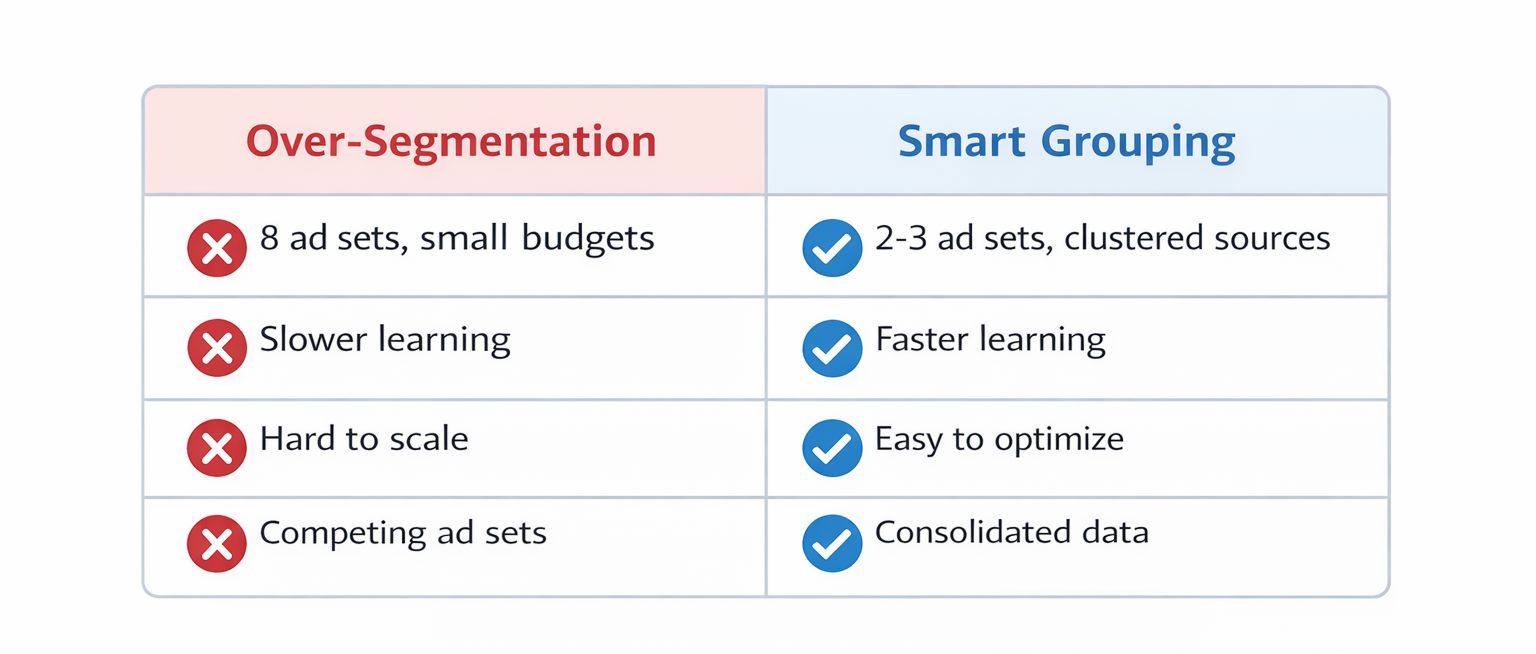
Instead, group similar sources into broader but intentional clusters:
-
Combine 3 to 5 creators or communities with aligned followings into one ad set.
-
Skip the temptation to isolate every variable. Meta’s system performs better with more data per set.
-
Focus on clarity, not control — your goal is to find repeatable audience behaviors, not over-analyze noise.
This approach aligns closely with why over-segmentation hurts delivery and efficiency.
Step 3: Design for Contrast, Not Noise
Instagram is visual, but most ads blend into the feed. Making a great ad isn’t about adding more — it’s about cutting what’s unnecessary.
Aim for subtle but deliberate contrast:
-
Use neutral backgrounds with one bold accent (for example, a white layout with a coral button).
-
Introduce elements that feel native to the feed — like unedited screenshots, low-fi product demos, or creator-style angles.
-
Limit your creative mix: one static, one short-form video, one UGC-style testimonial. Let the platform optimize.
If you’re leaning into UGC-style formats, this guide shows how to do it without sacrificing control or brand clarity.
Flashy design doesn’t guarantee attention. Intentional design does.
Step 4: Optimize for Repeat Exposure, Not Just the First Click
Most people won’t convert after seeing your ad once. So stop optimizing like they will.
| Touchpoint | Ad Type | Message Focus | Example Creative |
|---|---|---|---|
| 1st Touch | Awareness Ad | Product tease, curiosity, light hook | “New must-have. Find out what’s coming.” |
| 2nd Touch | Engagement Ad | Benefits, limited-time offer, value props | “Upgrade your everyday carry – free shipping included.” |
| 3rd Touch | Trust Ad | Testimonial, review, proof of value | “This is the best quality bag I’ve found — Verified Buyer” |
Instead, build your strategy around familiarity:
-
Keep your visual identity consistent. If you use a product shot in one ad, echo it across formats.
-
Vary your messaging across exposures. Start with problem awareness, follow up with benefits, and finish with social proof.
-
Use sequence retargeting to guide users through a simple story — not just the same headline over and over.
This principle ties closely to how retargeting works best when messaging evolves, not repeats.
Step 5: Let Automation Work — but Set It Up Right
You don’t need to fight Meta’s optimization system. You just need to feed it better starting signals.
Here’s how:
-
Use dynamic creative, but keep it clean — no more than 3 to 5 variations per element.
-
Test broad targeting only after you’ve proven performance with a well-structured warm audience.
-
Avoid major edits mid-flight. Every reset costs you momentum and puts campaigns back in the learning phase.
If your campaigns regularly stall, this breakdown of the learning phase explains what’s actually happening.
Automation isn’t risky when it’s supported by strong intent signals.
Step 6: Rethink Budget Scheduling
Most advertisers let campaigns run 24/7. But performance isn’t consistent across hours or days.
Look beyond impressions:
-
Review conversion patterns — not just volume. If your best buyers act late at night, shift spend accordingly.
-
Use automated rules to cap or pause during low-performance windows.
-
If you’re using campaign budget optimization (CBO), apply it with clear timing logic, not just default settings.
You don’t need to constantly adjust budgets. Just schedule with purpose.
Step 7: Prioritize Learning Stage Completion
One of the biggest missed levers in optimization is getting your campaigns through the learning phase. If your ads are stuck there, they can’t stabilize.
To improve delivery:
-
Avoid frequent changes — especially to budget, creative, or targeting.
-
Keep ad set counts low. Two to four per campaign is often the sweet spot.
-
Give campaigns enough runway to gather reliable data. Don’t shut them down before the system understands what’s working.
You can also explore how daily budget vs CBO impacts stability and learning.
Final Thought: Optimization Is Subtraction, Not Addition
The most reliable Instagram ad performance doesn’t come from clever tweaks or endless A/B tests. It comes from removing friction — in your setup, your creative, your targeting.
When you focus on the quality of your audience and simplify your approach, everything else gets easier to optimize.
Start with strong signals. Cut what’s unnecessary. Let the system scale what works.
That’s how you stop overthinking and start growing.