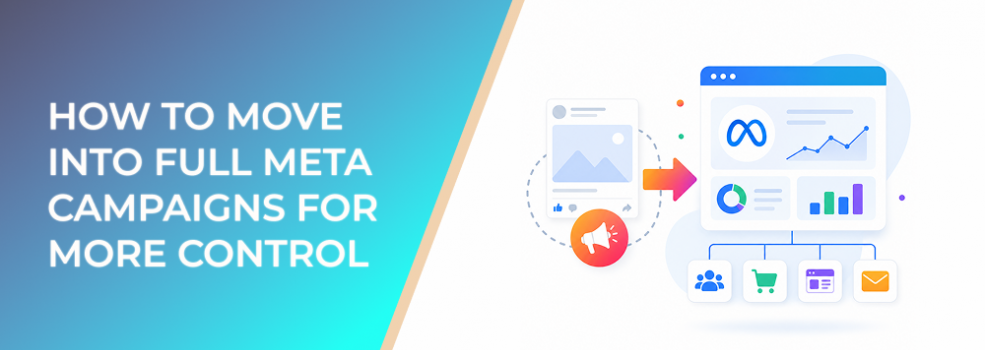
Boosted posts are useful until they start limiting what you need to control.
At first, boosting feels efficient. You can take an existing Facebook post, add budget, and reach more people quickly. But as soon as the campaign needs better audience segmentation, conversion-focused optimization, creative testing, exclusions, placement control, or stronger performance measurement, the boosted-post workflow can become too shallow.
That is when marketers need to move from a boosted post to a full Meta campaign.
Meta’s Help snippets distinguish boosted posts from ads created through Ads Manager and Meta Business Suite by noting that the latter offer more advanced customization, which is exactly why this migration matters for performance-focused advertisers.
The goal is not to abandon the original post. The goal is to rebuild the campaign around better control.
The Problem
The problem is trying to fix limited control inside a format that was designed for simplicity.
A boosted post can extend reach, amplify content, and create quick engagement. But it is not always the right structure for campaigns that need commercial performance.
Marketers often keep adjusting the boosted post: changing budget, expanding the audience, extending the duration, or trying another post. But the real issue is not always the post itself. The issue is the campaign structure.
If the campaign needs qualified leads, purchases, retargeting, conversion optimization, creative testing, or audience exclusions, the solution is usually not another boost.
The solution is moving into a full campaign.
Why This Problem Hurts Performance
Limited control hurts performance because it forces advertisers to make broad changes instead of precise improvements.
If a boosted post underperforms, the advertiser may not know why. Was the audience too broad? Was the placement mix wrong? Was the objective too shallow? Did the creative only work for warm followers? Was the landing page misaligned? Did the campaign optimize toward cheap engagement instead of qualified intent?
Without full campaign structure, those questions are harder to answer.
That weakens CPC, CPA, CAC, ROAS, lead quality, and conversion-rate decisions. It also makes scaling risky. If you cannot isolate what is working, increasing budget may only amplify the same inefficiency.
For agencies and growth teams, limited control also creates reporting problems. Clients want to know what improved, what failed, and what should happen next. A boosted post may show activity, but it may not provide enough learning to make confident decisions.
Common Scenarios Where This Happens
An agency boosts a client’s strongest organic post, gets engagement, and then needs better lead quality.
A B2B marketer promotes an educational post, sees traffic, and then realizes the audience includes too many users outside the buying committee.
An ecommerce team boosts a product post, gets clicks, and then needs to separate prospecting, retargeting, and purchase optimization.
A local business boosts a service announcement, receives casual comments, and then needs a campaign built around bookings or quote requests.
A startup boosts launch content and later needs to test different messaging, offers, and audiences to find a repeatable acquisition path.
These are all signs that the campaign has outgrown boosted-post simplicity.
Why the Problem Happens
The problem happens because boosting starts from content, while full campaign strategy starts from objectives.
A boosted post asks, “Which post do you want to promote?”
A full campaign asks, “What result do you want, who should see the ad, what message should they receive, and how will success be measured?”
Those are different starting points.
Boosted posts can also create false confidence. If a post gets good engagement, marketers may assume it is ready to scale. But organic engagement often comes from existing followers, loyal customers, or warm users. Paid expansion can expose the same post to colder audiences where the result changes.
Another cause is lack of segmentation. Boosted posts often collapse too many variables into one campaign. A full campaign allows marketers to separate audience types, creative versions, funnel stages, and measurement goals.
That separation is what makes optimization possible.
The Solution
The solution is to migrate the boosted post into a full campaign workflow.
Step 1: Identify the control gap
Start by naming what the boosted post cannot do well enough.
Is the audience too broad? Is lead quality weak? Do you need exclusions? Do you need retargeting? Do you need to test creative variations? Do you need a conversion-focused objective? Do you need better placement or budget control?
Do not migrate just because full campaigns sound more advanced. Migrate because there is a specific control gap.
Step 2: Rebuild around the campaign objective
Choose the objective based on the business result.
If the goal is leads, build around lead capture and lead quality. If the goal is purchases, build around the sales path. If the goal is retargeting, separate warm audiences from cold prospecting. If the goal is testing, design the campaign to answer one clear question.
Meta’s documentation around objective selection reinforces that campaign objectives should align with the advertiser’s business goal.
Step 3: Separate audiences
Do not move from one broad boost into one broad full campaign.
Separate audiences by intent, source, funnel stage, or ICP fit. For example, you might create different ad sets for cold prospecting, warm engagers, competitor-related audiences, niche communities, or professional segments.
This helps you see which audience is actually producing useful results.
Step 4: Expand creative beyond the original post
The original boosted post can still be useful. It may become one ad variation.
But a full campaign should usually test additional creative. Create versions with different hooks, CTAs, formats, proof points, or offer framing.
The goal is to stop relying on one organic post and start learning which message works in paid delivery.
Step 5: Measure business outcomes
Do not judge the rebuilt campaign only by engagement.
Track the metrics that match the objective: landing page views, conversion rate, qualified lead rate, CPA, CAC, ROAS, booked calls, purchases, or pipeline contribution.
The migration only works if measurement improves along with control.
How LeadEnforce Helps
LeadEnforce fits naturally into the audience step of this migration.
When advertisers move beyond boosted posts, they often realize that broad targeting was one of the reasons performance stalled. A full campaign gives them more room to test audience inputs, but they still need relevant sources.
LeadEnforce helps advertisers create audience inputs from Facebook groups, Instagram followers and engagers, LinkedIn-derived professional data, and custom social-profile links. That is useful when the campaign needs more precise prospecting than a basic boosted post can provide.
For B2B teams, LeadEnforce can support audiences based on professional context. For ecommerce brands, it can support audience tests around followers of relevant Instagram profiles. For agencies, it can help create more client-specific audience inputs instead of relying only on broad interests.
LeadEnforce does not fix weak creative, poor landing pages, bad tracking, or unclear offers. It helps solve the audience relevance part of the migration from boosted posts to full campaigns.
Risks and Considerations
Moving into a full campaign adds control, but it also adds responsibility.
More settings do not automatically mean better results. If the campaign objective is unclear, the audience is too small, the creative is weak, or the landing page does not match the ad promise, the full campaign can still underperform.
Be careful not to over-segment too early. Too many small ad sets can limit delivery and make results hard to interpret.
Also avoid changing too many variables at once. If you change the audience, creative, offer, landing page, and objective together, you may not know what caused the improvement or decline.
If LeadEnforce is used, choose sources carefully. A niche group, Instagram profile, or LinkedIn-derived segment should match the ICP, not just the general topic.
Prerequisites and Dependencies
Before migrating, you need a clear ICP, campaign objective, primary KPI, budget range, offer, and conversion path.
You also need a reason to migrate. A boosted post that works well for local awareness may not need to become a full campaign. Migration makes sense when the campaign needs better control or stronger performance learning.
For full campaigns, prepare creative variations, audience hypotheses, placement assumptions, and a measurement plan.
If LeadEnforce is part of the workflow, identify relevant source groups, Instagram profiles, LinkedIn criteria, or social-profile data before building the campaign.
Practical Recommendations
Start with the boosted post that created the clearest signal.
Look for posts with meaningful comments, shares, saves, product questions, profile visits, or link behavior. Do not migrate a post just because it has likes.
Write down what the boosted post taught you and what it could not answer.
Then rebuild the campaign around one primary goal. Separate audiences. Test creative variations. Use business metrics, not only engagement metrics.
Move gradually. A small structured test is better than a large campaign built on assumptions.
When audience relevance is the main limitation, use LeadEnforce before scaling. The best time to improve audience inputs is before the campaign spends heavily, not after broad delivery has already created noisy results.
Final Takeaway
Boosted posts are useful for quick distribution, but they become limiting when the campaign needs control.
If you need better objectives, audience segmentation, creative testing, exclusions, conversion optimization, or business-level measurement, move the promotion into a full Meta campaign. Keep the useful creative signal from the boosted post, but rebuild the campaign around performance control.
To create more relevant audience inputs for your next full Meta campaign, join the free 7-day LeadEnforce trial period.
Related LeadEnforce Articles
- Boosted Posts vs Meta Ads: What Actually Drives Better CPA and ROAS — Explains why boosted posts and full Meta campaigns differ most in control and optimization.
- Use Facebook Page Ads as a Real Performance Test, Not Just a Quick Boost — Helps advertisers turn quick Page-created ads into more useful campaign learning.
- When Facebook Page Ads Reach the Wrong Audience — Connects weak Page ad performance to audience mismatch and targeting quality.
- How to Stop Meta From Optimizing for the Wrong Result — Useful for diagnosing campaigns that generate activity but not the right business outcome.
- How to Create High-Converting Facebook Custom Audiences — Provides broader guidance for building stronger custom audiences in Meta campaigns.