Complex B2B products rarely fail because of weak targeting. They fail because the message doesn’t match how buyers actually evaluate risk, change, and internal alignment.
If you’re selling something that requires multiple stakeholders, budget justification, and operational change, your messaging is not just persuasion. It’s a decision system.
This article breaks down how to structure messaging frameworks that reflect real buying dynamics — not simplified marketing assumptions — and how to operationalize them in campaigns.
Why Messaging Breaks in Complex B2B Sales
You can often spot weak messaging by looking at engagement patterns inside your campaigns.
Click-through rates may look acceptable, but downstream signals tell a different story: low form completion rates, high bounce on pricing pages, or stalled pipeline progression after the first call.
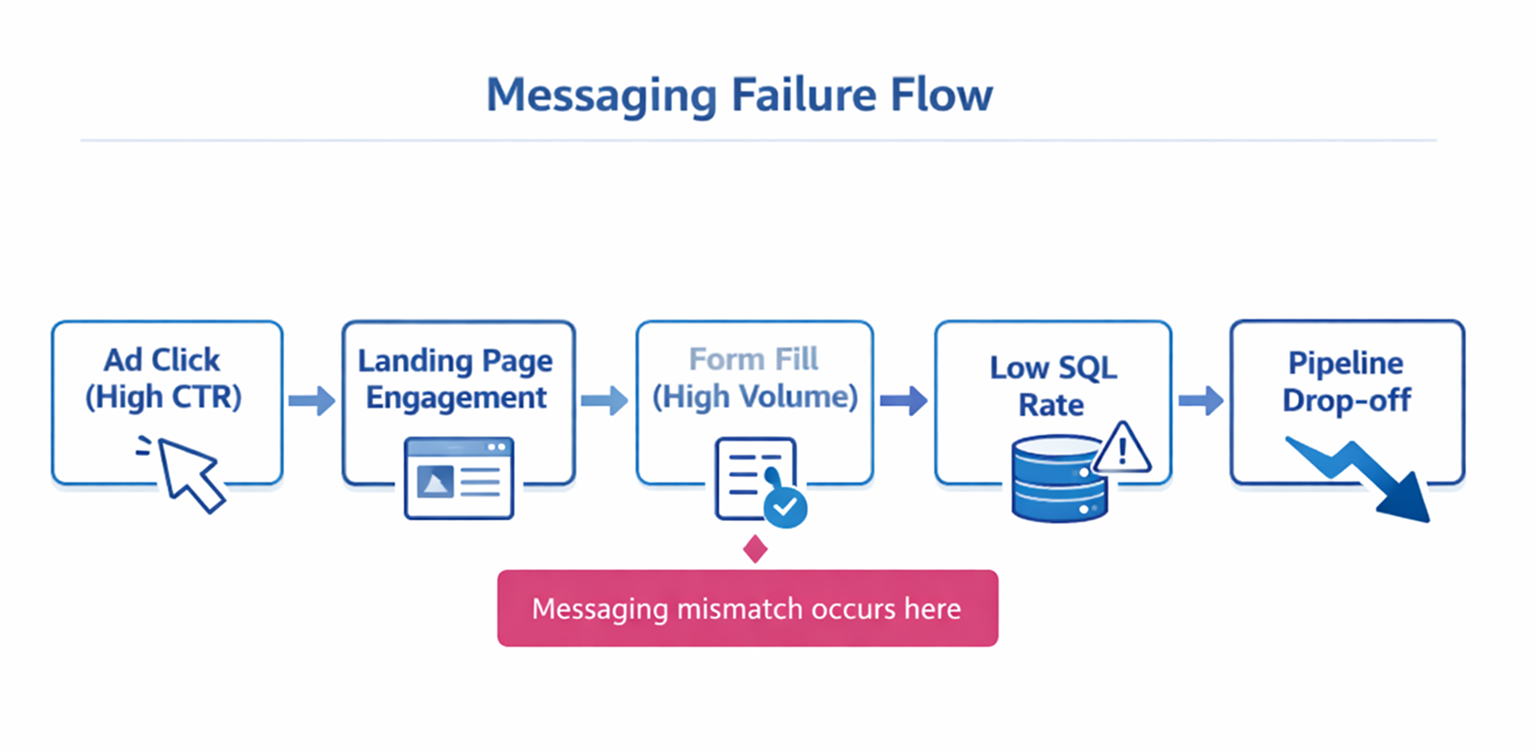
That usually means the message triggered curiosity, not alignment.
The core issue is structural:
-
The message compresses a complex product into a single value proposition, which removes the context buyers need to evaluate it and compare it against alternatives in their stack.
-
It assumes a single decision-maker, while in reality, multiple roles interpret the message through different incentives, constraints, and success metrics.
-
It skips the “translation layer” between feature and business impact, forcing the buyer to do that work internally — which often leads to friction or drop-off.
In Ads Manager, this shows up as:
-
High CTR with low conversion quality, meaning users are intrigued but not aligned;
-
Strong top-of-funnel engagement but weak SQL rates, indicating mismatch in intent;
-
Inconsistent performance across industries or company sizes, suggesting messaging lacks structural clarity.
Messaging isn’t failing randomly. It’s failing because it doesn’t match how decisions actually happen.
The Core Shift: From Value Propositions to Decision Narratives
Most B2B messaging frameworks rely on value propositions:
“Save time,” “reduce costs,” “increase efficiency.”
These are directionally correct but operationally insufficient.
Buyers don’t act on abstract benefits. They act when they can clearly map:
-
What changes in their current system;
-
What risks are introduced or removed;
-
How this decision will be defended internally.
A more effective structure is a decision narrative, which includes:
-
The current system state — how things work today;
-
The structural limitation — where the system breaks or stalls;
-
The intervention — what your product changes;
-
The outcome — how this affects measurable business results.
For example, instead of:
“Improve lead quality with better targeting,”
You’d structure it as:
“When all leads are treated equally, Meta optimizes toward cheap conversions. That increases volume but lowers sales acceptance rates. By feeding CRM-qualified signals back into the algorithm, you shift delivery toward users that resemble closed deals, not just form fills.”
If you want a deeper breakdown of how signal quality impacts targeting, see How CRM Data Improves Lookalike Performance.
Now the buyer sees:
-
The mechanism;
-
The failure point;
-
The correction.
This aligns with how experienced operators think.
Mapping Messaging to Stakeholder Roles
Complex B2B purchases involve multiple roles, each evaluating the product through a different lens.
If your messaging doesn’t reflect that, it will resonate partially — and stall.
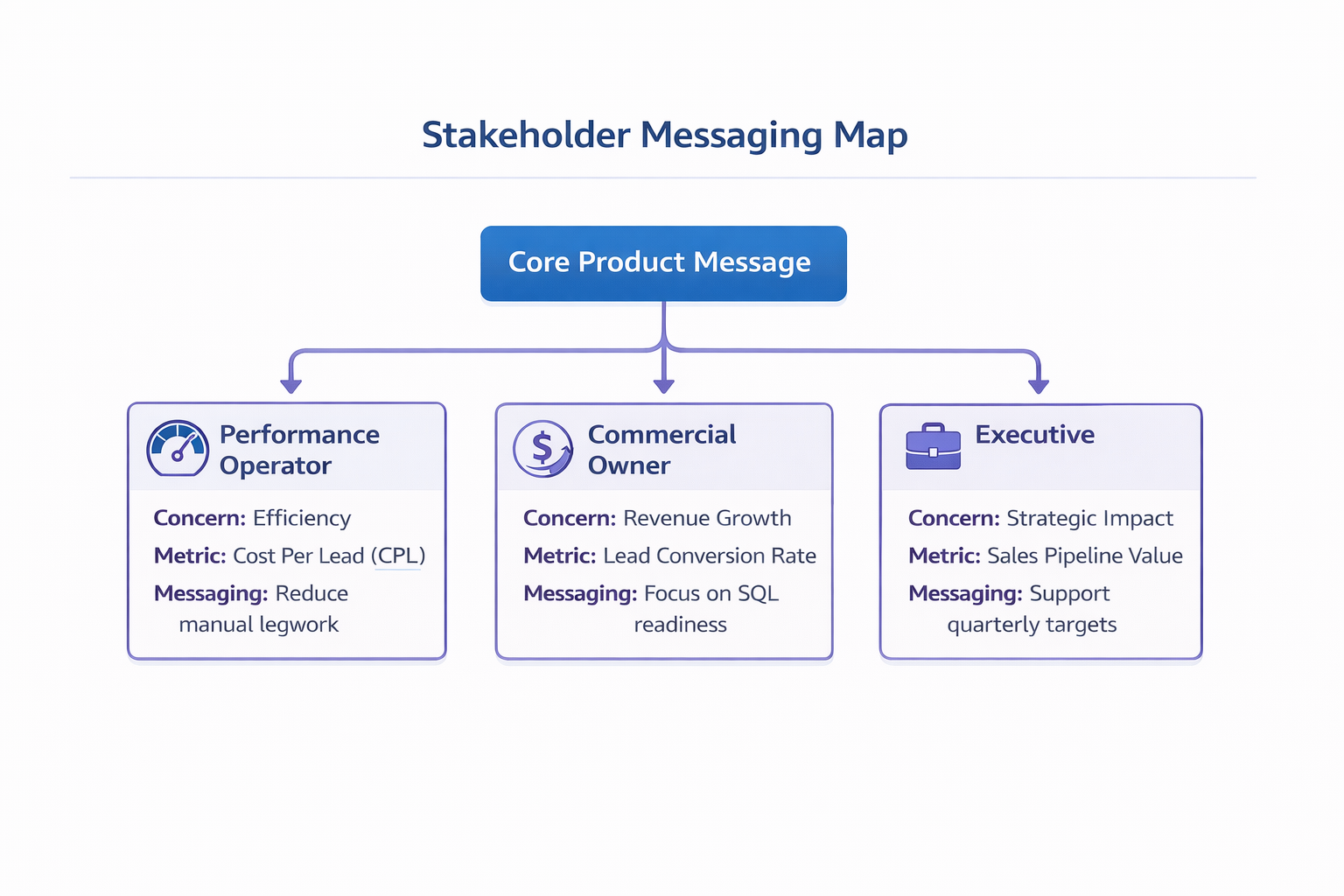
A practical way to structure this is to map messaging layers to roles:
1. Performance Operator (e.g., Paid Media Manager)
This person cares about execution details and measurable signals.
Your messaging should address:
-
How the product changes campaign behavior (e.g., auction participation, bid adjustments, signal consistency);
-
What signals improve (e.g., CPM stability, conversion rate consistency, learning phase duration);
-
What becomes easier to diagnose or control in Ads Manager.
Example angle:
-
“When conversion signals become more consistent, the learning phase stabilizes faster, reducing volatility in spend allocation.”
2. Commercial Owner (e.g., Head of Marketing or Revenue)
This role focuses on pipeline and revenue efficiency.
They evaluate:
-
Lead-to-opportunity conversion rates;
-
Sales cycle length;
-
Budget efficiency at the pipeline level.
Messaging should connect:
-
Marketing activity → pipeline quality → revenue outcomes.
Example angle:
-
“Lower CPL doesn’t matter if opportunity rates drop. This approach increases cost per lead slightly but improves opportunity conversion by 30–40%.”
This ties directly into how you should interpret performance metrics — covered in KPIs That Actually Matter in B2B Lead Generation.
3. Executive / Financial Stakeholder
This stakeholder evaluates risk, scalability, and predictability.
They need clarity on:
-
ROI stability;
-
Implementation complexity;
-
Dependency on internal resources.
Messaging should reduce perceived risk:
-
“The system integrates with your existing CRM and starts influencing delivery within 7–10 days, without changing your current campaign structure.”
Each of these layers should exist explicitly in your messaging framework. Otherwise, the buyer has to reconstruct them — and most won’t.
The Three Messaging Layers Every Complex Product Needs
Instead of trying to compress everything into one message, structure it across three layers that mirror how buyers process information.
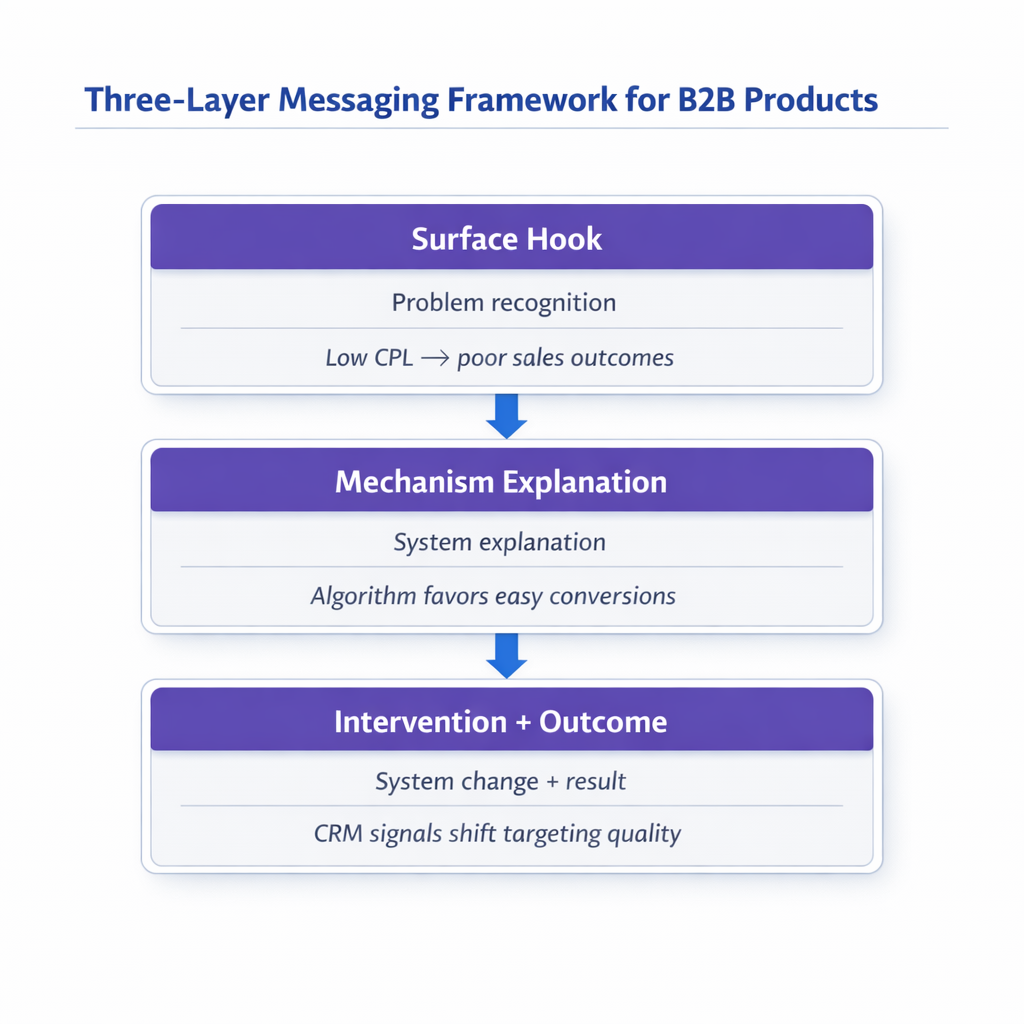
Layer 1 — Surface Hook (Attention and Relevance)
This is what drives the initial click.
It must connect to a recognizable problem, not a generic benefit.
Weak:
-
“Improve your marketing performance.”
Stronger:
-
“Why your lowest CPL campaigns often produce the worst sales outcomes.”
This works because it reflects a real contradiction that operators have seen in their accounts.
Layer 2 — Mechanism Explanation (Understanding)
Once the user engages, the next step is explaining why the problem exists.
Instead of summarizing benefits, describe the system:
-
How the algorithm interprets signals;
-
How data quality affects targeting;
-
Where distortion enters the process.
Example:
-
“When all conversions are treated equally, the algorithm prioritizes users who are easier to convert, not those more likely to buy.”
If you want to understand how this affects retargeting behavior as well, see Retargeting Based on Content Engagement Signals.
This is verifiable in campaign behavior, which increases credibility.
Layer 3 — Intervention and Outcome (Decision Readiness)
Finally, show how your product changes that system.
This must be specific:
-
What data is introduced or modified;
-
How quickly the system responds;
-
What metrics shift as a result.
Example:
-
“By sending qualified lead events back to Meta, you reduce noise in the optimization signal, which shifts delivery toward higher-intent audiences within 1–2 learning cycles.”
Now the buyer can connect action to outcome.
Building a Messaging Framework You Can Actually Use in Campaigns
A common mistake is creating messaging frameworks that look good in strategy documents but don’t translate into ads, landing pages, or sales conversations.
To make the framework usable, structure it as modular components:
1. Problem Statements (Diagnostic Entry Points)
Each problem statement should reflect a real, observable situation.
Examples:
-
“Your CPL dropped, but your sales team rejects more leads than before, increasing acquisition cost at the opportunity level.”
-
“Retargeting performance declines even as traffic volume increases, indicating audience saturation or weak signal prioritization.”
These act as entry points for different segments.
2. Mechanism Blocks (Reusable Explanations)
Instead of rewriting explanations for every campaign, define core mechanisms:
-
Signal quality vs volume tradeoff — higher volume often introduces noise that degrades optimization;
-
Algorithm bias toward easy conversions — platforms favor users who convert quickly, not necessarily those who convert to revenue;
-
Data feedback loops between CRM and ad platforms — stronger feedback improves targeting precision over time.
Each mechanism should be:
-
Short enough to fit in landing page sections;
-
Specific enough to feel credible to an experienced operator.
3. Proof Anchors (Evidence and Validation)
These reduce skepticism.
Include:
-
Before/after performance shifts (e.g., opportunity rate increasing from 12% to 19%);
-
Time-to-impact (e.g., measurable changes within two weeks of integration);
-
Observable platform signals (e.g., CPA stabilization after learning phase resets decrease).
This directly addresses the “Ads Manager Reality Check.”
4. Outcome Framing (Business Translation)
Translate technical improvements into business outcomes:
-
“Higher signal quality” → “fewer wasted sales calls and better rep utilization”;
-
“Better targeting precision” → “more predictable pipeline and forecast accuracy.”
Without this step, technical messaging remains isolated and harder to justify internally.
Diagnosing Messaging Gaps in Live Campaigns
You don’t need surveys or interviews to identify messaging problems. Campaign data already shows where alignment breaks.
Look for patterns like:
-
High CTR + low conversion rate
The hook is strong, but the mechanism or expectation is unclear. -
Good conversion rate + poor SQL rate
The message attracts the wrong intent level. -
Strong initial engagement + long sales cycles
Buyers are interested but lack internal justification.
Each pattern maps to a messaging gap:
-
Hook problem;
-
Mechanism clarity problem;
-
Outcome framing problem.
This diagnostic approach keeps messaging grounded in performance data, not opinion.
Practical Takeaway
If your product requires explanation, your messaging must reflect how decisions are actually made — not how marketing frameworks simplify them.
A strong messaging system should:
-
Mirror real campaign behavior and observable signals;
-
Translate technical mechanisms into business impact;
-
Support multiple stakeholders without fragmenting the narrative.
When this structure is in place, campaigns don’t just generate more leads.
They generate leads that are easier to convert, justify, and close.