Case studies are often treated as “proof assets,” but in most ad accounts they function more like weak credibility signals than performance drivers. The issue isn’t the format itself — it’s how the information is translated into the ad system.
When case studies fail, it’s usually because they are presented as static stories instead of structured signals the algorithm and the user can both interpret.
This article breaks down how case studies actually influence ad performance, where they typically break, and how to rebuild them into assets that drive qualified demand.
Why Most Case Study Ads Underperform
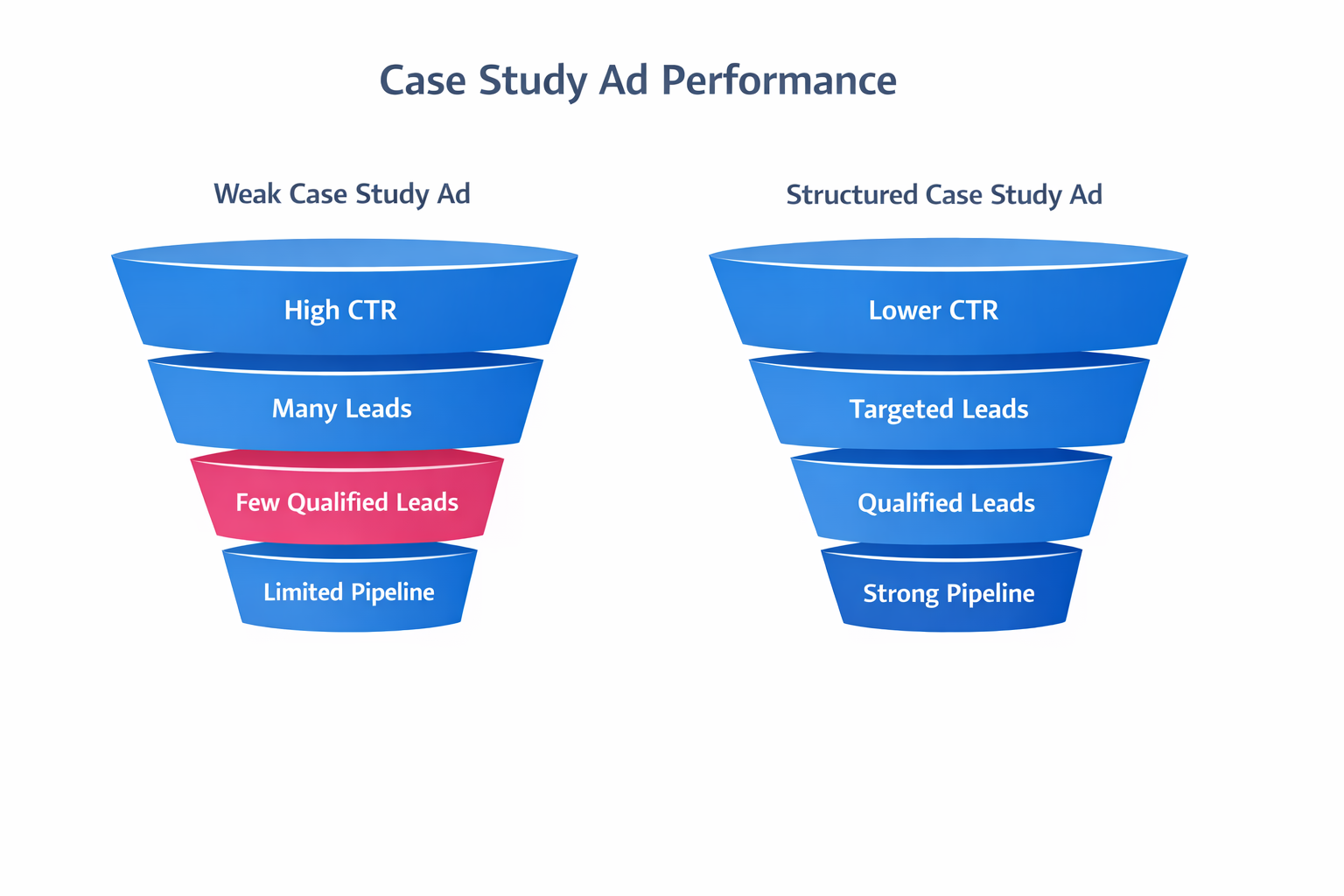
A common pattern: you launch a case study-based ad, CTR looks healthy, CPC stays reasonable, but lead quality drops or pipeline doesn’t move.
This happens because the ad attracts curiosity, not qualification.
In most cases, the structure looks like this:
-
Headline focuses on outcome, not context.
For example, “How Company X Increased Revenue by 300%.” This pulls in a wide audience, including users who don’t match the underlying conditions. -
No filtering mechanism in the creative.
The ad does not specify industry, deal size, or operational constraints, so the algorithm expands into irrelevant segments. -
Narrative overload before clarity.
Users see a long story but can’t quickly determine if the case is relevant to them.
Inside Ads Manager, this shows up as:
-
High CTR with low downstream conversion to qualified stages.
-
Increasing CPL stability but declining CPQL.
-
Broad audience expansion with inconsistent performance across segments.
This is closely related to the pattern explained in Why Your Ads Get Clicks But No Sales: Fixing the Audience Misalignment
The system is doing its job — it’s finding engagement. The problem is the signal you’re feeding it.
What Case Studies Actually Do in the Auction
A case study doesn’t just “build trust.” It shapes how the algorithm interprets your audience.
When a user clicks or engages, the platform records behavioral patterns tied to that interaction. If the case study is too broad, the system learns the wrong signals.
Three mechanisms are at play:
-
Engagement clustering.
If your case study appeals to multiple unrelated segments, the algorithm groups them together. This reduces targeting precision over time. -
Conversion signal dilution.
If low-fit users convert (e.g., download or sign up), they contaminate the optimization pool. Future delivery shifts toward similar low-quality profiles. -
Bid competitiveness mismatch.
Strong claims without clear constraints attract competitive clicks, increasing CPM and CPC without improving pipeline outcomes.
A well-structured case study narrows these signals instead of expanding them — the same principle discussed in Audience Quality vs Quantity: What Drives Better Long-Term Results?
Structuring Case Studies for Qualification, Not Just Credibility
The goal is not to make the case study more impressive. The goal is to make it more selective.
Instead of telling a story, you’re defining a pattern that the right buyers recognize instantly.
A functional structure looks like this:
-
Context anchor (who this is for).
Specify industry, company size, or operational model.
Example: “B2B SaaS company selling into enterprise IT teams.” -
Constraint (what made the problem difficult).
This filters out irrelevant users.
Example: “Long sales cycle with multiple stakeholders and low demo conversion.” -
Intervention (what actually changed).
Focus on the mechanism, not just the action.
Example: “Shifted from lead-based optimization to SQL-based signal feedback.” -
Outcome (quantified, but tied to context).
Avoid standalone metrics.
Example: “Reduced CPQL by 32% while maintaining pipeline volume.”
This structure aligns with how full-funnel systems work, as outlined in Facebook Ads Funnel Strategy: From Audience Identification to Conversion.
Translating Case Studies Into Ad Creatives
A full case study rarely works as a direct ad. It needs to be compressed into a decision signal.
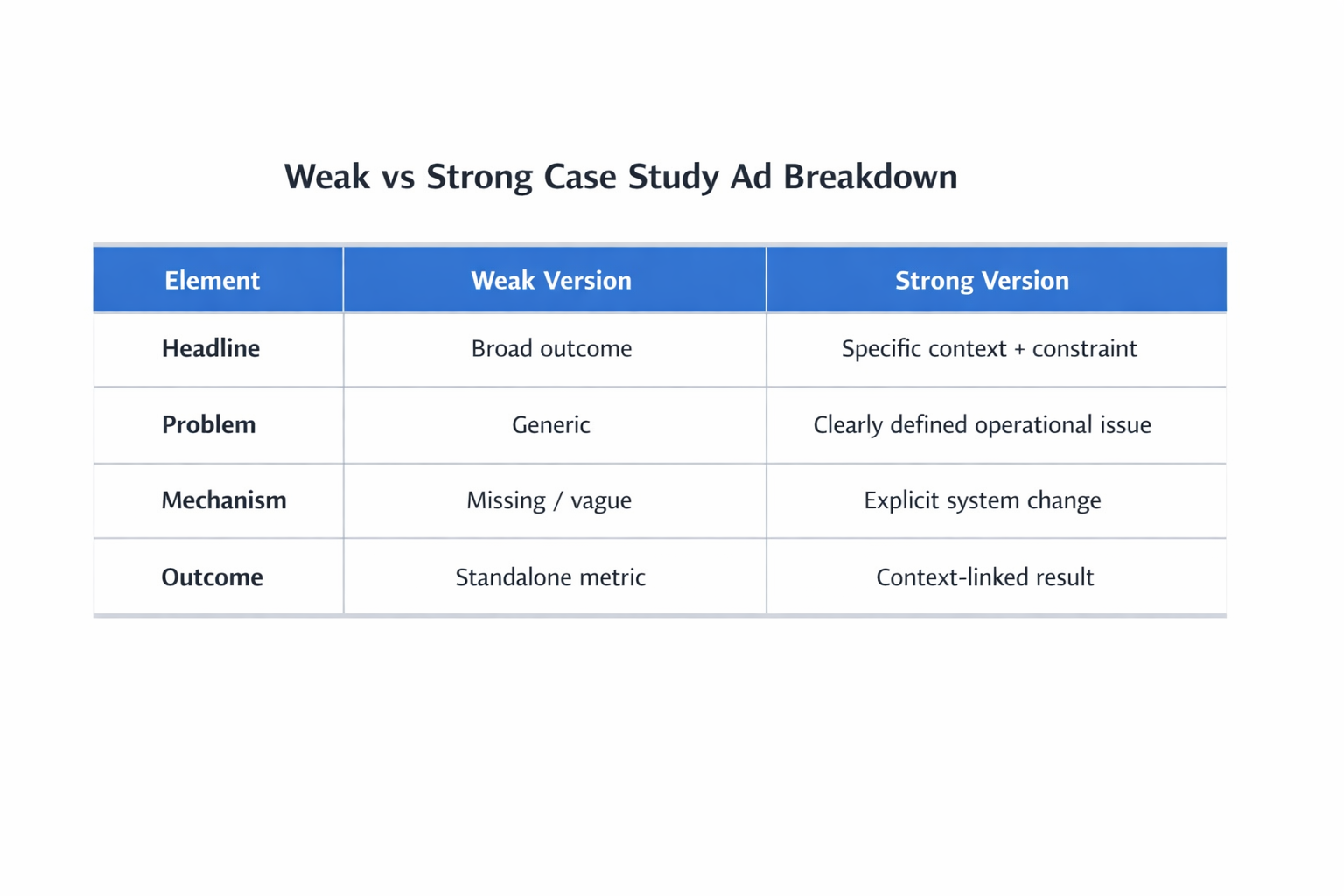
Effective transformations include:
1. Constraint-Driven Headlines
Instead of broad outcomes, anchor the message in a specific situation.
-
Weak: “How We Increased Revenue by 300%”
-
Strong: “Scaling Paid Acquisition for Enterprise SaaS with 6-Month Sales Cycles”
2. Problem – Mechanism Pairing
Users don’t convert because of results alone — they convert when they recognize the problem and believe the mechanism applies to them.
Structure the ad like this:
-
Problem: “High lead volume, low sales acceptance.”
-
Mechanism: “Switching optimization from leads to CRM-qualified events.”
3. Outcome as Validation, Not Hook
Results should confirm the mechanism, not carry the entire message.
-
Use outcomes after the context is clear.
-
Tie metrics directly to the described system.
Example: “After shifting to CRM-based optimization, CPQL dropped 28% within three weeks.”
Where to Place Case Studies in the Funnel
Case studies perform differently depending on where they appear in the funnel.
Misalignment here is a frequent source of wasted spend.
-
Top of funnel (cold audiences).
Case studies should act as filters, not deep narratives. -
Mid funnel (engaged users).
Longer breakdowns become effective. -
Bottom of funnel (high intent).
Detailed case studies support conversion.
This aligns with broader targeting strategy tradeoffs explained in Retargeting vs. Broad Targeting: Which Strategy Drives Better Results?
Diagnosing Case Study Performance in Ads Manager
You can usually tell within a few days whether a case study is working as intended.
Look for these signals:
-
CTR vs. downstream drop-off.
-
Lead-to-opportunity ratio.
-
Audience expansion patterns.
-
Frequency vs. conversion rate.
These are observable inside Ads Manager and directly reflect signal quality.
Common Structural Mistakes
Even strong companies fall into predictable traps:
-
Over-generalization.
-
Narrative-first structure.
-
Metric inflation without context.
-
Missing negative qualifiers.
Each of these weakens both user filtering and algorithmic learning.
Practical Takeaway
Case studies are not just proof — they are targeting tools.
When structured correctly, they:
-
Filter the audience before the click.
-
Improve signal quality for optimization.
-
Align expectations with actual offer fit.
If your case study ads generate volume but not pipeline, the issue is almost always structural — not creative fatigue.