Many advertisers like ABO because it gives them tighter control over budgets.
Each ad set gets its own spend limit, which makes audience testing easier and reporting cleaner. The problem is that ABO can become slow and rigid when performance changes quickly.
One ad set may suddenly outperform the others, but the budget stays locked unless someone adjusts it manually.
Meta ad set budget sharing was built to reduce that friction.
What ad set budget sharing actually does
Budget sharing allows Meta to move up to 20% of one ad set’s daily budget into another active ad set inside the same campaign.
The total campaign spend does not increase. Meta simply redistributes part of the budget toward stronger opportunities in real time.
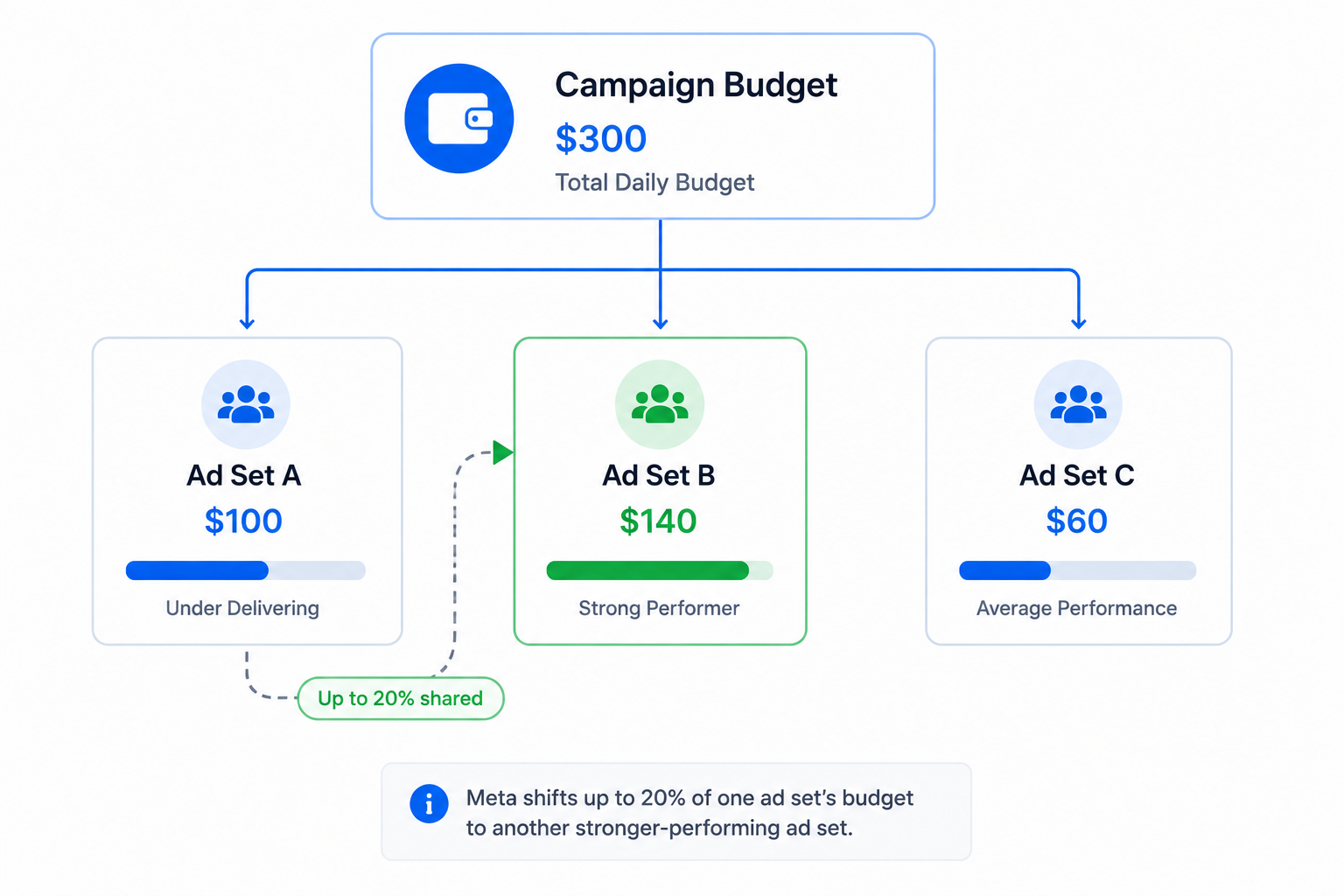
This gives advertisers a middle ground between strict ABO and full Campaign Budget Optimization.
With budget sharing enabled, you still keep separate ad set budgets while allowing Meta some flexibility during delivery.
That makes it useful for advertisers who want more structure than CBO but less manual budget work than traditional ABO.
Why Meta introduced this feature
ABO campaigns often waste spend because budgets stay too fixed.
A stronger audience may hit its budget cap early while weaker ad sets continue spending normally. Media buyers then step in manually, which creates delays and can reset learning signals.
Budget sharing helps Meta react faster when performance shifts between ad sets.
This usually works well in campaigns where audience behavior changes throughout the week or during promotions.
Strong use cases include:
- Ecommerce campaigns with changing daily demand.
- Creative testing across similar audiences.
- Prospecting campaigns with several related ad sets.
- Seasonal campaigns with uneven traffic spikes.
This fits naturally with a CBO or ABO budget strategy because budget sharing adds limited automation without fully removing ad set control.
The part advertisers often misunderstand
Budget sharing does not distribute spend evenly.
Meta still prioritizes performance signals. If one ad set starts generating lower CPA or better conversion rates, the system may shift shared budget there repeatedly.
That can create noticeable spend imbalances inside the campaign.
Advertisers often see this in Ads Manager:
- One ad set suddenly spends far more than expected.
- Smaller audiences lose delivery quickly.
- Winning ad sets collect more optimization data.
- Weak ad sets struggle to recover delivery momentum.
This is one reason advertisers investigate uneven spend distribution across Facebook ad sets. Budget sharing can amplify early performance differences very quickly.
How Meta calculates spend flexibility
Meta combines two layers of flexibility:
- Daily budget flexibility, where spend may go up to 75% above the daily budget on strong days.
- Shared budget flexibility, where up to 20% of another ad set’s budget may shift temporarily.
That means spend can move more aggressively than many advertisers expect.
Meta’s own example shows that a $20 ad set may spend up to $42 daily once both flexibility systems are combined.
For advertisers managing strict CPA targets, this matters because ABO campaigns are no longer fully fixed once sharing is enabled.
When budget sharing becomes ris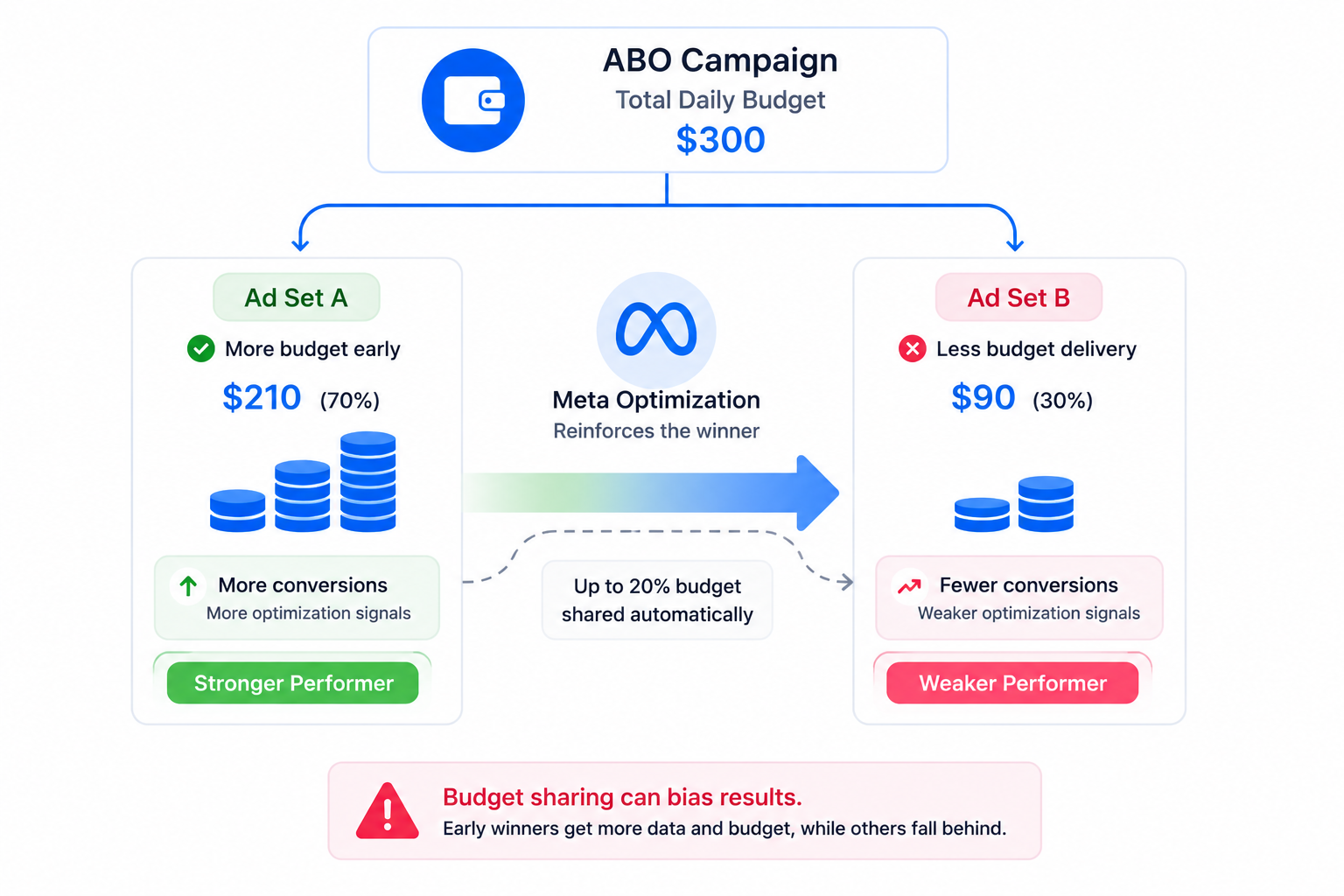 ky
ky
The feature can distort controlled tests.
If the goal is clean audience comparison, Meta’s automatic redistribution may favor one ad set early and create a feedback loop. The stronger ad set gains more spend, gathers more conversion data, and then keeps winning even more delivery.
That makes test results less reliable.
Budget sharing also becomes risky when audience quality is weak. Meta may simply shift more budget toward the ad set producing cheaper but lower-quality leads.
This is especially common in lead generation campaigns where front-end CPL looks strong while sales-qualified lead rates decline later.
That is why audience quality matters before automation does.
LeadEnforce helps here by giving advertisers stronger audience signals through Facebook groups, Instagram engagers, and social profile targeting. Better audience inputs usually improve Meta’s budget allocation decisions.
How to test ad set budget sharing properly
Keep the setup simple when testing the feature.
Do not change creatives, targeting, and placements at the same time. That makes delivery patterns difficult to read.
Instead:
- Run the campaign with sharing disabled first.
- Compare spend distribution after enabling it.
- Watch CPA changes at the ad set level.
- Review lead quality, not just conversion volume.
Many advertisers judge the feature too early. An ad set receiving extra shared budget may look like the clear winner simply because Meta accelerated delivery there first.
Final takeaway
Meta ad set budget sharing gives ABO campaigns more flexibility without fully switching to CBO.
It works best when advertisers want separate ad set control but still need Meta to react faster to changing performance. But during strict testing campaigns, automatic redistribution can make audience comparisons less reliable.
Before enabling the feature, make sure the campaign already has strong audience quality and stable conversion data.