CPM increases without a clear trigger are rarely random. When costs rise while CTR and CVR remain stable, the issue often sits outside visible campaign metrics.
In many cases, the underlying factor is how Meta evaluates the experience tied to your business after the click — especially for commerce-focused accounts.
That evaluation is formalized in what Meta calls the Business Portfolio Feedback Score. Unlike most delivery signals, this one has explicit thresholds and direct consequences for both ads and selling capabilities.
What the Business Portfolio Feedback Score Actually Measures
Meta defines the Business Portfolio Feedback Score as a reflection of customer feedback about post-purchase experiences.
This is a critical distinction. The system is not measuring:
-
Click performance.
-
Conversion rate.
-
Cost efficiency.
It is measuring whether users feel satisfied after they interact with your business and complete a purchase or action.
This aligns closely with what many advertisers miss when focusing only on front-end metrics. As explained in How to Analyze Facebook Ad Performance Beyond CTR and CPC, performance signals often look strong while underlying quality deteriorates.
The score aggregates feedback across your entire business portfolio, including all Pages and Shops connected to it. This means performance is evaluated at a business level, not just at the campaign or account level.
How the Score Is Structured (And What the Numbers Mean)
Unlike most Meta signals, this score follows a defined scale with clear implications.
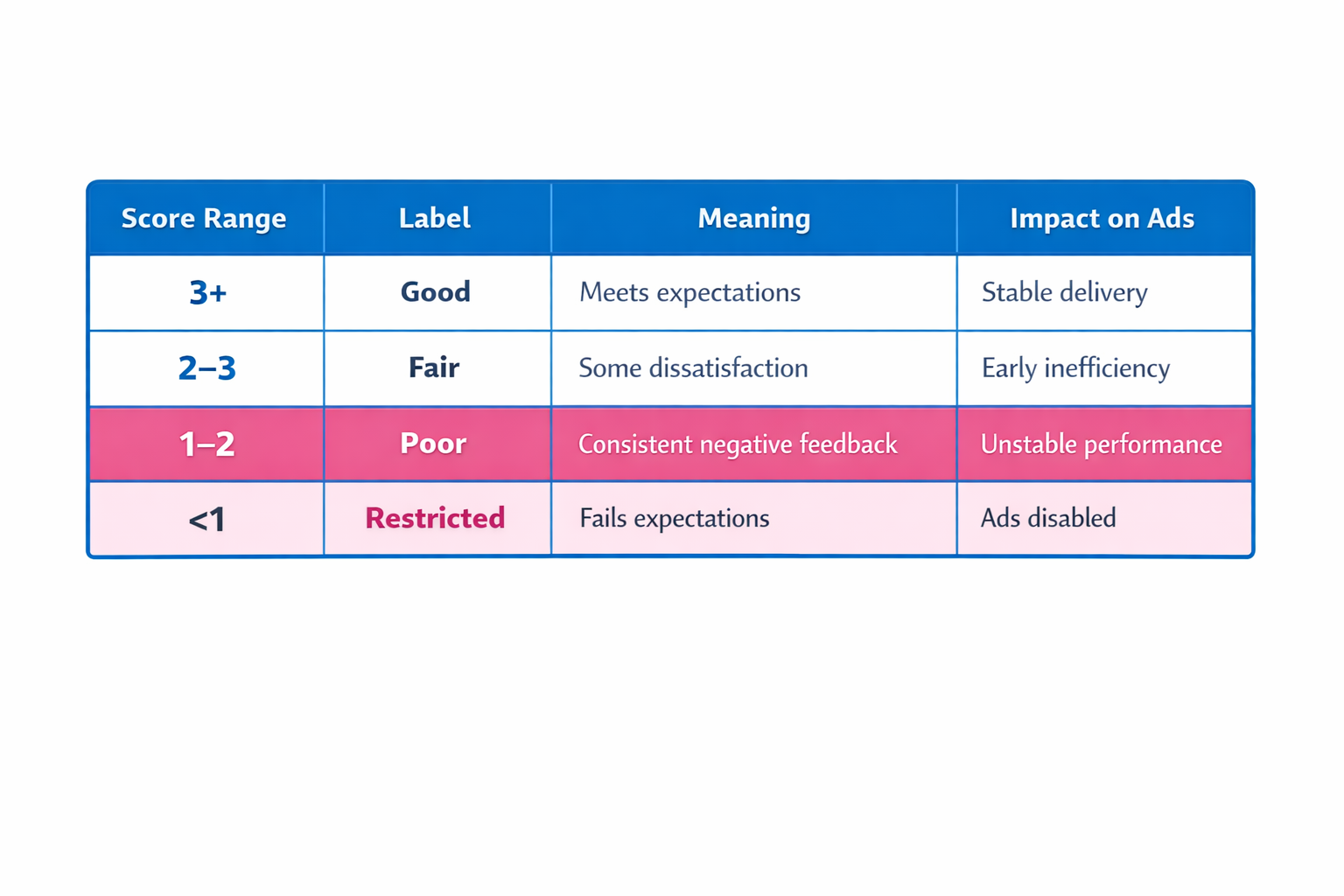
Your business portfolio is categorized based on the score:
-
3 or higher — Good
Your ads and Shops are meeting customer expectations. Delivery remains stable, and Meta maintains confidence in your business. -
2 to 3 — Fair
Some experiences fall short. At this stage, you may start seeing subtle performance degradation, especially in competitive auctions. -
1 to 2 — Poor
Dissatisfaction becomes consistent. Delivery becomes unstable, and scaling becomes difficult. -
Below 1 — Restricted
Your business may lose the ability to advertise or sell products. This is not optimization-related — it is a platform-level restriction.
This structure turns the feedback score into more than a quality metric. It becomes a control mechanism over delivery and eligibility.
Where the Score Comes From in Practice
The score is based on feedback from users who have likely completed purchases through your ads or Shops.
However, the way Meta aggregates this feedback introduces complexity.
The system combines:
-
Feedback from purchases made through ads linked to your Pages.
-
Feedback from Shops connected to your business portfolio.
-
Feedback from Pages that may not individually show a score but still contribute data.
This explains why the portfolio score can differ from what you see at the Page level.
For example:
-
Two Pages may each have a feedback score of 3.
-
The overall business portfolio score may still be 2.
This happens because Meta includes all relevant interactions — even those that don’t generate a visible Page-level score.
Why This Score Directly Impacts Ad Performance
Although the score is framed around customer experience, its effects show up clearly in campaign performance.
When the score declines, Meta adjusts delivery behavior:
-
It becomes more selective in auction participation.
-
It requires stronger predicted outcomes to compete.
-
It reduces overall delivery confidence.
The result is familiar:
-
Rising CPM.
-
Reduced reach.
-
Limited scaling potential.
These patterns are often misdiagnosed as targeting or creative issues. In reality, they are trust-related signals — similar to what’s described in Why Facebook Ads Performance Declines Over Time (and How to Prevent It).
Why the Portfolio Score Differs From Page-Level Scores
A common source of confusion is the difference between Page feedback and portfolio feedback.
The key distinction:
-
Page score reflects feedback tied to that Page’s ads.
-
Portfolio score aggregates feedback across the entire business.
Because of this:
-
A Page can appear healthy in isolation.
-
The overall business can still be flagged as underperforming.
This is particularly relevant for businesses managing multiple funnels or offers under one Business Manager.
Where Feedback Score Problems Usually Start
The score rarely drops because of a single issue. It degrades through repeated mismatches between expectation and actual experience.
The most common patterns include:
-
Ad-to-experience mismatch, where messaging sets expectations the product or process doesn’t meet.
-
Low-quality conversions, often caused by optimizing for volume instead of intent.
-
Operational gaps, such as delivery delays or unclear policies.
-
Post-click friction, especially on mobile devices.
Many of these issues originate after the click. That’s why improving performance often requires changes outside Ads Manager.
For example, Creating a Seamless Experience Between Ads and Landing Pages explains how small inconsistencies between messaging and experience can significantly impact outcomes.
How to Diagnose Feedback Score Issues
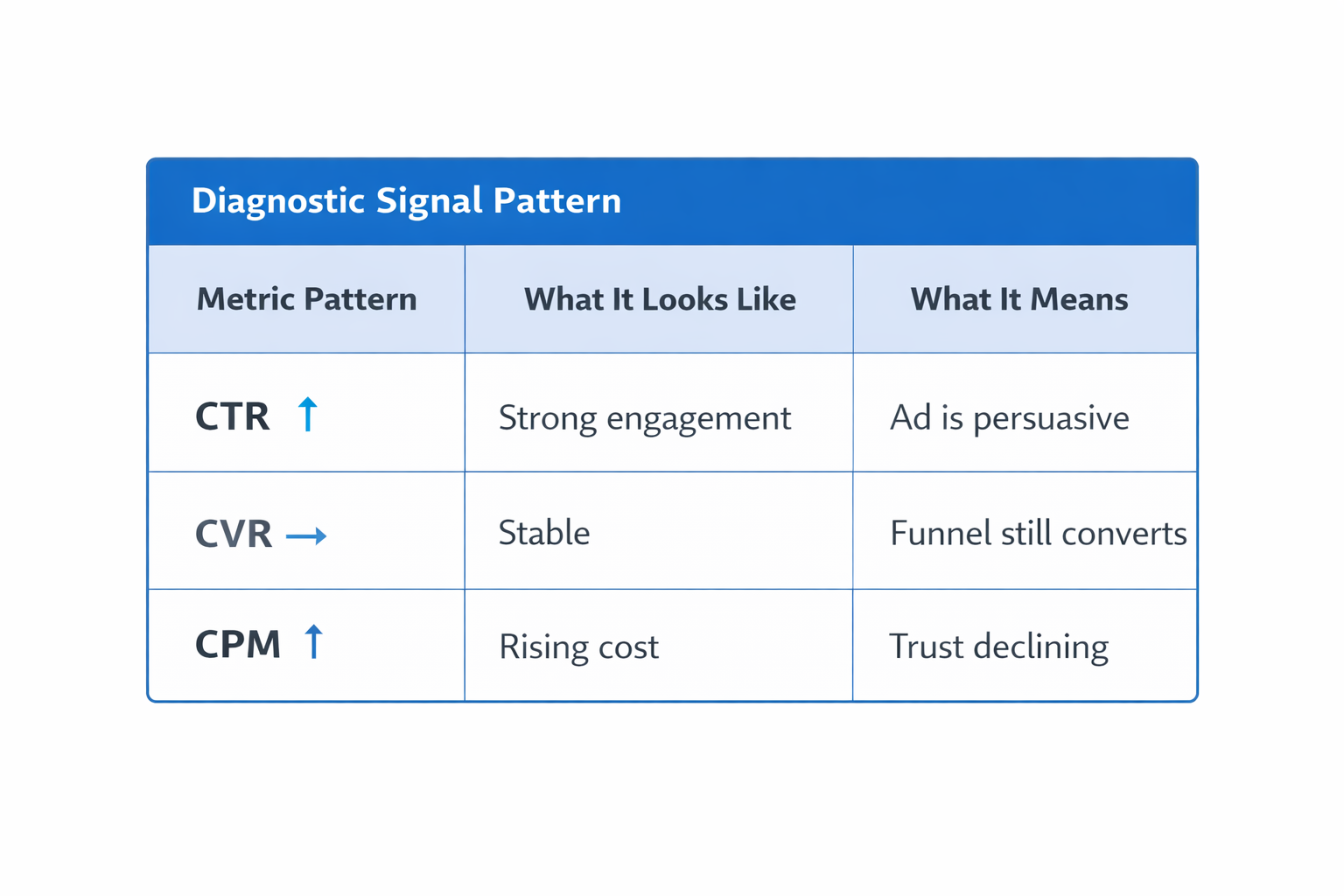
There is no single dashboard for this score, so diagnosis relies on patterns.
Look for combinations like:
-
Stable or increasing CTR.
-
Acceptable CVR.
-
Gradually rising CPM.
This pattern signals that engagement is strong, but trust is declining.
You should also compare:
-
Page-level feedback scores.
-
Overall business performance trends.
-
Internal customer satisfaction data.
How to Improve Your Business Portfolio Feedback Score
Improving the score requires fixing the actual experience — not just optimizing campaigns.
The most effective actions include:
-
Aligning expectations with reality, ensuring ads accurately reflect the purchase process and outcomes.
-
Improving customer experience, including delivery, communication, and clarity.
-
Prioritizing weak Pages, since they disproportionately affect the overall score.
-
Using internal data, such as refunds or complaints, to identify friction points.
If your score drops significantly, you can request a review through Business Support Home.
The Strategic Shift Most Advertisers Miss
Most advertisers treat Meta as a performance system focused on conversions.
At the portfolio level, Meta operates as a customer experience enforcement system.
It evaluates whether your business:
-
Sets accurate expectations.
-
Delivers on those expectations.
-
Maintains consistent satisfaction across interactions.
This is closely related to the broader idea explained in Optimizing for Post-Click Experience: What Happens After, where post-click behavior becomes a primary driver of performance.
Practical Takeaway
If your campaigns become more expensive or unstable without clear changes, the issue may not be in your ads.
It may be in how users experience your business after the click.
The Business Portfolio Feedback Score determines:
-
Whether your ads remain competitive in auctions.
-
Whether your campaigns can scale.
-
Whether your business can continue advertising at all.
Once that layer is compromised, campaign-level optimization has limited impact. Fixing the underlying experience becomes the only reliable path forward.