You can have a campaign that wins auctions, drives cheap clicks, and still fails to generate pipeline. That disconnect is frustrating because nothing looks obviously broken in Ads Manager.
In many cases, the issue isn’t targeting or creative. It’s what happens after the click — on the landing page. If you’ve ever dealt with traffic that “should convert but doesn’t,” you’re looking at a post-click problem, not a top-of-funnel one.
When Performance Looks Fine — But Results Don’t Follow
This is a pattern most media buyers run into sooner or later.
You see stable delivery metrics:
-
CPM holds steady, meaning you’re still competitive in auctions.
-
CTR is strong, which suggests your creative and audience pairing is working.
-
Spend is consistent, so the system is not throttling delivery.
But conversions don’t follow. Or they decline gradually.
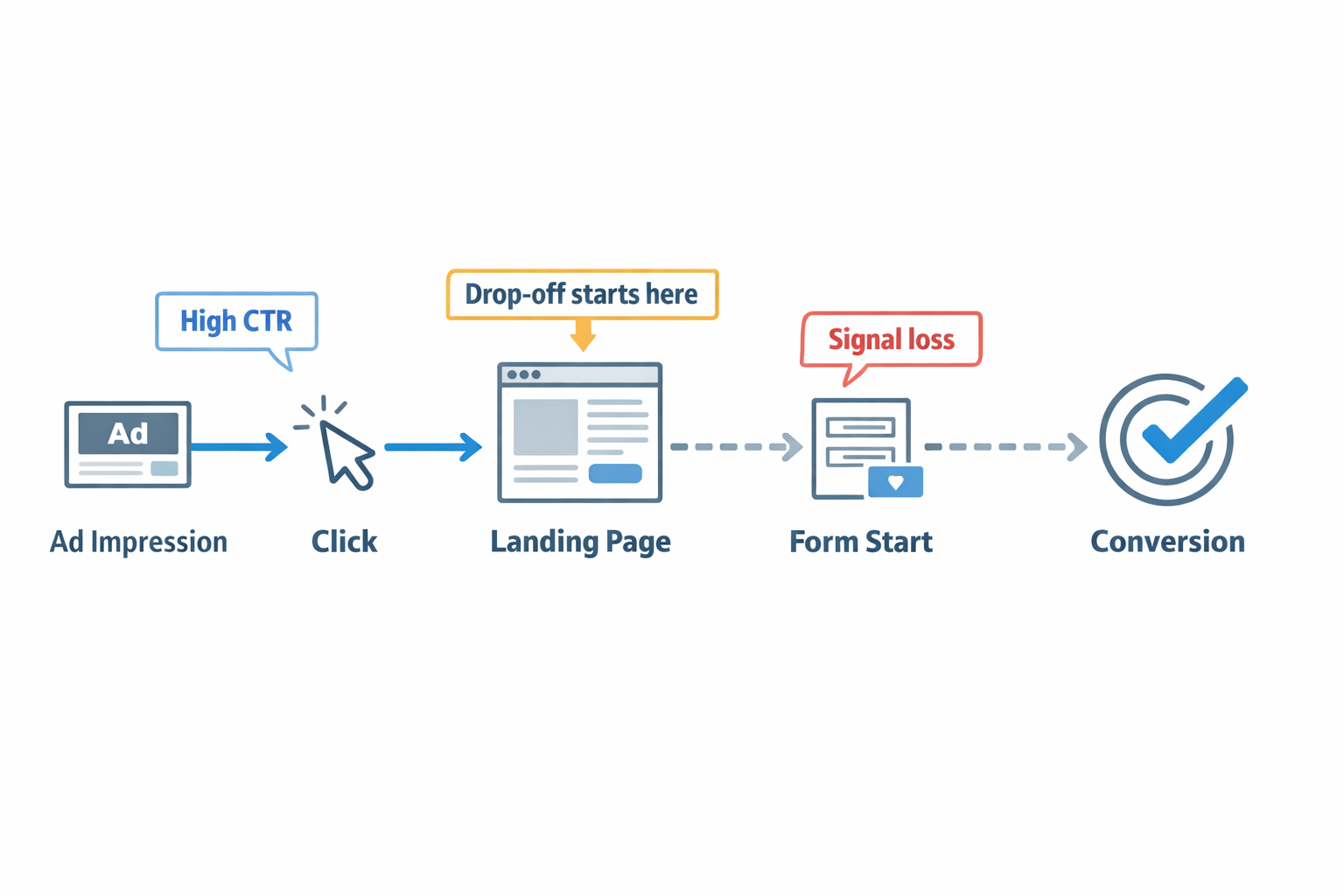
What’s actually happening is simple: Meta is still finding users who are willing to click, but fewer of those users complete the intended action. This exact disconnect is explored in more depth in What to Do When Your CPC Is Low But Conversions Are Flat, where strong surface metrics hide deeper funnel issues.
Over time, you’ll notice:
-
The same volume of clicks produces fewer conversions.
-
CPA increases without a clear trigger.
-
Retargeting starts carrying more of the results.
At that point, the issue is no longer traffic acquisition — it’s what happens after the click.
How Friction Turns Into a Delivery Problem
Meta doesn’t evaluate your landing page visually. It reacts to behavior.
When users encounter friction, the system picks up indirect signals:
-
Users hesitate before converting, which increases time-to-event and weakens signal clarity.
-
Some users leave immediately, creating a high concentration of low-quality sessions.
-
Others interact but don’t complete the action, producing inconsistent conversion data.
Individually, these seem minor. But at scale, they break pattern recognition.
And that’s critical — because the algorithm relies on patterns to scale.
When those patterns weaken:
-
Targeting becomes less precise.
-
Budget shifts toward easier, lower-intent conversions.
-
Efficiency drops even if your audience hasn’t changed.
This is why post-click behavior plays such a central role in performance, as explained in Optimizing for Post-Click Experience: What Happens After.
Where Friction Actually Comes From
Most landing pages don’t fail because of one major flaw. It’s usually a set of small issues that interrupt momentum.
Let’s break down the most common ones in detail.
1. Forms That Interrupt Instead of Convert
The form is where intent peaks — and where many campaigns lose momentum.
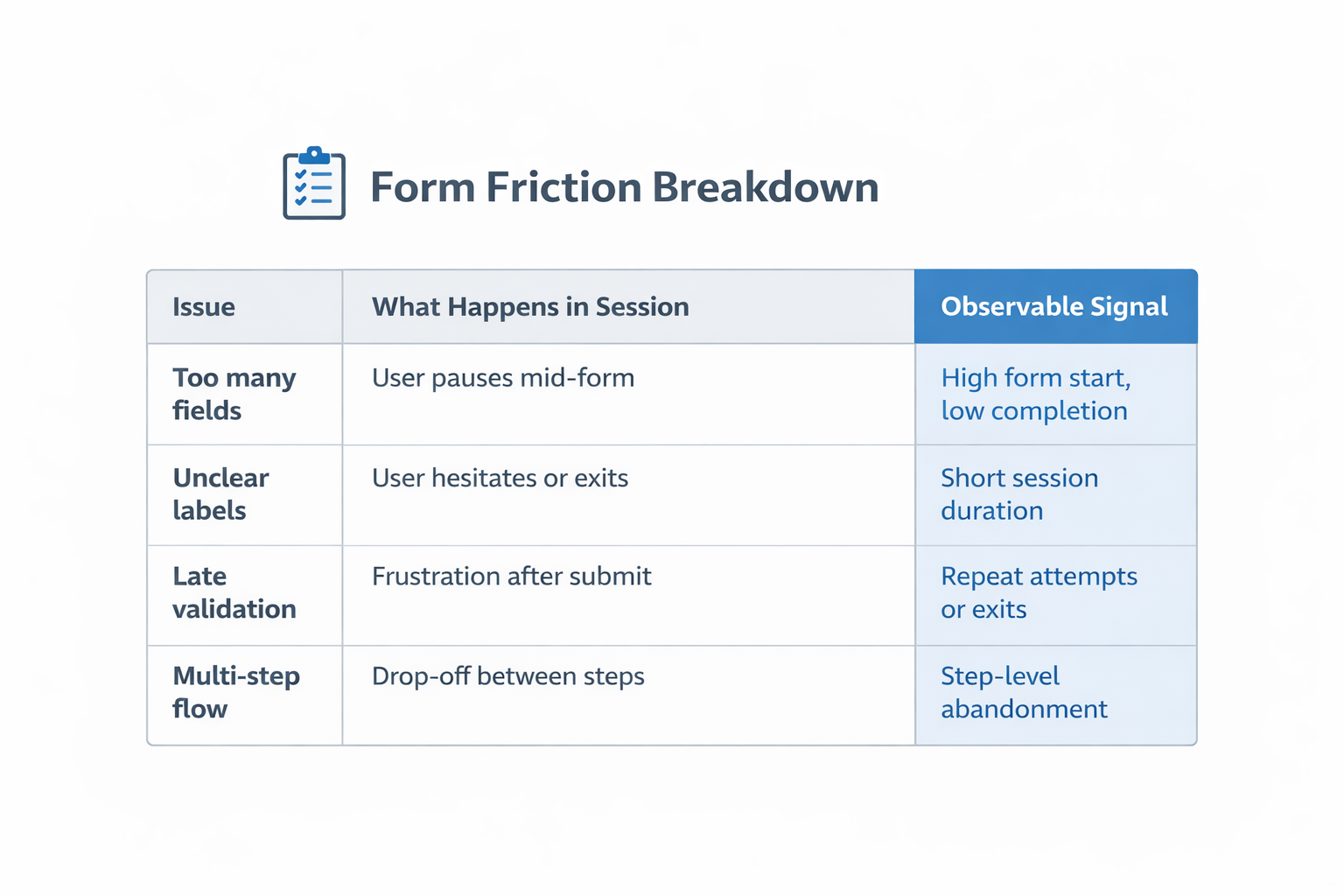
Here’s how friction builds:
-
Too many required fields.
Every additional field introduces a decision. Instead of acting quickly, users start evaluating whether it’s worth the effort.
In practice, reducing fields from 7 to 4 often increases completion rate without hurting lead quality — because qualification can happen later. -
Unclear or ambiguous labels.
If a user pauses to interpret what “Business size” or “Company stage” means, you’ve already slowed them down.
That hesitation is enough to break flow, especially on mobile. -
Delayed validation feedback.
When users submit a form and then see errors, it creates friction and frustration. Many won’t retry — they’ll exit. -
Multi-step forms that feel longer than they are.
Even if the number of fields is the same, splitting them into steps can create the perception of effort.
If progress isn’t clearly communicated, users abandon mid-process.
You can confirm this quickly: if many users start the form but don’t finish it, friction is the cause.
2. Mobile Experience That Looks Fine — But Doesn’t Work
A page can pass every internal review and still underperform on mobile.
Why? Because real usage is not clean or controlled.
Common issues:
-
CTA not immediately visible.
If users land and don’t instantly see what to do, conversion probability drops. Even a small scroll requirement matters. -
Keyboard overlaps key elements.
When typing hides the CTA or next field, users have to manually adjust the screen. Many won’t. -
Sticky elements block interaction.
Chat widgets, banners, or headers often cover buttons on smaller screens. -
Spacing pushes content too far down.
What looks minimal on desktop can feel empty and inefficient on mobile.
These problems don’t show up as explicit errors. Instead, you’ll notice:
-
Lower mobile conversion rate.
-
Higher CPC on mobile placements.
-
Gradual reduction in mobile spend.
If you want a deeper dive into mobile-specific issues, see Why Your Mobile Landing Page Is Killing Conversions (And How to Fix It).
3. A Disconnect Between Ad and Page
This is one of the most underestimated sources of friction.
Users click because of a specific promise. If the landing page doesn’t continue that promise precisely, they pause.
That pause kills conversions.
Common mismatches:
-
Promise mismatch.
The ad offers a clear outcome, but the page becomes broader or more generic. -
Tone inconsistency.
The ad is direct and practical, but the page shifts into vague or overly polished messaging. -
CTA misalignment.
The ad pushes for action, while the page softens it or changes intent.
That forces users to reassess their decision — which breaks momentum.
This problem is closely related to funnel misalignment discussed in From Click to Conversion: Where Funnels Usually Break.
4. Uncertainty at the Point of Conversion
Not all friction is technical. A lot of it is psychological.
Users hesitate when something feels unclear or risky.
This happens when:
-
Next steps are not defined.
Users don’t know if they’ll get contacted, get access, or enter a sales process. -
Pricing expectations are unclear.
Even if pricing isn’t required, users need context to feel comfortable submitting. -
The form feels like commitment.
If it feels like “talk to sales,” many users hold back. -
Trust signals are missing.
No testimonials, logos, or proof near the CTA reduces confidence at the final step.
Nothing is broken — but the experience feels incomplete.
And that’s enough to reduce conversion probability.
Why This Gradually Hurts Campaign Performance
Landing page friction doesn’t break campaigns overnight. It slowly weakens them.
At first:
-
CPA increases slightly.
-
Results fluctuate more.
-
Scaling becomes less predictable.
Then:
-
The algorithm shifts toward lower-intent users.
-
Signal quality drops.
-
Performance plateaus.
From the outside, it looks like fatigue or saturation.
In reality, it’s signal degradation.
How to Diagnose It Without Guessing
You don’t need assumptions here. The data already shows the issue — if you look at it correctly.
Compare Click Intent vs Conversion Outcome
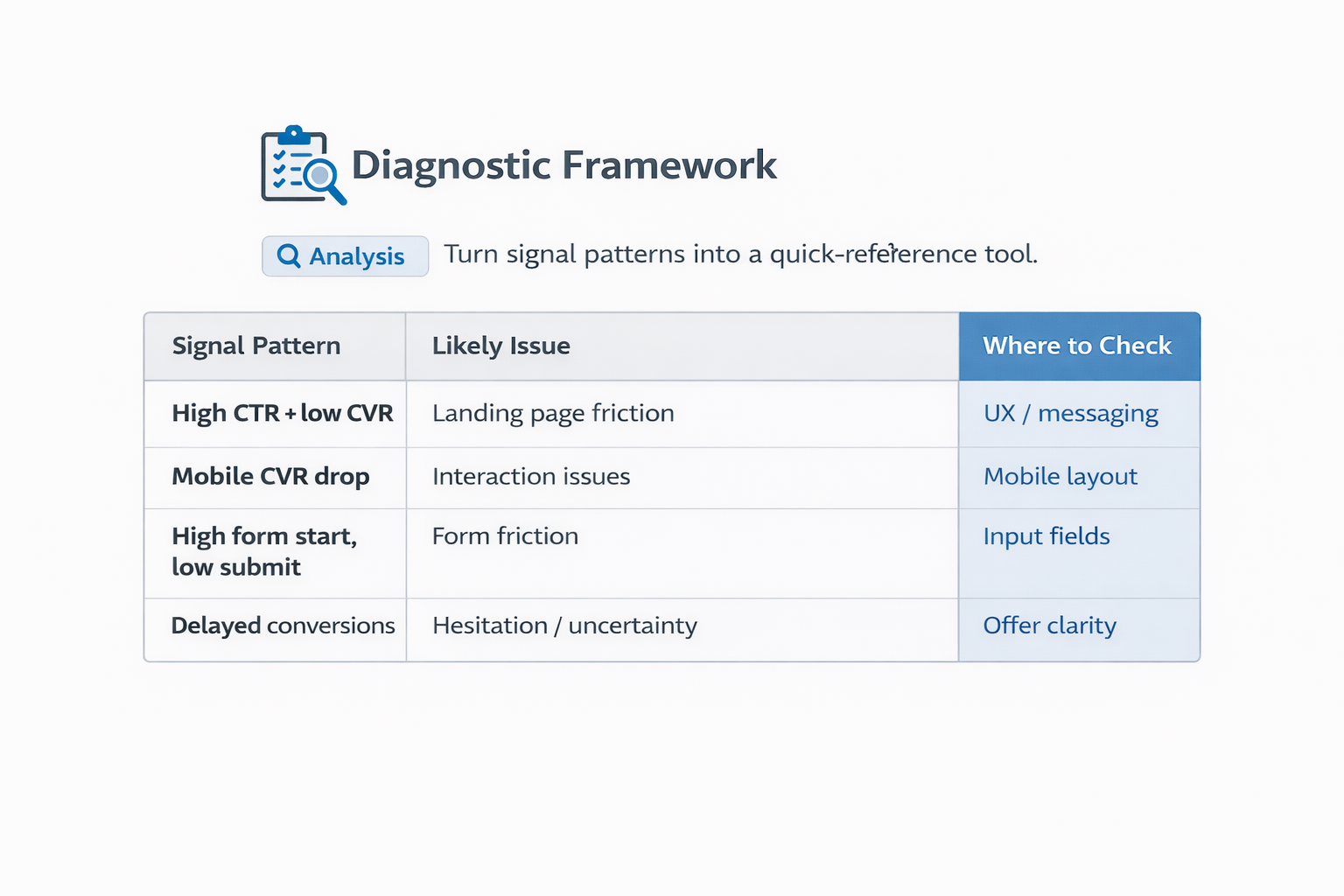
Look for mismatches:
-
High CTR + low CVR → post-click failure.
-
Stable CPC + rising CPA → conversion inefficiency.
-
Strong traffic + weak outcomes → expectation mismatch.
Break It Down by Device
Avoid blended metrics.
Instead:
-
Compare mobile vs desktop CVR.
-
Track CPC differences.
-
Watch budget distribution shifts.
If mobile drops first, it’s almost always a UX issue.
Look Inside the Form Funnel
Break conversion into steps:
-
Page visit → scroll.
-
Scroll → form interaction.
-
Form interaction → completion.
If users start but don’t finish, friction is the issue.
Watch Conversion Timing
When friction increases:
-
Conversions take longer.
-
Same-session conversions decrease.
-
Retargeting becomes more important.
That delay weakens optimization because Meta prioritizes fast, clear signals.
How to Fix It Without Rebuilding Everything
You don’t need a redesign. You need to remove hesitation.
Focus on:
-
Reducing input effort.
Cut unnecessary fields and simplify decisions. -
Matching the ad exactly.
Keep promise, tone, and structure consistent. -
Testing real mobile behavior.
Use actual devices, not previews. -
Clarifying next steps.
Make outcomes explicit and low-risk. -
Adding confidence signals.
Show proof exactly where users hesitate.
Small changes here often outperform major targeting or creative adjustments.
The Bigger Perspective
Campaign performance depends on signal clarity.
Not just clicks — but how consistently clicks turn into action. Landing page friction breaks that consistency.
And when that happens:
-
The algorithm loses confidence.
-
Delivery becomes less efficient.
-
Scaling becomes unstable.
If your campaign is generating clicks but not converting, don’t rush to change targeting or creative.
Start with the moment after the click. That’s where most campaigns quietly lose performance — and where the fastest gains usually come from.