Campaign performance is usually explained through targeting, creatives, and budget allocation.
In reality, the structure of users inside Meta Business Portfolio has just as much influence. When access is distributed across different user types without clear alignment, campaigns become harder to manage and slower to optimize.
The Three Types of Users — and How They Interact
Meta Business Portfolio includes three types of users, each with a distinct role in how campaigns operate.
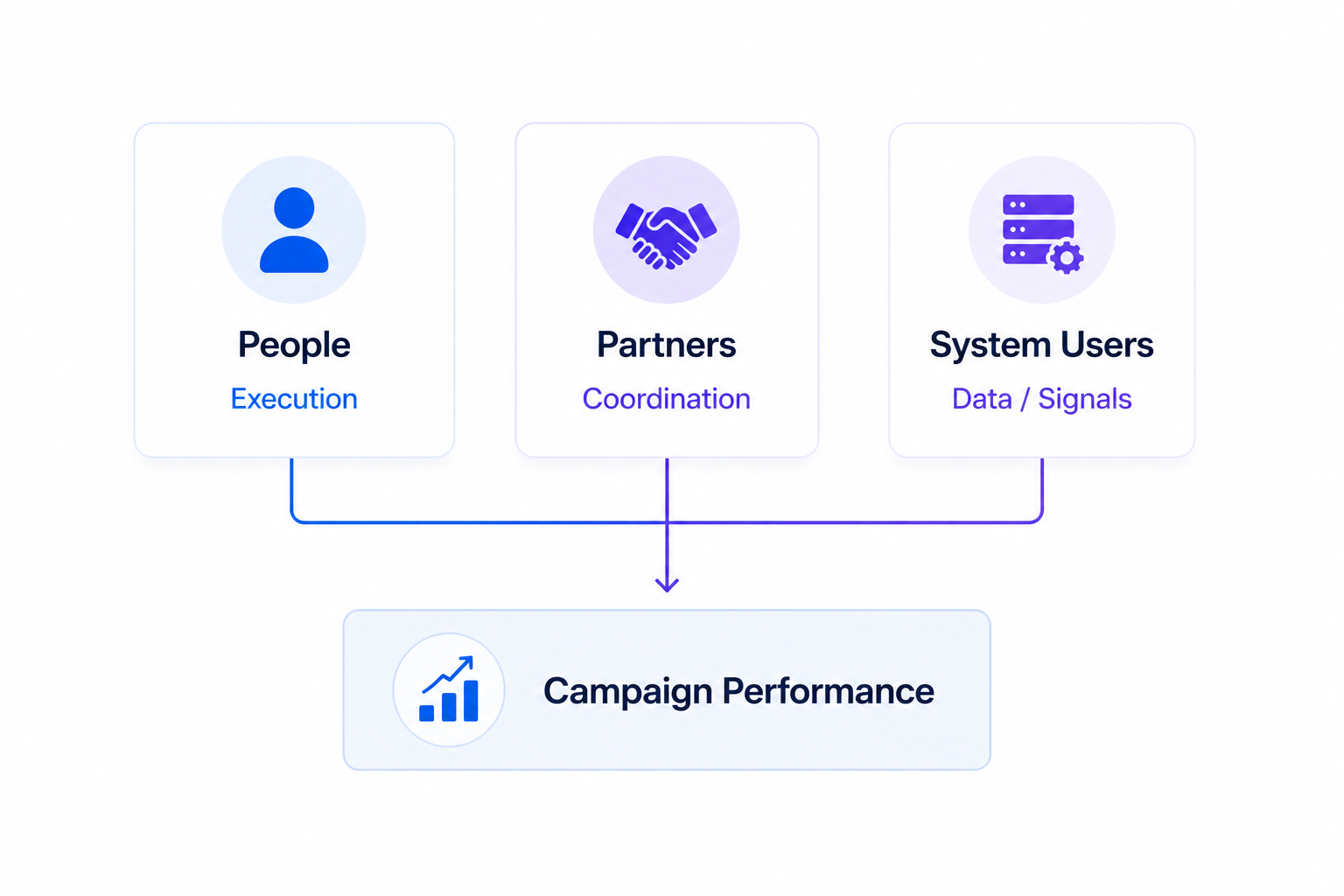
- People, who are individual users working inside your business portfolio.
- Partners, who are external businesses such as agencies or clients.
- System users, which represent software or servers making API calls.
At first glance, this classification seems straightforward. However, performance issues rarely come from one user type alone. They appear when these roles overlap without clear coordination.
People: Where Execution Speed Is Won or Lost
People are responsible for most day-to-day campaign activity. They analyze performance, adjust targeting, and manage budgets.
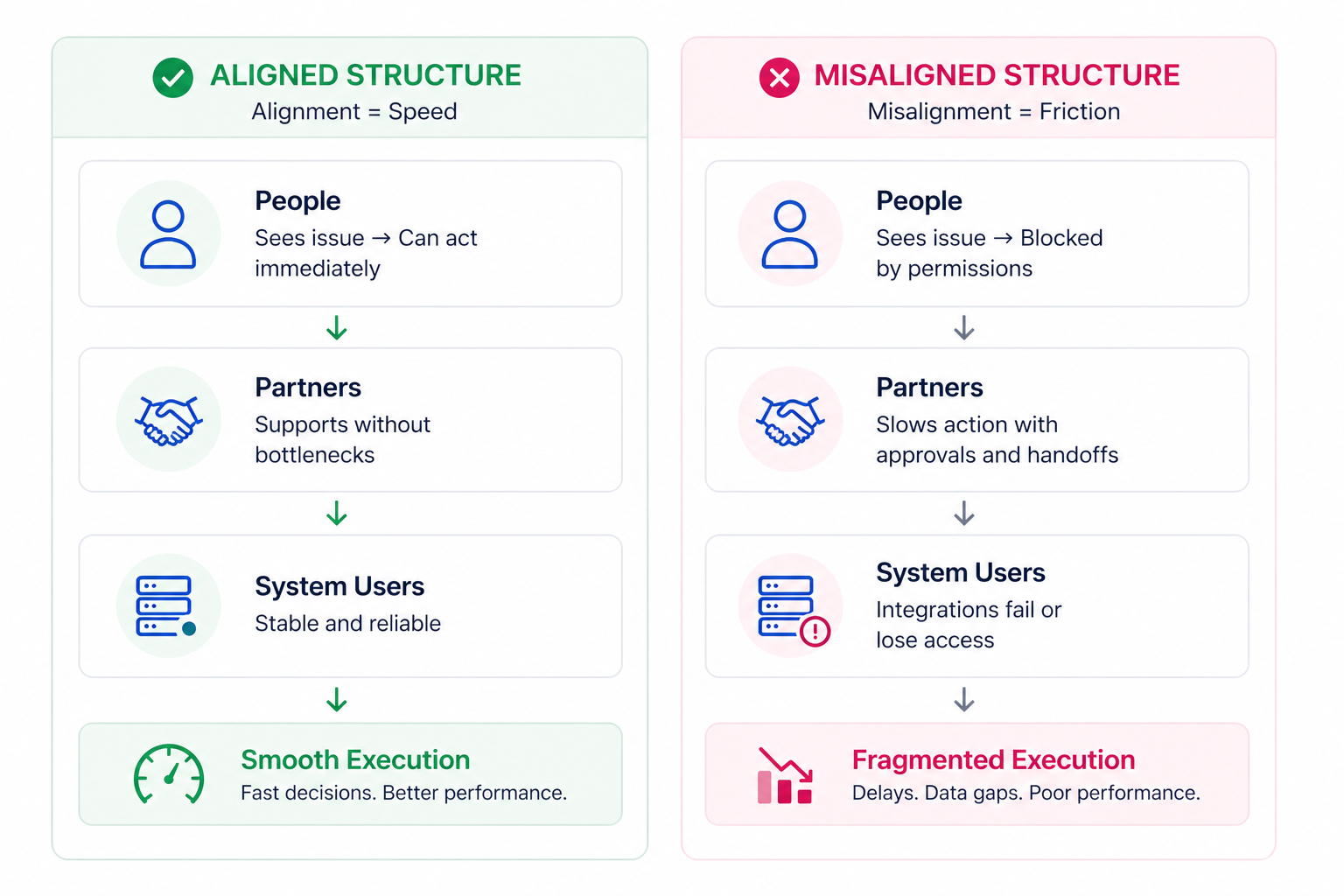
The problem begins when access does not match responsibility. A user may be accountable for results but unable to act quickly due to permission limits.
In practice, this creates recurring friction points:
- A media buyer detects rising CPA but cannot adjust budgets immediately.
- A strategist identifies a targeting issue but depends on another user to implement changes.
- A client has full control but makes occasional edits without full context.
Each situation introduces delays. These delays might seem minor, but in a fast-moving auction environment, they directly impact performance.
This is closely tied to your business asset permissions structure, which defines what each person can actually do inside the system.
Partners: Where Coordination Becomes a Bottleneck
Partners operate outside your organization but still interact with your assets. This includes agencies, consultants, or clients.
There are two common ways these relationships are structured:
- A business grants a partner access to its assets.
- A partner shares their assets with your business portfolio.
While this setup enables collaboration, it also introduces limitations.
For example, even if a partner has full control of a specific asset, they cannot share it with another business. Only the asset owner can do that. This restriction often creates bottlenecks in multi-team environments.
Partial access adds another layer of complexity. When a partner is limited to specific tasks, they can only assign those exact permissions within their own team. This makes delegation less flexible and slows down execution.
Over time, these constraints lead to coordination issues. Teams rely on approvals, handoffs, and indirect communication, which reduces the speed of optimization.
In more complex setups, this becomes a structural problem rather than a temporary inconvenience. How to Manage Facebook Ads for Multiple Clients Without Risking Account Issues explains how these coordination challenges affect performance at scale.
System Users: Where Failures Are Hard to Detect
System users function in the background and are often overlooked. They represent software or servers that interact with assets through API calls.
Meta defines two types of system users:
- Admin system users, which can create other system users and assign permissions.
- Regular system users, which are limited to the assets they are assigned.
Unlike human users, system users do not create visible delays when something breaks. Instead, issues tend to appear gradually.
Typical failure patterns include:
- Audience syncing stops without an obvious alert.
- Conversion data becomes incomplete or inconsistent.
- Integrations fail silently, reducing signal quality.
Because campaigns continue running, these issues are often misinterpreted as targeting or creative problems.
Why This Structure Affects Campaign Performance
Each user type influences a different layer of campaign execution.
When these layers are not aligned, several issues emerge at once:
- Execution slows down because people cannot act immediately.
- Coordination becomes inconsistent due to partner access limitations.
- Data quality declines when system users fail or lose access.
These problems rarely appear in isolation. Instead, they combine into patterns that are difficult to diagnose.
For example, a campaign may show stable delivery but declining conversions, while the underlying issue is delayed optimization combined with incomplete data signals.
Business Impact
User misalignment rarely produces a clear failure point, but it consistently reduces efficiency.
Over time, advertisers experience:
- Rising CPA due to slower optimization cycles.
- Lower ROAS because scaling opportunities are missed.
- Inconsistent performance across campaigns and accounts.
These issues are often misattributed to targeting or creative quality. However, structural inefficiencies amplify those problems.
Risks and Considerations
Changing user structure requires careful evaluation of dependencies.
It is important to understand:
- Which users are responsible for execution versus approval.
- How partners interact with shared assets.
- Which system users support critical workflows or integrations.
Removing or modifying access without a full audit can disrupt operations and create additional delays.
Practical Recommendations
Instead of reviewing access settings in isolation, evaluate how your team operates during real campaign changes.
Focus on three key questions:
- Who identifies performance issues first?
- Who has the authority to act?
- How long does it take to implement changes?
If there is a delay between insight and action, the issue is structural, not tactical. Align access with responsibility so that execution can happen without unnecessary friction.
Final Takeaway
Meta Business Portfolio users are not just administrative categories. They define how campaigns are executed, how data flows, and how quickly your team can respond to change.
When people, partners, and system users are aligned with real workflows, campaigns run efficiently. When they are not, performance declines gradually and becomes harder to diagnose.