Scaling paid social is not only a campaign problem.
It is also a billing problem.
As budgets grow, advertisers need cleaner payment processes, clearer spend accountability, and fewer interruptions caused by payment logistics.
Meta describes monthly invoicing as a payment option for eligible businesses that lets advertisers pay ad costs using a credit line instead of paying per charge.
For performance teams, the real question is not simply “Can we use monthly invoicing?”
The better question is: “Will monthly invoicing make our campaign operation easier to scale?”
What Monthly Invoicing Changes
Monthly invoicing changes how ad spend is organized and paid.
Instead of each payment event being treated as a separate charge, ad costs are consolidated through an invoicing workflow for eligible businesses. That can reduce billing clutter and make spend easier to review at the business, agency, or account level.
Meta’s indexed help result also says advertisers can check eligibility in Meta Business Suite by going to Settings, selecting Billing & payments, and looking for a banner at the top of the page. If no banner appears, the source says to continue paying for ads with the current payment method.
That eligibility detail matters.
Monthly invoicing is not a universal shortcut. It is a billing option tied to account, business, and eligibility conditions.
Why Monthly Invoicing Matters for Campaign Performance
Billing method does not change the Meta auction by itself.
But billing structure can affect how reliably your team runs campaigns.
Monthly invoicing changes 3 operating areas: cash-flow planning, budget governance, and reconciliation.
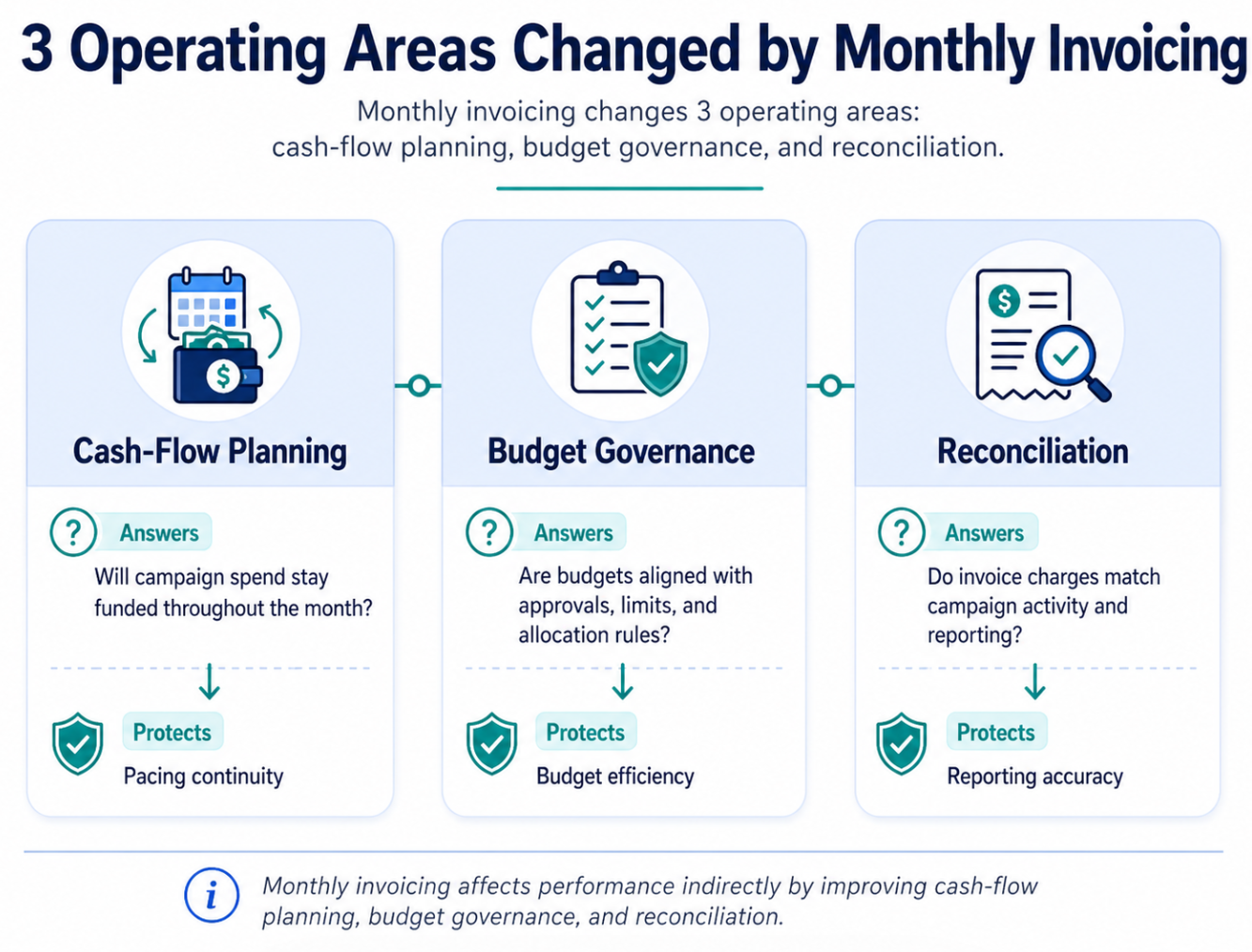
Monthly invoicing affects performance indirectly by improving cash-flow planning, budget governance, and reconciliation
Those areas influence performance indirectly.
If the team has better visibility into spend, it can make cleaner decisions about scaling, pausing, reallocating, and testing.
If finance understands billing cycles, the media team can avoid reactive budget cuts caused by invoice confusion.
If agencies can reconcile spend more easily, they can spend less time defending numbers and more time improving audience quality, creative strategy, and conversion performance.
For advertisers focused on CAC and ROAS, that operational clarity is valuable.
Business Impact on CPC, CPA, CAC, ROAS, and Budget Efficiency
Monthly invoicing is most useful when paid social budgets are large enough that billing friction becomes a real operating cost.
The impact can show up in several ways.
Better budget control
A consolidated billing process can make it easier to monitor how much spend is being committed across ad accounts.
That helps prevent overextension, especially when several teams are launching campaigns at once.
Cleaner client or department reconciliation
Agencies and multi-brand teams often need to connect spend to clients, markets, or business units. Monthly invoicing can make that process more structured.
Fewer reactive optimization decisions
When billing data is unclear, teams sometimes cut campaigns for the wrong reason. Clearer billing can prevent finance pressure from being misread as performance pressure.
Stronger scaling discipline
Monthly invoicing can support scaling, but it does not replace audience quality. A larger billing structure only helps if the campaigns being funded are built on relevant audiences, strong creative, and measurable conversion paths.
Typical Scenarios Where Monthly Invoicing Applies
Monthly invoicing is most relevant in these situations.
Agencies managing significant client spend
Agencies may need a more structured way to manage billing, invoicing, and spend accountability across multiple ad accounts.
Growth teams preparing to scale
A startup or SMB moving from small tests to serious acquisition spend needs billing operations that will not break under higher volume.
B2B lead-generation teams
B2B campaigns often involve longer sales cycles. Clean monthly billing helps teams compare ad spend against pipeline quality, booked calls, SQLs, and eventual CAC.
Ecommerce brands with seasonal spend spikes
During launches, holidays, or promotional windows, billing clarity helps teams avoid confusing campaign expansion with uncontrolled spend.
Affiliate and performance teams
Affiliate marketers often work with strict margin targets. Monthly invoicing can support more disciplined budget reviews when many tests are running simultaneously.
Risks and Considerations
Monthly invoicing is not automatically better for every advertiser.
The main risk is treating billing approval as a substitute for performance readiness.
A credit line or invoicing setup can make it easier to run larger budgets, but it does not make weak targeting profitable. If your audience strategy is broad, stale, or poorly matched to your offer, monthly invoicing may simply make it easier to spend inefficiently.
Other considerations include:
- Eligibility may not be available for every business.
- Finance permissions and business access need to be clear.
- Billing responsibility should be documented.
- Teams need a process for reviewing invoices against campaign results.
- Campaign owners should know which ad accounts are assigned to which billing setup.
- Agencies should avoid unclear client liability for ad spend.
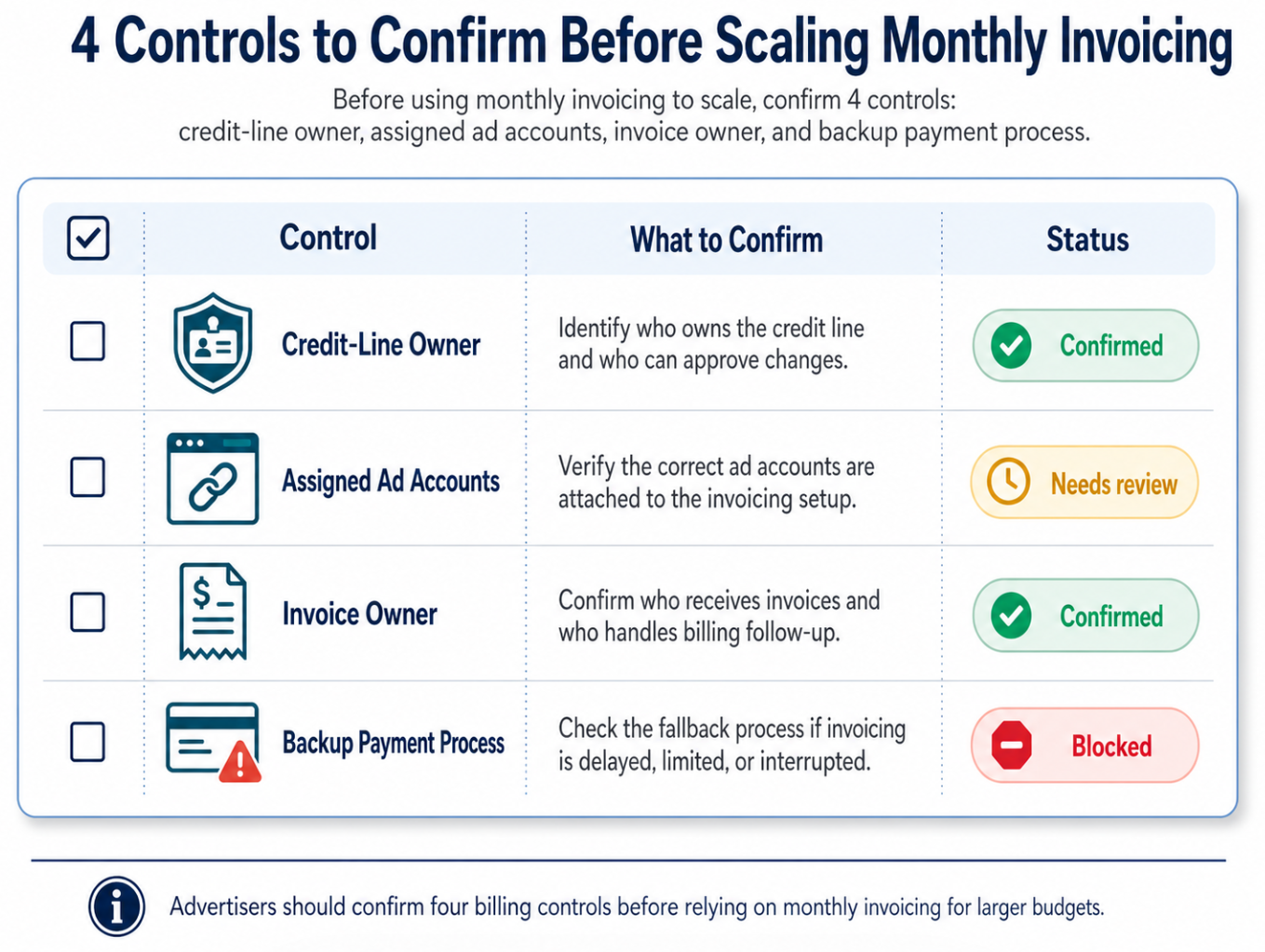
Advertisers should confirm four billing controls before relying on monthly invoicing for larger budgets
Before using monthly invoicing to scale, confirm 4 controls: credit-line owner, assigned ad accounts, invoice owner, and backup payment process.
Prerequisites and Dependencies
Before relying on monthly invoicing, advertisers should confirm several operational details.
You need the right business access.
You need clarity on who owns billing responsibility.
You need clean ad account structure.
You need internal agreement on how invoices will be reviewed.
You need a campaign naming system that finance and marketing can both understand.
You also need campaign-level readiness. Monthly invoicing can help organize spend, but performance still depends on the quality of audiences, creative, landing pages, conversion tracking, and optimization decisions.
How LeadEnforce Helps
LeadEnforce helps advertisers make better use of the budget they are preparing to scale.
Monthly invoicing can make larger spend easier to manage, but it does not tell you who to target. LeadEnforce helps performance teams reduce targeting guesswork by building high-intent audiences from social and professional signals.
Advertisers can use LeadEnforce to create audience hypotheses from:
- Facebook groups related to specific pain points or communities.
- Instagram followers and engagers around relevant brands, creators, or niche profiles.
- LinkedIn professional data for B2B segmentation.
- Custom social-profile data tied to real audience behavior.
That is useful before scaling.
If monthly invoicing helps your team manage more budget, LeadEnforce helps make sure that budget is aimed at people with stronger relevance signals.
For agencies, this can also improve client conversations. Instead of saying, “We need more budget,” the agency can say, “We have a billing structure ready, and here are the high-intent audiences we want to test first.”
Practical Recommendations
Check eligibility in Meta Business Suite before building plans around monthly invoicing.
Do not wait until a campaign launch to confirm billing access, finance roles, or ad account assignments.
Document who is responsible for invoices and who is responsible for campaign performance.
Review monthly spend alongside CPA, CAC, ROAS, lead quality, and conversion rate.
Separate billing readiness from scaling readiness. Monthly invoicing may support bigger budgets, but only better audience and campaign strategy will make those budgets efficient.
Use LeadEnforce before budget expansion to identify higher-intent audiences that can be tested before broad scaling.
Final Takeaway
Monthly invoicing is a billing infrastructure decision.
For eligible advertisers, it can make larger Meta ad budgets easier to manage and reconcile. But it should be paired with disciplined campaign testing and stronger audience inputs.
The best time to improve billing structure is before scale exposes weak operations.
The best time to improve audience quality is before that billing structure makes it easier to spend more.
Related LeadEnforce Articles
- Why Increasing Facebook Ads Budget Can Hurt Performance — Explains why higher budgets can expose weak audience structure, auction pressure, and signal problems.
- Facebook Campaign Scaling Without Losing ROAS: What to Watch Closely — Relevant for advertisers considering monthly invoicing as part of a broader scaling plan.
- Why Your Meta Business Portfolio Setup Affects Paid Social Performance — Shows how business structure can influence campaign operations, access, and performance diagnosis.
- No Full Control of Your Meta Business Portfolio? Fix Access Before Campaigns Stall — Useful when monthly invoicing or finance workflows depend on the right level of business control.
- How to Improve Audience Match Quality in Meta Ads — Helps teams make better use of scaled budgets by improving audience quality.