Running paid social campaigns isn’t just about setting budgets and picking creatives. The Meta ecosystem rewards advertisers who understand the mechanics behind delivery, learning, attribution, and audience structure.
Below, we cover 7 expert-level mistakes that quietly drain ad performance, even for skilled marketers.
1. Optimizing Too Early in the Funnel
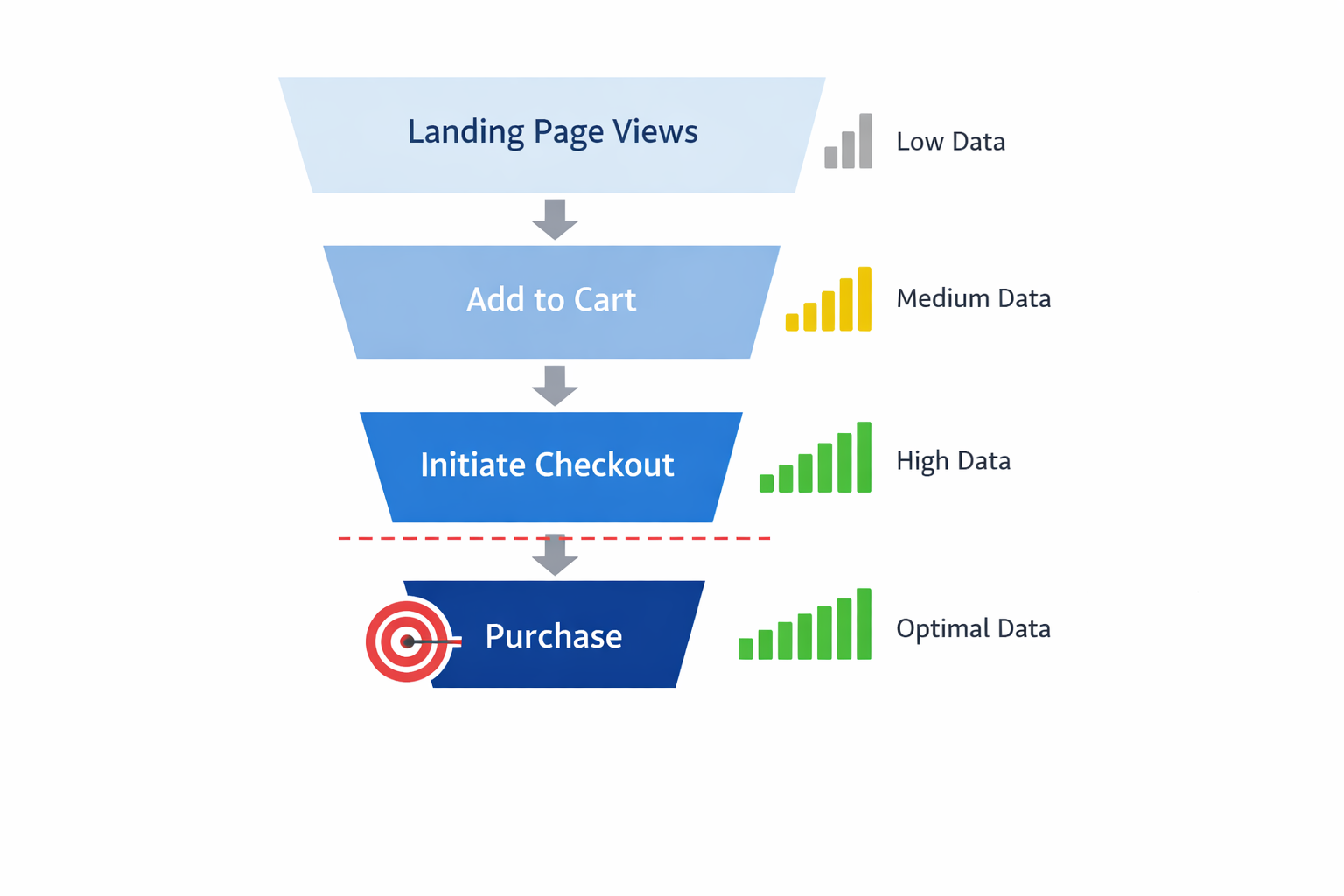
Most advertisers choose the conversion event they want, not the one the algorithm can realistically optimize for based on data volume.
Why This Is a Problem
Optimizing for purchases when you generate only a handful per week doesn’t give the algorithm enough signal. Delivery becomes unstable, learning resets frequently, and performance looks inconsistent without a clear reason.
This mistake often shows up as campaigns that technically “work” but never scale.
What To Do Instead
Start by optimizing for higher-volume signals that still represent qualified intent:
-
Add to cart;
-
Initiate checkout;
-
Lead form opened.
Once you consistently generate around 50 conversions per week, switch to your final conversion event. This staged approach allows the algorithm to learn patterns progressively.
For a deeper explanation of how objective choice affects downstream performance, see How Facebook Ad Objectives Impact Lead Quality.
2. Using Platform Defaults for Placements and Bidding
Meta’s defaults, such as Advantage+ Placements and lowest-cost bidding, are designed for simplicity, not precision.
The Real Risk
These settings often optimize toward the cheapest available impressions, not the most valuable ones. In practice, this can push spend toward placements that generate volume but no meaningful outcomes.
You may see stable CPMs while lead quality or conversion intent quietly degrades.
A Better Approach
-
Placements: Start broad, but regularly review placement-level performance. Exclude placements with sustained spend and zero conversions.
-
Bidding: If results fluctuate or lead quality drops, test cost caps or bid caps to regain control during scaling.
Meta automation works best when it operates within clear boundaries. For a detailed breakdown of how campaign-level settings influence results, see How Meta Ads Campaign Settings Impact Performance Metrics.
3. Building Lookalikes From Unrefined Seed Data
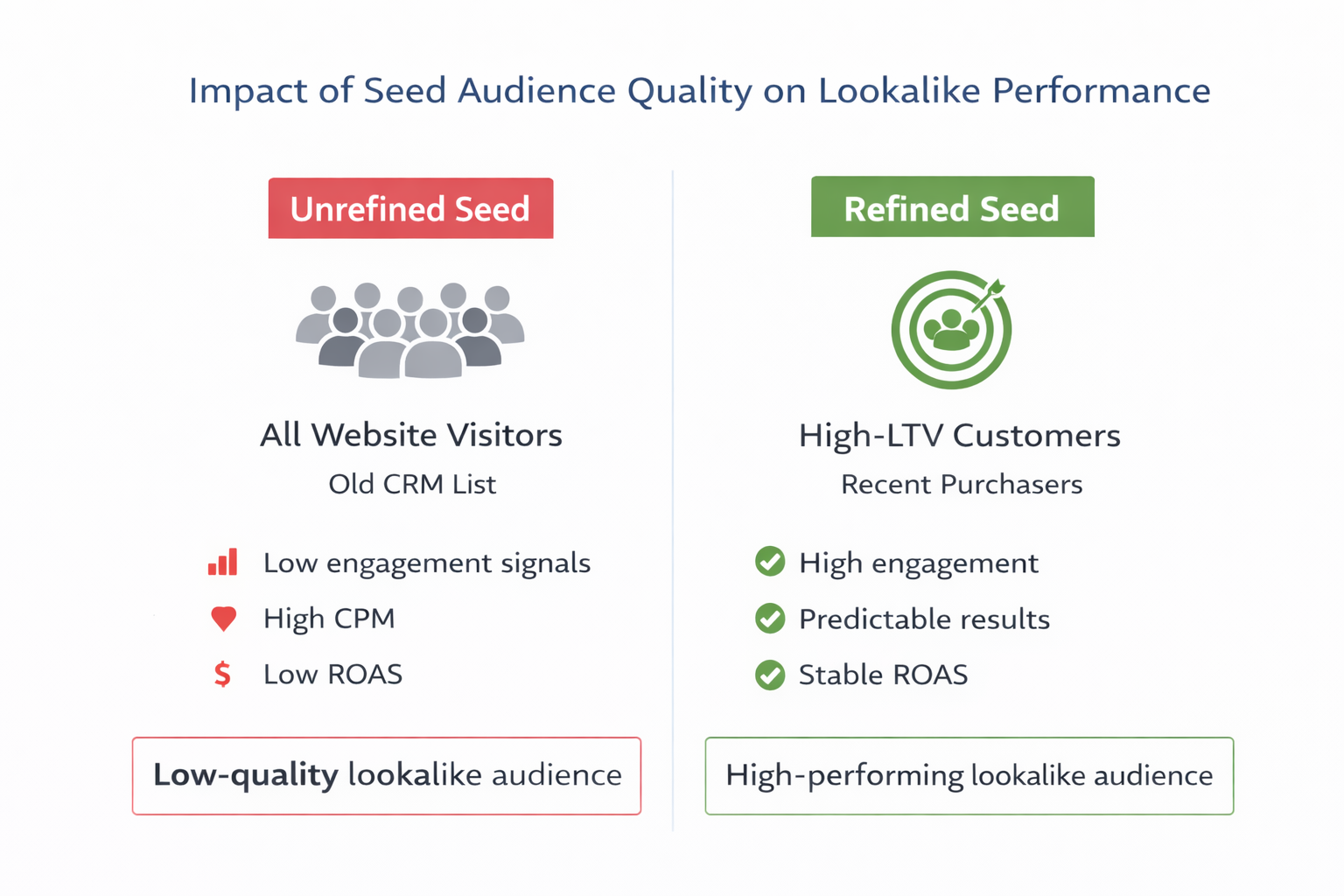
Lookalike audiences are only as good as the data used to create them. Many advertisers rely on outdated CRM lists or broad pixel events without validating quality.
What’s Wrong With That
You effectively ask the algorithm to replicate average or low-value users. The result is broader reach, higher CPMs, and weaker conversion rates that are difficult to diagnose.
How To Fix It
Use narrowly defined, behavior-based seed audiences:
-
Top 5% of spenders from the last 90 days;
-
Leads that converted into customers within a short time window;
-
Users with repeat purchases or strong engagement signals, such as multiple sessions.
Higher-quality seed data improves predictive accuracy. This topic is explored further in Lookalike Audiences: How to Seed, Train, and Scale.
4. Ignoring Auction Overlap at Scale
As accounts grow, advertisers often run multiple campaigns that target overlapping audiences. This creates internal competition inside the auction.
The Consequence
Your campaigns bid against each other. CPMs rise without any external market change, and performance appears to “randomly” decline.
This issue becomes more severe as budgets increase.
What You Can Do
-
Use Meta’s audience overlap tool to identify conflicts;
-
Consolidate ad sets with similar targeting;
-
Apply exclusions, such as removing retargeting audiences from prospecting campaigns.
Auction efficiency is a structural concern, not a creative one. For a detailed analysis, see The Role of Audience Overlap in Facebook Ads Performance.
5. Running High-Frequency Creative Without Burnout Protection
Creative fatigue rarely appears suddenly. It builds quietly while metrics still look acceptable.
What Happens
CPM increases slowly. CTR declines incrementally. By the time ROAS drops, the damage is already done.
Because fatigue doesn’t trigger obvious warnings, it often goes unnoticed until results collapse.
Better Practice
-
Use dynamic creative to introduce controlled variation;
-
Set automated rules to pause ads once frequency exceeds defined thresholds;
-
Monitor unique impressions per user on a rolling weekly basis.
Proactive rotation is cheaper than recovery.
6. Overusing Broad Targeting Without Predictive Structures
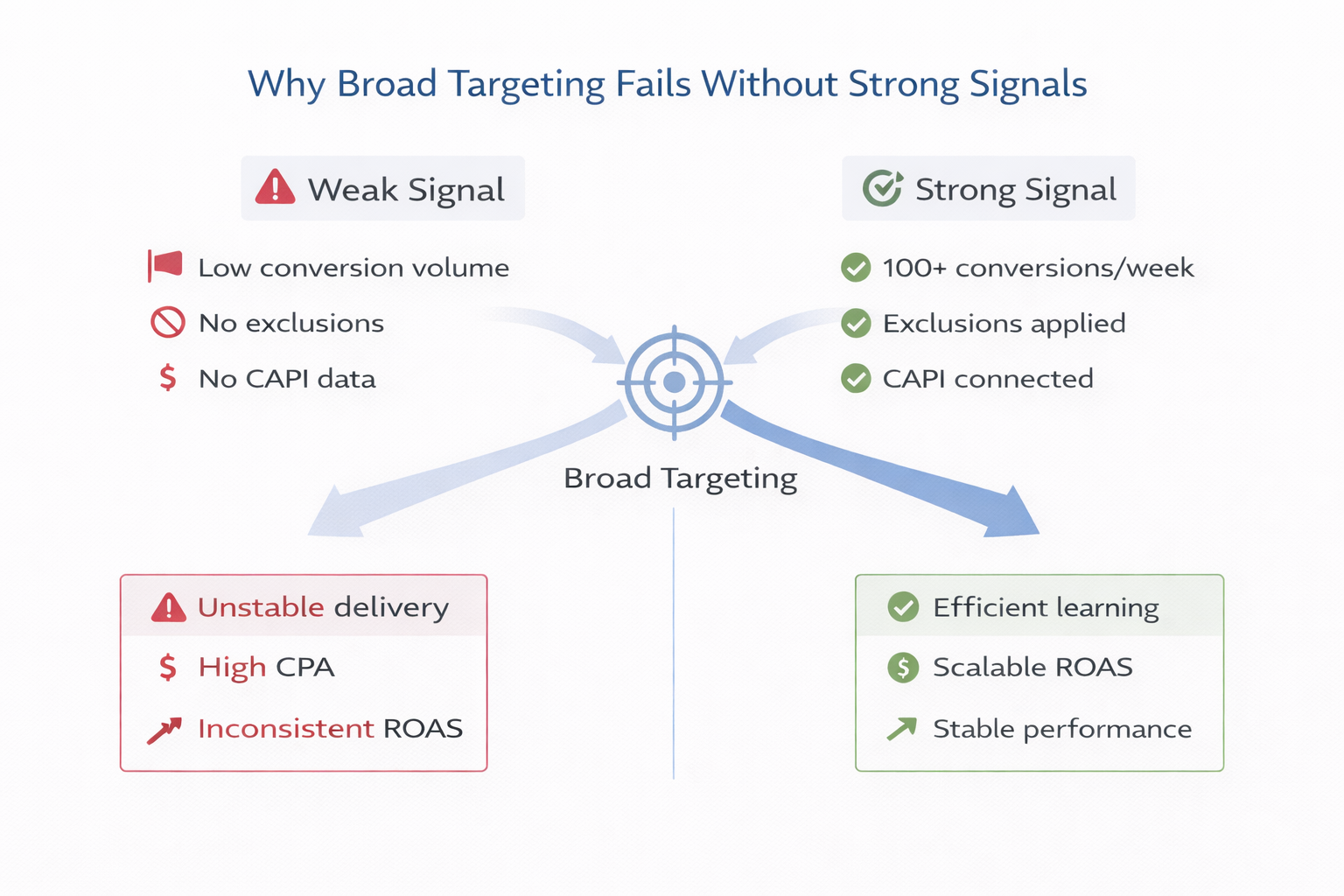
Broad targeting can work, but only when the algorithm has enough high-quality signals to learn from.
What’s Missing
Without sufficient conversion volume or reliable data inputs, Meta has no clear direction. Delivery becomes inefficient, and results vary widely across short time periods.
How to Make Broad Work
-
Use broad targeting only after reaching consistent conversion volume;
-
Exclude past purchasers, low-quality leads, or irrelevant segments;
-
Feed offline conversions back through Conversions API (CAPI) to strengthen signal quality.
Broad targeting amplifies existing data. It does not replace it.
7. Scaling Without Volume Stability
Short-term performance spikes often trigger premature scaling decisions.
The Problem
Budgets increase before results stabilize. Learning phases reset. Performance becomes erratic, and advertisers misinterpret volatility as market saturation.
The Smarter Way
-
Require stable CPA or ROAS over a 7–10 day window;
-
Scale horizontally by duplicating winning ad sets before increasing budgets;
-
Monitor impression share to avoid exhausting limited audiences.
Scaling is a statistical decision, not a reaction to recent wins.
Final Takeaway
Many paid social issues appear to be creative or budget problems. In reality, they are usually structural mistakes hidden beneath surface-level metrics.
These seven issues rarely appear as clear warnings inside Ads Manager. Instead, they manifest as stalled growth, unstable ROAS, or scaling failures.
By correcting these deeper mistakes, you build ad systems that:
-
Deliver consistent, qualified conversions;
-
Scale predictably without efficiency loss;
-
Remain resilient during algorithm changes and market shifts.
If you want Meta Ads to function as a scalable growth channel, start by fixing what’s invisible.